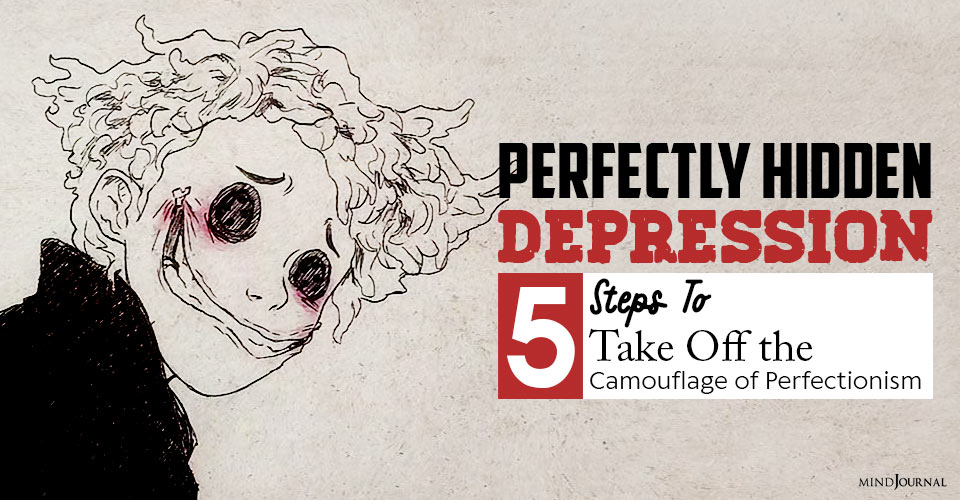
Perfectly Hidden Depression: Five Steps To Take Off the Camouflage of Perfectionism

Author : Dr. Margaret R Rutherford

Do any of these ring familiar to you: perfectionism with an inner constant critic, over-responsibility, inability or great difficulty with expressing emotional vulnerability, chastising yourself if you’re not counting your blessings, always being there for others, but sharing very little of who you really are or what problems you might have?

These are five of the ten traits of perfectly hidden depression; they ensure that the perfectionist mask cloaking your silent depression remains intact. 

Researchers such as Paul Hewitt of the University of British Columbia are sounding the cry that perfectionism can be a helpful trait, but that it can also be also linked with self-dissatisfaction and can create significant stress on your body. It doesn’t end there;  it’s also being shown that perfectionism can cause even greater damage.

Related: 17 Signs You Are An Overachiever And How To Deal

How can perfectionism be fatal?

Several studies within the last decade have reflected a strong correlation between perfectionism and suicide, including findings that 70 percent of 33 boys and young men who had killed themselves were described by their parents as placing “exceedingly high” demands on themselves. 

The New York Times quotes Gordon Flett, a lead researcher of perfectionism and co-author of the new book, Perfectionism: A Relational Approach to Conceptualization, Assessment, and Treatment, says, “It’s natural for people to want to be perfect in a few things, say in their job — being a good editor or surgeon depends on not making mistakes. It’s when it generalizes to other areas of life, home life, appearance, hobbies, that you begin to see real problems.”

Why is this so scary? Because if you’re perfectionistic, you’re likely also really good at hiding pain.

So what would cause you to want to change? After all, who wouldn’t want the perfect-looking life? Who would want to change a formula that leads to professional success? Why mess with seeming perfection? 

Because at some point the end no longer justifies the means. Eventually, the burden of isolation, the despair of closeted-off feelings, or the suicidal urges to end the charade become too great, so much so that you might come to tell a good friend or a parent about your struggles or even go into a therapist’s office for help.

perfectly hidden depression and perfectionism

The five stages of healing… the Five C’s…

There are five basic steps basic for all change to take place. I’ve termed them, “The Five C’s Of Healing.”

Perfectly Hidden Depression

1. Consciousness

First, you have to identify a problem as a problem before you can change it. Specifically, you have to recognize that you’ve been hiding your true internal experience of depression for years, creating a persona that looks good to others, and that you believed served to keep you safe.

Related: Why Being Good Enough Is Better Than Being Perfectionistic

2. Commitment 

The second step is Commitment to a process that will be difficult, and involve not only change with yourself but change with others. Your perfectionism can raise its head in strange ways, through impatience with yourself, intense self-criticism, or pushback from others. 

3. Confrontation

Almost simultaneously, the third step is taking shape, which is Confrontation of irrational beliefs and rules that may have kept you safe and secure as a child, but no longer lead you to thrive as an adult. They may even be holding you back and distorting the boundaries of what you believe is possible.  

4. Connection 

The fourth step is Connection with your emotions, perhaps long unrecognized or accepted. Trauma may be present in your history, or some kind of childhood learning or experience that created the need to avoid or deny painful feelings.

Your goal is to unravel emotions that have been over-compartmentalized and stuffed away for many years. (If this struggle becomes too intense, then reaching out to a trauma professional isn’t only suggested, it’s needed.)

Think about the old game of Pick Up Stix or the more recent one, Jenga. The strategy to win involves careful assessment of what sticks or what Jenga piece you can remove without the entire thing crashing down around you.

If you’re hiding your depression, you’re facing this very challenge. You decide where to begin the change, and slowly and with compassion for yourself, take down the persona, piece by piece, and replace it (or reconstruct it) with a healthier, more open, and more vulnerable, self.

Related: 13 Habits of People With Concealed Depression

5. Change

Those risks lead to the fifth step, Change. Change in what you do, in what you say, in what you feel — who you are — which is where you get your hope. You can see that you aren’t trapped by your past and that you can look ahead to greater self-acceptance, as you recognize the power of vulnerability and emotional openness.

When change is beginning, I hear words like this from those experiencing it…

Well, this isn’t really a big deal, but I wanted you to know that I stopped myself from changing the subject like I might have done before. Instead, I told my husband I was getting mad. I actually told him how I was feeling,” You can hear the change… the confrontation of the habit to avoid conflict and stay hidden.

Here’s another example. “This may not really matter all that much, but I looked at some old pictures last week. I was six. The first thought I had was how many mistakes that child would make — how it would be better if he could stay a child. Why is that the thing that comes to mind?”  And tears came to his eyes. You can hear the growing awareness of highly critical perfectionism, and you can feel the sadness that connection brings.

Please consider taking these steps. They just might ultimately save your life.

If you wonder where you might fit on the PHD spectrum, please take this questionnaire.

Check out Dr. Margaret Rutherford’s best-selling book, Perfectly Hidden Depression on Amazon.


Written By Dr. Margaret Rutherford 
Originally Appeared On Dr. Margaret Rutherford 
Perfectly Hidden Depression pinex
Perfectly Hidden Depression pin

Published On:

Last updated on:

Dr. Margaret R Rutherford

Dr. Margaret Rutherford, a clinical psychologist, has practiced for twenty-six years in Fayetteville, Arkansas. Earning the 2009 Arkansas Private Practitioner of the Year award for her volunteer work at a local free health clinic, she began blogging and podcasting in 2012 to destigmatize mental illness and educate the public about therapy and treatment. With her compassionate and common-sense style, her work can be found at https://DrMargaretRutherford.com, as well as HuffPost, Psych Central, Psychology Today, The Mighty, The Gottman Blog and others. She hosts a weekly podcast, The SelfWork Podcast with Dr. Margaret Rutherford. And her new book, Perfectly Hidden Depression: How to Break Free from the Perfectionism that Masks Your Depression, is published by New Harbinger and available at Amazon, Barnes, and Noble or your local bookstore.

Disclaimer: The informational content on The Minds Journal have been created and reviewed by qualified mental health professionals. They are intended solely for educational and self-awareness purposes and should not be used as a substitute for professional medical advice, diagnosis, or treatment. If you are experiencing emotional distress or have concerns about your mental health, please seek help from a licensed mental health professional or healthcare provider.

Leave a Comment

Today's Horoscope

Your Daily Horoscope For 4 April, 2026: Free Predictions

Daily Horoscope 4 April, 2026: Prediction For Each Zodiac Sign

Look at your daily prediction and see what the stars have in store for your love life and your future!

Latest Quizzes

How Many Circles Do You See? A Simple Test of Thinking Style

How Many Circles Do You See? Your Answer Might Reveal Narcissistic Traits! 

Take a closer look at this simple image and discover what your circle count reveals about your thinking style, perception, and attention in this fun and engaging visual test.

Latest Quotes

Real Signs Your Body Is Actually in Good Health: How to Know You’re Truly Well

Real Signs Your Body Is Actually in Good Health: How to Know You’re Truly Well

Real signs your body is healthy don’t always show up on lab reports. From good sleep and clear skin to regular digestion and a stable mood, your body is constantly sending quiet signals of wellness.

Readers Blog

Caption This Image and Selected Wisepicks – 5 April 2026

Caption This Image and Selected Wisepicks – 5 April 2026

Ready to unleash your inner wordsmith? ✨??☺️ Now’s your chance to show off your wit, charm, or sheer genius in just one line! Whether it’s laugh-out-loud funny or surprisingly deep, we want to hear it.Submit your funniest, wittiest, or most thought-provoking caption in the comments. We’ll pick 15+ winners to be featured on our website…

Latest Articles

Do any of these ring familiar to you: perfectionism with an inner constant critic, over-responsibility, inability or great difficulty with expressing emotional vulnerability, chastising yourself if you’re not counting your blessings, always being there for others, but sharing very little of who you really are or what problems you might have?

These are five of the ten traits of perfectly hidden depression; they ensure that the perfectionist mask cloaking your silent depression remains intact. 

Researchers such as Paul Hewitt of the University of British Columbia are sounding the cry that perfectionism can be a helpful trait, but that it can also be also linked with self-dissatisfaction and can create significant stress on your body. It doesn’t end there;  it’s also being shown that perfectionism can cause even greater damage.

Related: 17 Signs You Are An Overachiever And How To Deal

How can perfectionism be fatal?

Several studies within the last decade have reflected a strong correlation between perfectionism and suicide, including findings that 70 percent of 33 boys and young men who had killed themselves were described by their parents as placing “exceedingly high” demands on themselves. 

The New York Times quotes Gordon Flett, a lead researcher of perfectionism and co-author of the new book, Perfectionism: A Relational Approach to Conceptualization, Assessment, and Treatment, says, “It’s natural for people to want to be perfect in a few things, say in their job — being a good editor or surgeon depends on not making mistakes. It’s when it generalizes to other areas of life, home life, appearance, hobbies, that you begin to see real problems.”

Why is this so scary? Because if you’re perfectionistic, you’re likely also really good at hiding pain.

So what would cause you to want to change? After all, who wouldn’t want the perfect-looking life? Who would want to change a formula that leads to professional success? Why mess with seeming perfection? 

Because at some point the end no longer justifies the means. Eventually, the burden of isolation, the despair of closeted-off feelings, or the suicidal urges to end the charade become too great, so much so that you might come to tell a good friend or a parent about your struggles or even go into a therapist’s office for help.

perfectly hidden depression and perfectionism

The five stages of healing… the Five C’s…

There are five basic steps basic for all change to take place. I’ve termed them, “The Five C’s Of Healing.”

Perfectly Hidden Depression

1. Consciousness

First, you have to identify a problem as a problem before you can change it. Specifically, you have to recognize that you’ve been hiding your true internal experience of depression for years, creating a persona that looks good to others, and that you believed served to keep you safe.

Related: Why Being Good Enough Is Better Than Being Perfectionistic

2. Commitment 

The second step is Commitment to a process that will be difficult, and involve not only change with yourself but change with others. Your perfectionism can raise its head in strange ways, through impatience with yourself, intense self-criticism, or pushback from others. 

3. Confrontation

Almost simultaneously, the third step is taking shape, which is Confrontation of irrational beliefs and rules that may have kept you safe and secure as a child, but no longer lead you to thrive as an adult. They may even be holding you back and distorting the boundaries of what you believe is possible.  

4. Connection 

The fourth step is Connection with your emotions, perhaps long unrecognized or accepted. Trauma may be present in your history, or some kind of childhood learning or experience that created the need to avoid or deny painful feelings.

Your goal is to unravel emotions that have been over-compartmentalized and stuffed away for many years. (If this struggle becomes too intense, then reaching out to a trauma professional isn’t only suggested, it’s needed.)

Think about the old game of Pick Up Stix or the more recent one, Jenga. The strategy to win involves careful assessment of what sticks or what Jenga piece you can remove without the entire thing crashing down around you.

If you’re hiding your depression, you’re facing this very challenge. You decide where to begin the change, and slowly and with compassion for yourself, take down the persona, piece by piece, and replace it (or reconstruct it) with a healthier, more open, and more vulnerable, self.

Related: 13 Habits of People With Concealed Depression

5. Change

Those risks lead to the fifth step, Change. Change in what you do, in what you say, in what you feel — who you are — which is where you get your hope. You can see that you aren’t trapped by your past and that you can look ahead to greater self-acceptance, as you recognize the power of vulnerability and emotional openness.

When change is beginning, I hear words like this from those experiencing it…

Well, this isn’t really a big deal, but I wanted you to know that I stopped myself from changing the subject like I might have done before. Instead, I told my husband I was getting mad. I actually told him how I was feeling,” You can hear the change… the confrontation of the habit to avoid conflict and stay hidden.

Here’s another example. “This may not really matter all that much, but I looked at some old pictures last week. I was six. The first thought I had was how many mistakes that child would make — how it would be better if he could stay a child. Why is that the thing that comes to mind?”  And tears came to his eyes. You can hear the growing awareness of highly critical perfectionism, and you can feel the sadness that connection brings.

Please consider taking these steps. They just might ultimately save your life.

If you wonder where you might fit on the PHD spectrum, please take this questionnaire.

Check out Dr. Margaret Rutherford’s best-selling book, Perfectly Hidden Depression on Amazon.


Written By Dr. Margaret Rutherford 
Originally Appeared On Dr. Margaret Rutherford 
Perfectly Hidden Depression pinex
Perfectly Hidden Depression pin

Published On:

Last updated on:

Dr. Margaret R Rutherford

Dr. Margaret Rutherford, a clinical psychologist, has practiced for twenty-six years in Fayetteville, Arkansas. Earning the 2009 Arkansas Private Practitioner of the Year award for her volunteer work at a local free health clinic, she began blogging and podcasting in 2012 to destigmatize mental illness and educate the public about therapy and treatment. With her compassionate and common-sense style, her work can be found at https://DrMargaretRutherford.com, as well as HuffPost, Psych Central, Psychology Today, The Mighty, The Gottman Blog and others. She hosts a weekly podcast, The SelfWork Podcast with Dr. Margaret Rutherford. And her new book, Perfectly Hidden Depression: How to Break Free from the Perfectionism that Masks Your Depression, is published by New Harbinger and available at Amazon, Barnes, and Noble or your local bookstore.

Leave a Comment

    Leave a Comment