Addicted to Helping: Why We Feel The Need To Fix Others

Author : Stephanie Lyn

Have you ever wondered if you actually love assisting people or if you are addicted to helping others to the point of over-indulgence? Let’s learn more about how empaths, caregivers or those who are codependent in relationships love fixing a broken person.


“It’s not your job to fix other people. You can’t fix them. You can only change the way you live and the way you respond to life. Decide instead to have all the traits you wish to see in others, then you will generate your own brand of happy.” – Lisa Prosen

If you’re an empath, codependent, or a caregiver, this is for you, so listen up. Are you a person who loves to find wounded people and heal them? Have you ever wondered why you choose wounded people and have the desire to try to fix them?


Addicted to helping others? Part of the reason is the good in you.

You see a broken person and can see who they are to their core. But you have to realize that not everything in life is meant for you to fix. Knowing the difference between when helping someone is a good thing and when helping someone is a bad thing is important.

Let’s take this back to your childhood to help explain why you want to fix others. If you are the person who likes to fix people and you are the person people call when they need help, chances are that when you were growing up, your needs were not always being met.

What you needed was often pushed aside. You ended up learning over time that what you wanted or needed came second and the other person’s needs and wants always came first.


Related: Why The Girl Who Fixes People Often Ends Up In Toxic Relationships

You probably also learned that someone showing you love was showing it through them fixing things for you. There was a pattern there that you probably never saw.

  • Love equals this person buying you things.
  • Love equals this person taking you places for fun.
  • Love equals this person doing things for you all the time and never allowing you to do it on your own.

Sound familiar?

A big part of wanting to fix another person is that you deemed what is acceptable and what’s not.

One of the biggest problems with this is not everyone wants to be saved, and not everyone is ready or desires to open a door to their past. Real love is accepting someone for who they are, but remember, that doesn’t mean you should be accepting toxic behaviors.

It’s important to find the relationships and friendships that are the right fit for you. Not everyone wants to live the same way you do.
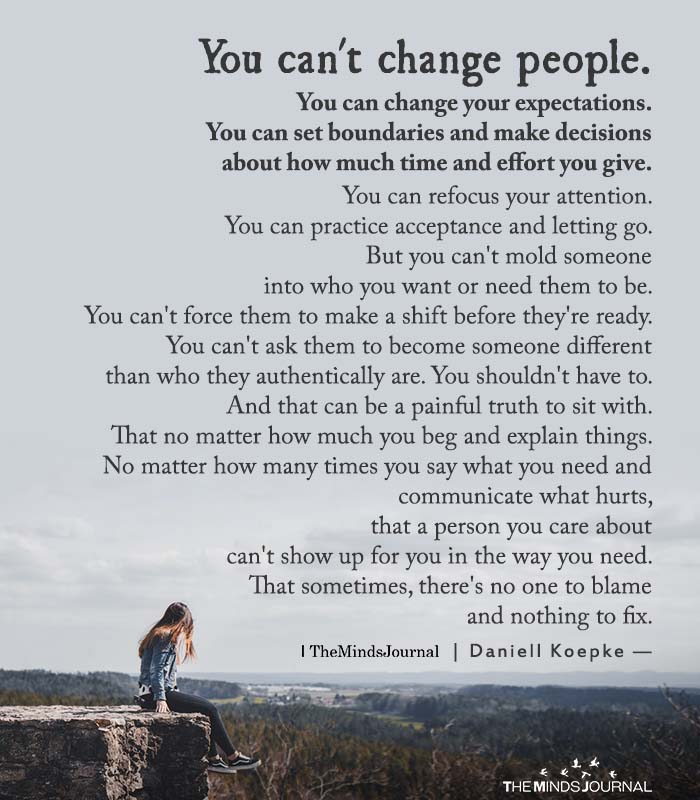
Fix someone

A lot of wanting to fix someone is coming from a good place within yourself.

But at the end of the day, it might show someone that you feel they are not good enough if you are always trying to fix them. This is not black and white though.


If you are in an emotionally abusive relationship, you shouldn’t overlook that and keep moving forward and accepting them for who they are. You can accept them for who they are, but they probably aren’t someone you want in your life.

Something that needs to be done is taking people at face value and keeping in mind that they may possibly never change. Pretend that they are who they are forever.

Can you fix a broken person?

Now if you are codependent, you may want to always save the day because if the other person is not good, you’re not good either. You feel if they are depressed, you are going to feel depressed too, so you take it upon yourself to fix the situation.

It’s important to know when you should offer help and when you should not.

addicted to helping others

You must always keep in mind that this has nothing to do with you. Of course, you can be there to help but only if and when they want it.

If you are codependent as an adult, you have dealt with some abuse or narcissistic behavior in the past. You probably learned to put your stuff on the back-burner, and when you learned that behavior, you also learned that your needs do not matter.

Related: 7 Reasons Why You Keep Attracting Toxic People And How to Fix This

If you were in an environment in your childhood that wasn’t always the happiest or the best, you wanted to make that person, your parent or caregiver, feel better because their mood affected you.


You wanted to make everything good because you didn’t know how to navigate seeing that something wasn’t good. A habit you picked up over time was that when something was wrong with someone else, it was your job to fix it.

As an adult when you meet new people, you will always attract what the standard was growing up. You probably know logically that it’s not right, but it’s all you know.

Related: We Are Not Here to Fix Each Other and Why You Shouldn’t Try

Once you become more mindful and aware of this, you will start to realize what’s for you and what’s not. Being mindful means you get to choose. You must be mindful of the type of relationship you want in your life, what’s your responsibility, and what’s not.

Remember, when we have a partner, they are your partner in life. They are not there for you both to sit on top of each other. Of course, there will be times when you help each other, but there has to be a point where you understand you have to take care of yourself first.


When you heal your codependency, you will realize this more. Not every empath is a codependent and not every codependent is an empath, but they often go hand-in-hand.

If you are someone who is addicted to helping others, here’s an insightful video about why you should get rid of the fixer personality:


Written By Stephanie Lyn 
Originally Appeared On Stephanie Lyn Life Coaching
Addicted to Helping Why We Feel The Need  pin
Addicted to Helping Why We Feel The Need To Fix Others pin
Addicted to Helping pin


Published On:

Last updated on:

Stephanie Lyn

Stephanie is a Life and Relationship Coach focusing on healing from narcissistic abuse, codependency, and past wounds. A major part of her teaching is a process called Self-Parenting. This practice is about learning how to become a healthy adult and learning the basic life skills that most of us did not learn growing up. She focuses her attention on teaching the strategies and simple practices to begin reprogramming your inner self. The parts of you that have been damaged from what her clients have experienced throughout their lives. Within her practice she has created a thriving YouTube Channel, Stephanie Lyn Coaching and podcast Heal, Survive, Thrive where people go to learn her teachings and gain the support they need to overcome what they have been through. Stephanie’s philosophies are simple “learn the basic principles you did not learn growing up.”

Disclaimer: The informational content on The Minds Journal have been created and reviewed by qualified mental health professionals. They are intended solely for educational and self-awareness purposes and should not be used as a substitute for professional medical advice, diagnosis, or treatment. If you are experiencing emotional distress or have concerns about your mental health, please seek help from a licensed mental health professional or healthcare provider.

Leave a Comment

Today's Horoscope

Your Daily Horoscope For 4 April, 2026: Free Predictions

Daily Horoscope 4 April, 2026: Prediction For Each Zodiac Sign

Look at your daily prediction and see what the stars have in store for your love life and your future!

Latest Quizzes

How Many Circles Do You See? A Simple Test of Thinking Style

How Many Circles Do You See? Your Answer Might Reveal Narcissistic Traits! 

Take a closer look at this simple image and discover what your circle count reveals about your thinking style, perception, and attention in this fun and engaging visual test.

Latest Quotes

Real Signs Your Body Is Actually in Good Health: How to Know You’re Truly Well

Real Signs Your Body Is Actually in Good Health: How to Know You’re Truly Well

Real signs your body is healthy don’t always show up on lab reports. From good sleep and clear skin to regular digestion and a stable mood, your body is constantly sending quiet signals of wellness.

Readers Blog

Caption This Image and Selected Wisepicks – 5 April 2026

Caption This Image and Selected Wisepicks – 5 April 2026

Ready to unleash your inner wordsmith? ✨??☺️ Now’s your chance to show off your wit, charm, or sheer genius in just one line! Whether it’s laugh-out-loud funny or surprisingly deep, we want to hear it.Submit your funniest, wittiest, or most thought-provoking caption in the comments. We’ll pick 15+ winners to be featured on our website…

Latest Articles

Have you ever wondered if you actually love assisting people or if you are addicted to helping others to the point of over-indulgence? Let’s learn more about how empaths, caregivers or those who are codependent in relationships love fixing a broken person.


“It’s not your job to fix other people. You can’t fix them. You can only change the way you live and the way you respond to life. Decide instead to have all the traits you wish to see in others, then you will generate your own brand of happy.” – Lisa Prosen

If you’re an empath, codependent, or a caregiver, this is for you, so listen up. Are you a person who loves to find wounded people and heal them? Have you ever wondered why you choose wounded people and have the desire to try to fix them?


Addicted to helping others? Part of the reason is the good in you.

You see a broken person and can see who they are to their core. But you have to realize that not everything in life is meant for you to fix. Knowing the difference between when helping someone is a good thing and when helping someone is a bad thing is important.

Let’s take this back to your childhood to help explain why you want to fix others. If you are the person who likes to fix people and you are the person people call when they need help, chances are that when you were growing up, your needs were not always being met.

What you needed was often pushed aside. You ended up learning over time that what you wanted or needed came second and the other person’s needs and wants always came first.


Related: Why The Girl Who Fixes People Often Ends Up In Toxic Relationships

You probably also learned that someone showing you love was showing it through them fixing things for you. There was a pattern there that you probably never saw.

  • Love equals this person buying you things.
  • Love equals this person taking you places for fun.
  • Love equals this person doing things for you all the time and never allowing you to do it on your own.

Sound familiar?

A big part of wanting to fix another person is that you deemed what is acceptable and what’s not.

One of the biggest problems with this is not everyone wants to be saved, and not everyone is ready or desires to open a door to their past. Real love is accepting someone for who they are, but remember, that doesn’t mean you should be accepting toxic behaviors.

It’s important to find the relationships and friendships that are the right fit for you. Not everyone wants to live the same way you do.

Fix someone

A lot of wanting to fix someone is coming from a good place within yourself.

But at the end of the day, it might show someone that you feel they are not good enough if you are always trying to fix them. This is not black and white though.


If you are in an emotionally abusive relationship, you shouldn’t overlook that and keep moving forward and accepting them for who they are. You can accept them for who they are, but they probably aren’t someone you want in your life.

Something that needs to be done is taking people at face value and keeping in mind that they may possibly never change. Pretend that they are who they are forever.

Can you fix a broken person?

Now if you are codependent, you may want to always save the day because if the other person is not good, you’re not good either. You feel if they are depressed, you are going to feel depressed too, so you take it upon yourself to fix the situation.

It’s important to know when you should offer help and when you should not.

addicted to helping others

You must always keep in mind that this has nothing to do with you. Of course, you can be there to help but only if and when they want it.

If you are codependent as an adult, you have dealt with some abuse or narcissistic behavior in the past. You probably learned to put your stuff on the back-burner, and when you learned that behavior, you also learned that your needs do not matter.

Related: 7 Reasons Why You Keep Attracting Toxic People And How to Fix This

If you were in an environment in your childhood that wasn’t always the happiest or the best, you wanted to make that person, your parent or caregiver, feel better because their mood affected you.


You wanted to make everything good because you didn’t know how to navigate seeing that something wasn’t good. A habit you picked up over time was that when something was wrong with someone else, it was your job to fix it.

As an adult when you meet new people, you will always attract what the standard was growing up. You probably know logically that it’s not right, but it’s all you know.

Related: We Are Not Here to Fix Each Other and Why You Shouldn’t Try

Once you become more mindful and aware of this, you will start to realize what’s for you and what’s not. Being mindful means you get to choose. You must be mindful of the type of relationship you want in your life, what’s your responsibility, and what’s not.

Remember, when we have a partner, they are your partner in life. They are not there for you both to sit on top of each other. Of course, there will be times when you help each other, but there has to be a point where you understand you have to take care of yourself first.


When you heal your codependency, you will realize this more. Not every empath is a codependent and not every codependent is an empath, but they often go hand-in-hand.

If you are someone who is addicted to helping others, here’s an insightful video about why you should get rid of the fixer personality:


Written By Stephanie Lyn 
Originally Appeared On Stephanie Lyn Life Coaching
Addicted to Helping Why We Feel The Need  pin
Addicted to Helping Why We Feel The Need To Fix Others pin
Addicted to Helping pin


Published On:

Last updated on:

Stephanie Lyn

Stephanie is a Life and Relationship Coach focusing on healing from narcissistic abuse, codependency, and past wounds. A major part of her teaching is a process called Self-Parenting. This practice is about learning how to become a healthy adult and learning the basic life skills that most of us did not learn growing up. She focuses her attention on teaching the strategies and simple practices to begin reprogramming your inner self. The parts of you that have been damaged from what her clients have experienced throughout their lives. Within her practice she has created a thriving YouTube Channel, Stephanie Lyn Coaching and podcast Heal, Survive, Thrive where people go to learn her teachings and gain the support they need to overcome what they have been through. Stephanie’s philosophies are simple “learn the basic principles you did not learn growing up.”

Leave a Comment

    Leave a Comment