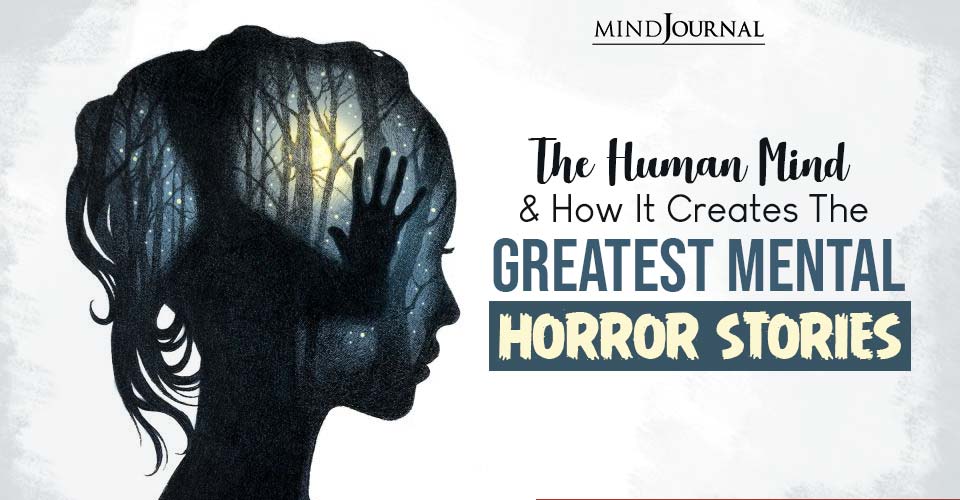
The Human Mind and How It Creates The Greatest Mental Horror Stories

Author : Dr. Steven C. Hayes

Much of what we don’t know about being human is simply in our minds. As the human mind is such a complex organ, it creates mental horror stories. Let’s look at how it performs the roles a storyteller and a listener when it comes to dealing with negative thoughts.

It’s nearing the end of October, and Halloween is about to begin. This is the time of monsters. The time of vampires, werewolves, mummies, and other horrific figures. People dress up in all sorts of ways to represent humanity’s deepest and darkest fears. In reality, however, people’s biggest fears look a bit different than what horror movies often try to sell us on.

According to a recent survey by the Chapman University in California, Americans mostly fear corrupt government officials, followed by their loved ones dying (there’s a match with horror movies), loved ones getting seriously ill, civil unrest, another pandemic, and financial collapse. It will require serious creativity to turn any of these fears into suitable party costumes.

Related: Does Consciousness Exist Outside Of The Brain?

How The Human Mind Creates Mental Horror Stories

The greatest horror story ever told doesn’t happen in the pages of a book, or on the movie screen. Instead, it happens inside of your own head. The human mind is a masterful storyteller, and it creates the most elaborate horror stories of your own personal hell.

It may tell you that “you will get into an accident on your way to work”, that “you have cancer without knowing it”, that “you will never be good enough to achieve your dream”, and that “all of your friends secretly despise you”. Your mind knows your biggest weaknesses and insecurities, and it will not hesitate to use them against you.

It may sound like a bad joke, but there’s actual logic behind it. Your mind doesn’t get pleasure from torturing you, but instead attempts to warn you of possible calamities. By predicting horror scenarios – even though they are unlikely and won’t happen – your mind prepares you for the worst-case scenario. Better be safe than sorry.

Evolutionary speaking, it ties into a process that may have helped our ancestors survive longer, which is why we all have brains that frequently predict danger. But human language and cognition put that healthy caution on steroids allowing us to carry it ten steps too far. Ironically when we over react to our fears that very reaction plugs into a self-amplifying circuit — its as if our own fearful reactions PROVE we have something to fear.

Your mind may mean well, but it doesn’t change the fact that these personalized horror stories can hinder us in life. They may reel us into struggling with our fear, isolating us from others, and preventing us from doing what is important and meaningful to us.

How The Human Mind Creates Mental Horror Stories

I suspect that’s part of why we deliberately create fear on Halloween — in order to play with it and detune an unhealthy process of amplification.

So, let’s go with that! Let’s put on our witches hat and this week if we notice fears that are getting the best of us, let’s try to be S.P.O.O.K.Y.

Related: 25 Fascinating Psychological Effects Most of Us Don’t Know About

The S.P.O.O.K.Y. Formula for Mental Horror Stories

S = Spot

Before you can effectively deal with your thoughts and feelings, you need to notice them as they happen. You need to spot the horror story as it unfolds in the moment. You can acknowledge it out loud, or just internally to yourself. Doesn’t matter. What matters is that you take notice of it as it happens.

P = Pause

As your mind throws you into the deep end of difficult thoughts and feelings, it’s easy to become overwhelmed. For this reason, it’s important to pause. Allow yourself a moment. Breathe. You can and will take care of the matter, but you don’t have to do it in a frenzy. Pause and take a moment to yourself.

O = Observe

Next, it’s time to take a closer look at the monster. What does it really look like? What thoughts are showing up? What can you feel in your body? And what else do you notice? Observe the horror story in all its detail. Like a curious scientist making a new discovery, you want to observe without judgment. Pure, neutral observation.

O = Open

Up This next step is possibly the hardest of them all. After you have observed your horror story, it’s time to open up to it. This means allowing yourself to get in contact with these difficult thoughts and feelings. Don’t forget to breathe. Yes, it’s hard, but it’s also important. The more you can allow yourself to open up to what is difficult, the less it will control you, and the easier it will be for you to do what is important and meaningful.

K = Karaoke

Now a bit of fun. See if you can distill your horror story into a single sentence, for instance “I’m going to die old and alone”. Once you have it, think of your favorite monster, and imagine them saying the sentence. Now do a full Karaoke.

Impersonate Frankenstein’s monster mumbling “Nobody loves me”. Pretend to be a witch cackling “I’m lazy and stupid”. Experiment with different voices, and see how it affects the horror story. Chances are, it will lose a bit of its grip and you will gain a different perspective.

Y = Yes, Thank you

Then see if you can finish with a gentle “yes” and thanking your mind for its scary attempt to be of use. Your mind is trying to protect you. Don’t treat it harshly! Yes, it is OK to have scary stories. Much in the same way you will thank the ghosts and goblins coming to your door far all their work on their costumes done to scare you, see if a bit of appreciation settles the mind. After all — it did get you to sing scary Karaoke!

In horror movies – at least the ones with a happy ending – the protagonists that survive are not fearless. Quite the opposite. You can see their fear, their anxiety, their stress, and their worries. But instead of letting themselves be controlled by their fears, they are able to focus on what matters most, and take effective action.

And when you are confronted by your own personal horror story, see if you can adapt this level of resourcefulness and remember to be S.P.O.O.K.Y.

Did you find the S.P.O.O.K.Y formula interesting? Let us know more about your thoughts in the comments below.


Written by: Steve C. Hayes
Originally appeared on: Stevenchayes.com
Republished with permission
Human Mind Creates Greatest Mental Horror Stories pin

Published On:

Last updated on:

Dr. Steven C. Hayes

Steven C. Hayes is Nevada Foundation Professor in the Behavior Analysis program at the Department of Psychology at the University of Nevada. An author of 44 books and nearly 600 scientific articles, his career has focused on an analysis of the nature of human language and cognition and the application of this to the understanding and alleviation of human suffering. He is the developer of Relational Frame Theory, an account of human higher cognition, and has guided its extension to Acceptance and Commitment Therapy (ACT), a popular evidence-based form of psychotherapy that uses mindfulness, acceptance, and values-based methods.

Disclaimer: The informational content on The Minds Journal have been created and reviewed by qualified mental health professionals. They are intended solely for educational and self-awareness purposes and should not be used as a substitute for professional medical advice, diagnosis, or treatment. If you are experiencing emotional distress or have concerns about your mental health, please seek help from a licensed mental health professional or healthcare provider.

Leave a Comment

Today's Horoscope

Daily Horoscope 24 March, 2026: Free Predictions

Daily Horoscope 24 March, 2026: Prediction For Each Zodiac Sign

24th March 2026 could bring new beginnings and emotional clarity for all 12 signs! See what your daily horoscope reveals!

Latest Quizzes

Free Vase Personality Test: 3 Options; Choose A Vase

Vase Personality Test: Your First Pick Reveals Your Main Character Trait

Take a moment, look closely, and pick an object that represents you.

Latest Quotes

We’re Not Antisocial: We’re Craving True Belonging, Not Shallow Interactions

We’re Not Antisocial: We’re Craving True Belonging, Not Shallow Interactions

We’re not antisocial; we’re just tired of shallow interactions. When you’re craving belonging, small talk feels empty, and your mind longs for deeper, authentic connection that truly sees you.

Readers Blog

Caption This Image and Selected Wisepicks – 22 March 2026

Caption This Image and Selected Wisepicks – 22 March 2026

Ready to unleash your inner wordsmith? ✨??☺️ Now’s your chance to show off your wit, charm, or sheer genius in just one line! Whether it’s laugh-out-loud funny or surprisingly deep, we want to hear it.Submit your funniest, wittiest, or most thought-provoking caption in the comments. We’ll pick 15+ winners to be featured on our website…

Latest Articles

Much of what we don’t know about being human is simply in our minds. As the human mind is such a complex organ, it creates mental horror stories. Let’s look at how it performs the roles a storyteller and a listener when it comes to dealing with negative thoughts.

It’s nearing the end of October, and Halloween is about to begin. This is the time of monsters. The time of vampires, werewolves, mummies, and other horrific figures. People dress up in all sorts of ways to represent humanity’s deepest and darkest fears. In reality, however, people’s biggest fears look a bit different than what horror movies often try to sell us on.

According to a recent survey by the Chapman University in California, Americans mostly fear corrupt government officials, followed by their loved ones dying (there’s a match with horror movies), loved ones getting seriously ill, civil unrest, another pandemic, and financial collapse. It will require serious creativity to turn any of these fears into suitable party costumes.

Related: Does Consciousness Exist Outside Of The Brain?

How The Human Mind Creates Mental Horror Stories

The greatest horror story ever told doesn’t happen in the pages of a book, or on the movie screen. Instead, it happens inside of your own head. The human mind is a masterful storyteller, and it creates the most elaborate horror stories of your own personal hell.

It may tell you that “you will get into an accident on your way to work”, that “you have cancer without knowing it”, that “you will never be good enough to achieve your dream”, and that “all of your friends secretly despise you”. Your mind knows your biggest weaknesses and insecurities, and it will not hesitate to use them against you.

It may sound like a bad joke, but there’s actual logic behind it. Your mind doesn’t get pleasure from torturing you, but instead attempts to warn you of possible calamities. By predicting horror scenarios – even though they are unlikely and won’t happen – your mind prepares you for the worst-case scenario. Better be safe than sorry.

Evolutionary speaking, it ties into a process that may have helped our ancestors survive longer, which is why we all have brains that frequently predict danger. But human language and cognition put that healthy caution on steroids allowing us to carry it ten steps too far. Ironically when we over react to our fears that very reaction plugs into a self-amplifying circuit — its as if our own fearful reactions PROVE we have something to fear.

Your mind may mean well, but it doesn’t change the fact that these personalized horror stories can hinder us in life. They may reel us into struggling with our fear, isolating us from others, and preventing us from doing what is important and meaningful to us.

How The Human Mind Creates Mental Horror Stories

I suspect that’s part of why we deliberately create fear on Halloween — in order to play with it and detune an unhealthy process of amplification.

So, let’s go with that! Let’s put on our witches hat and this week if we notice fears that are getting the best of us, let’s try to be S.P.O.O.K.Y.

Related: 25 Fascinating Psychological Effects Most of Us Don’t Know About

The S.P.O.O.K.Y. Formula for Mental Horror Stories

S = Spot

Before you can effectively deal with your thoughts and feelings, you need to notice them as they happen. You need to spot the horror story as it unfolds in the moment. You can acknowledge it out loud, or just internally to yourself. Doesn’t matter. What matters is that you take notice of it as it happens.

P = Pause

As your mind throws you into the deep end of difficult thoughts and feelings, it’s easy to become overwhelmed. For this reason, it’s important to pause. Allow yourself a moment. Breathe. You can and will take care of the matter, but you don’t have to do it in a frenzy. Pause and take a moment to yourself.

O = Observe

Next, it’s time to take a closer look at the monster. What does it really look like? What thoughts are showing up? What can you feel in your body? And what else do you notice? Observe the horror story in all its detail. Like a curious scientist making a new discovery, you want to observe without judgment. Pure, neutral observation.

O = Open

Up This next step is possibly the hardest of them all. After you have observed your horror story, it’s time to open up to it. This means allowing yourself to get in contact with these difficult thoughts and feelings. Don’t forget to breathe. Yes, it’s hard, but it’s also important. The more you can allow yourself to open up to what is difficult, the less it will control you, and the easier it will be for you to do what is important and meaningful.

K = Karaoke

Now a bit of fun. See if you can distill your horror story into a single sentence, for instance “I’m going to die old and alone”. Once you have it, think of your favorite monster, and imagine them saying the sentence. Now do a full Karaoke.

Impersonate Frankenstein’s monster mumbling “Nobody loves me”. Pretend to be a witch cackling “I’m lazy and stupid”. Experiment with different voices, and see how it affects the horror story. Chances are, it will lose a bit of its grip and you will gain a different perspective.

Y = Yes, Thank you

Then see if you can finish with a gentle “yes” and thanking your mind for its scary attempt to be of use. Your mind is trying to protect you. Don’t treat it harshly! Yes, it is OK to have scary stories. Much in the same way you will thank the ghosts and goblins coming to your door far all their work on their costumes done to scare you, see if a bit of appreciation settles the mind. After all — it did get you to sing scary Karaoke!

In horror movies – at least the ones with a happy ending – the protagonists that survive are not fearless. Quite the opposite. You can see their fear, their anxiety, their stress, and their worries. But instead of letting themselves be controlled by their fears, they are able to focus on what matters most, and take effective action.

And when you are confronted by your own personal horror story, see if you can adapt this level of resourcefulness and remember to be S.P.O.O.K.Y.

Did you find the S.P.O.O.K.Y formula interesting? Let us know more about your thoughts in the comments below.


Written by: Steve C. Hayes
Originally appeared on: Stevenchayes.com
Republished with permission
Human Mind Creates Greatest Mental Horror Stories pin

Published On:

Last updated on:

Dr. Steven C. Hayes

Steven C. Hayes is Nevada Foundation Professor in the Behavior Analysis program at the Department of Psychology at the University of Nevada. An author of 44 books and nearly 600 scientific articles, his career has focused on an analysis of the nature of human language and cognition and the application of this to the understanding and alleviation of human suffering. He is the developer of Relational Frame Theory, an account of human higher cognition, and has guided its extension to Acceptance and Commitment Therapy (ACT), a popular evidence-based form of psychotherapy that uses mindfulness, acceptance, and values-based methods.

Leave a Comment

    Leave a Comment