

When you expose a narcissist, the energy in the room changes, and you feel it before you can even explain it. It’s not just about calling someone out. It’s that strange moment where their usual charm slips, and something else takes over.
If you have ever found yourself wondering how do narcissists react when you call them out on their bull****, or try to understand what happens when you expose a narcissist, well, you are not alone.
Contrary to what most people believe, exposing a narcissist does not lead to clarity the way you would expect, rather it leads to more confusion, deflection, projection, and reactions that feel off.
However, once your recognize these signs and understand their reactions, things start to make a lot more sense.
Read on to know more about what happens when you expose a narcissist.
Related: 10 Phrases Narcissists Use When They Realize You’re Not Falling For It Anymore
When You Expose a Narcissist, These 8 Reactions Reveal Their True Nature
1. They go cold instead of confrontational.
How do narcissists react when you call them out? You might expect anger, or raised voices. Something obvious, right? But sometimes, they just simply shut down.
The warmth disappears, the conversation feels empty; it’s like you are talking to someone who is no longer really there. Don’t mistake this as peace, because this is distance, rather intentional distance.
And it can make you feel like you have done something wrong, even if you haven’t.
This kind of withdrawal is its own form of control. It leaves you sitting with the discomfort, wondering if you pushed too far.
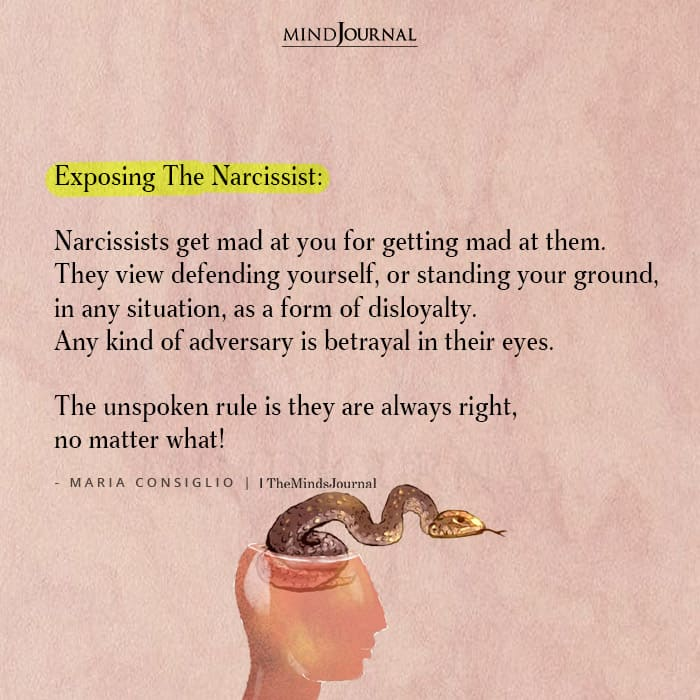
2. They try to pull you back in with charm.
If the confrontation doesn’t go their way, they might switch tactics completely. Suddenly, they are nicer, warmer, and more attentive. Maybe even apologetic, but in a vague, non-specific way.
It can feel like things are going back to normal. Like maybe you misjudged them. But it’s not really about resolution. It’s about regaining control of the dynamic, when you expose a narcissist.
When you are dealing with a narcissist, this push-and-pull – distance, then warmth – can be confusing enough to make you question why you spoke up in the first place.
3. They bring other people into it.
If you are wondering how do narcissists react when you call them out, then remember this. Sometimes, the reaction doesn’t stay between the two of you.
You might notice others getting involved, be it subtly or directly. Maybe someone starts acting differently toward you, or repeating a version of events that doesn’t sound quite right.
This is where things start to feel bigger than they should. It’s not always obvious, but the goal is to shift perception. If others see you a certain way, it weakens your position, and makes you out to be the “bad” one.
And suddenly, it’s not just about one conversation anymore, it’s about what serves their purpose. And that is to take back control and make you look negative in front of everyone.
4. They get passive-aggressive instead of direct.
Once you are done exposing a narcissist, instead of addressing things head-on, their behavior shifts in quieter, and more subtle ways.
Maybe a sarcastic comment here, or a delayed response there. A tone that feels slightly off, but not enough to call out directly. It’s hard to point to one specific thing, which makes it even more frustrating.
You feel the tension, but if you bring it up, it can easily be brushed off.
This kind of indirect reaction keeps you in a constant state of second-guessing, like something’s wrong, but you can’t quite prove it.
Related: 6 Signs You’re Trapped In Gaslightopia (And It’s Messing With Your Mind)
5. They suddenly rewrite the entire story.
After you call them out, it’s like the past gets edited in real time.
All those things you clearly remember? Well, they are “not how it happened.” Situations get twisted just enough to make you sound unreasonable, and even your reactions get reframed as the real issue.
It’s a very subtle, but effective manipulation tactic. You are not just defending one moment anymore, you are questioning the entire timeline.
And from a narcissist’s point of view, that’s the whole point. If they can reshape the narrative, they don’t have to own any part of it. So, what happens? You are left trying to prove something that shouldn’t need proof.

6. They test your boundaries again (and again).
What happens when you expose a narcissist? Well, just because you called something out doesn’t mean it stops. In fact, they might push a little more. Not in the same way, but in small, almost unnoticeable ways.
A comment here. A reaction there. Little things that make you pause. It’s like they are checking to see if you really meant what you said, or if you will let things slide again.
And if you do, even once, they take note. Because that’s all they need to get back in your good books and keep the pretense going.
7. They deny it so smoothly it throws you off.
When you are dealing with a narcissist, the denial isn’t loud or dramatic. It’s almost casual.
You bring something up – something you have thought through – and they respond like it’s completely unfounded. No hesitation, no pause. Just a calm “that never happened” or “you are overthinking it.”
And for a second, it works. You start second-guessing yourself, replaying the situation in your head.
That’s the trick. The smoother the denial, the more it makes you doubt your own memory. Because at the end of the day, it’s not about convincing you; they just need to shake your certainty.
8. They pull away just enough to make you chase.
When you expose a narcissist, they might create distance, but not completely. You will notice that they don’t disappear, they just become less available, less responsive, and less present.
And if you are used to a certain level of connection, that shift stands out like a sore thumb. You might find yourself reaching out more, trying to “fix” whatever feels off.
And that’s exactly where the dynamic quietly flips again. Because now, instead of holding them accountable, you are trying to get back to where things were, and just like that they are back in control.
Understanding what happens when you expose a narcissist isn’t about labeling someone, rather it’s about understanding the patterns that leave you feeling confused, emotionally exhausted, or off balance.
Related: 7 Signs A Narcissist Is Sabotaging You Every Time You’re Happy
Dealing with a narcissist often means stepping back instead of leaning in, even when your instinct is to fix things.
The moment you start seeing these reactions clearly, you also start seeing your options more clearly, and that’s where things begin to change.
Have you ever tried exposing a narcissist? How did that go? Let us know your thoughts and experiences in the comments down below!
Frequently Asked Questions (FAQs)
1. What’s a narcissist’s biggest fear?
A narcissist’s biggest fear isn’t failure, it’s being seen for who they really are. The moment someone stops buying into their version of things, it unsettles them. They rely a lot on how others perceive them, so losing that control hits hard. It’s not always obvious, but underneath it all, there’s a fear of being exposed, ignored, or not admired anymore. That loss of control is what really gets to them.
2. What happens if you expose a narcissist?
When you expose a narcissist, things don’t suddenly become clear or calm, in fact, it usually gets messier. They might deny everything, twist the story, or somehow make it about you instead. Sometimes they get defensive or distant, other times they switch it up and act unusually nice, like nothing happened. The dynamic shifts in a way that feels confusing. You expect honesty, but what you get instead are reactions that make you question yourself more than them.
3. What should you never tell a narcissist?
You should never tell a narcissist exactly how much they affect you emotionally. The more they know what hurts, what triggers you, or how deeply you care, the more they can use it to stay in control. It’s also risky to directly call them out in a confrontational way; they rarely take it as feedback and often turn it against you. Oversharing, explaining yourself too much, or showing vulnerability too quickly can backfire, because it gives them something to work with.


Leave a Comment