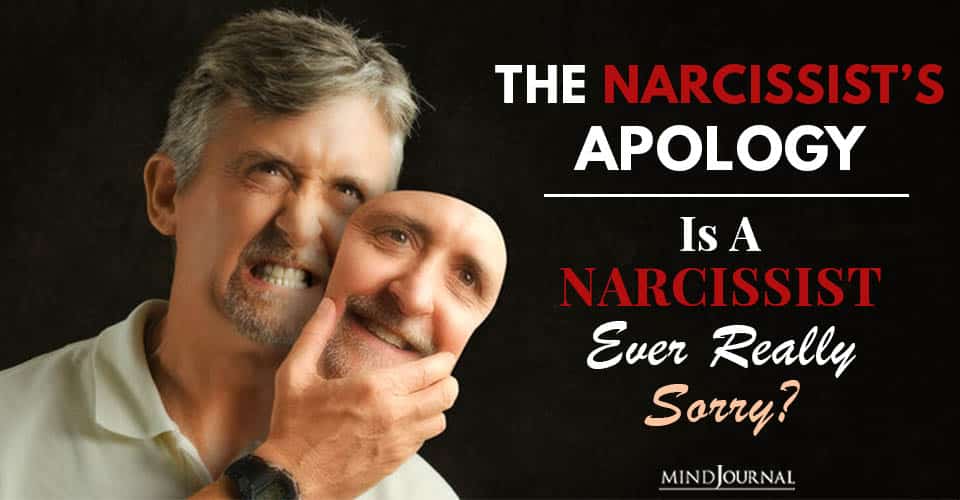
The Narcissist’s Apology: Is A Narcissist Ever Really Sorry?

Author : Maggie

A narcissist’s apology is never really an apology, you know? A narcissist’s apology is more like a temporary fix for your problems and just another way for them to manipulate you and emotionally abuse you, by keeping on their facade.


Ever been hoovered back into the cycle of abuse because of a narcissist’s apology? You are not alone. Most of us tend to think that they couldn’t be pathologically narcissistic if they’re apologizing, right? It’s just not something that narcissists do. Surely this time, things will change…

Think again gorgeous one.


It isn’t entirely accurate that a narc will never utter those words. Sure, it is a rare thing, and for many this simple phrase of contrition is completely absent from their vocabulary.

BUT, there are also many who do apologize…in the sense that these words will, on occasion, fall from their lips.

The issue isn’t there capacity to vocalize the utterance though. It’s that the intent differs in every possible way from one delivered with sincerity.


Whilst you would prefer to a) receive an apology that is genuine, and b) ultimately be in a relationship with an emotionally healthy person, there is a silver lining to the fauxpology…

Learning to recognize the narcissist’s sorry/not sorry for what it is, means you are also confronting the reality that they are narcissistic.

Hold fast to this truth. Refuse to be hoovered back in with yet another fauxpology. Break the cycle of abuse and set yourself free instead.

Related: Do Narcissists Ever Feel Sorry?

An apology from the heart

Let’s start by defining the anatomy of an apology from those who have a heart.

As humans, we falter, we err, we make mistakes. In any relationship, there will be times when these blunders impact those we care for. Inevitably, we hurt others. Because we care for those we choose to share our lives with, hurting others, in a sense hurts ourselves.


We feel saddened, disappointed in ourselves, perhaps even angry that we have let ourselves and others down. Guilt and remorse, as well as wanting to rectify how we have wronged our loved one, drives us to fix the hurt. Mending this hurt is all about expressing this remorse.

A genuine apology includes acknowledgment of what you did to hurt another, ownership of the responsibility, and a commitment to change the behavior in the future.

Examples of authentic heartfelt sorrow might sound like:

  • ‘I’m sorry I hurt you’.
  • ‘I was wrong, I shouldn’t have done that’.
  • ‘What can I do to make things right?’

Apologies from the heart are full of integrity, accountability, humility and compassion.

An apology devoid of heart

The narcissist’s mindset

The abusive narcissist does not have the necessary elements within them for a genuine heartfelt apology.

In the first instance, this requires recognition of wrong-doing. The narcissist spends a lifetime preoccupied with defending their belief in their own superiority and perfection. Obviously, this precludes the capacity to reflect with critical honesty on behaviors. Openness to being flawed, conflicts in every way with the traits of Narcissistic Personality Disorder (NPD).

Hence taking responsibility for being in the wrong, for the narc, is an impossibility. It simply does not happen.


Furthermore, central to seeking and granting forgiveness is empathy and the capacity to see beyond one’s own needs and interests. Extreme self-involvement, another hallmark of NPD, prevents experiencing these qualities. Finally, the pathological sense of entitlement of the true narcissist cements the deal. They are possessed with the certainty that they have a right to all they desire.

The cost to others of the narcissist getting their needs met, is irrelevant.

So why apologise?

Related: 15 Lies A Narcissist Says To Keep You Around

Anatomy of the fauxpology

1. When they use it.

So how does the narcissist’s mindset play out with the fauxpology?


Well, just as you suspected, primarily through the absence of apologies since to their self-righteous stance they’re always right and beyond reproach.

There are however circumstances where narcissists will choke out an apology. Specifically, when they are seeking to manipulate and control you.

What they are angling to achieve is to have you continue believing in their mask. It is about managing your perception of who they want you to believe they are, i.e.: a being of “perfection”.

Key phases when you are more likely to receive the fauxpology, are during love bombing and when you are being hoovered. It is rolled out if they suspect that they may be in danger of losing you as a source of supply (…and you are still valuable to them in that regard).

Understanding this highlights that the narcissist’s version of being sorry is entirely about them and has very little to do with you at all.

Want to know more about a narcissist’s apology? Check this video out below:


2. How they use it.

Spotting a narcissist through the fauxpology is surprisingly straightforward. It is utterly transparent once you know what to look for due to its stark contrast with a heartfelt apology.

You gorgeous one, do however you need to detach sufficiently from their attempts to trigger you during the fauxpology, in order to deconstruct it successfully (for more on this read Emotionally unhook yourself & starve the narcissist of supply: Here’s how).

But you CAN do it.

And remember that detaching becomes easier each time you see past the mask. Seeing through the fauxpology is just one more step in setting yourself free.

Now to the hallmarks of the unapology…

a) The ‘I’ statements

Keep in mind where the narcissist is coming from. To them, an apology is a handy device to get their needs met. Your needs are extraneous and therefore will be a big, fat void in the ‘sorry, not sorry’.

The non-existence of reference to your needs is an indication you are being served a fauxpology. The language reflects this.


Look for the ‘I’ statements that hit immediately following the ‘sorry’ announcement. These are the ‘buts’ that defend their needs (not yours, theirs) thereby nullifying the apology.

Examples are:

  • Self-justification – ‘I did it because I’m having such a hard time at the moment, you really should be taking this into consideration’.
  • Blame shifting – ‘I’m sorry I did that, but I did it because xyz/you made me do it’.

These slips convey their complete lack of ownership or responsibility resulting from entitlement.

Related: 5 Projection Techniques Narcissists Use To Attack Others


b) The ‘you’ statements

The second ginormous sign is what ensues with respect to the ‘you’ statements. These are equally revealing of the narcissist’s true intent.

On top of underscoring why they are a victim in the situation with their ‘I’ statements, excusing petulantly why they shouldn’t have to apologise, the grand flip has taken place, as you can see in the examples above.

Embedded in every fauxpology is the manipulation that YOU own the issue, YOU have erred, and the responsibility sits now and forever for every wrong-doing, with YOU. The crafting of the fauxpology is designed to make you feel guilty so that the likelihood of any accountability lying with the narc is reduced in the future.

Further examples of what these sound like are:

  • ‘I’m sorry you took it that way’.
  • ‘I’m sorry you got angry with me’.
  • ‘You shouldn’t be so sensitive I didn’t mean it that way’.
  • ‘You should get over it/let it go’.
  • ‘I said I’m sorry what more do you want from me’.

You’ll also detect the ‘sorry/no sorry’ never contains evidence of deeper reflection of what has caused you pain, nor appreciation for how you might be feeling. Because, as stated, this is frankly of no consequence to the pathological narcissist.

How you take it

The most reliable indicator in your arsenal, is to connect with how you are feeling as a result of the fauxpology.

Any better? Do you feel that your trust and confidence in the relationship and them, is being rebuilt, repaired? Do you feel their respect, care, and compassion? Do you feel valued?

Or do you feel kinda awful? Like you’ve done something wrong? Guilty perhaps? Maybe that you’ve overreacted and that the poor narcissist was forced to apologize when they really had no need to?

Uh-huh. Not good, right?


A genuine heartfelt apology builds greater intimacy and understanding with another. It is an exchange of vulnerability that leads to growth. A true demonstration of love.

A fauxpology…not so much.

The sorry, not sorry, only leaves you questioning yourself. It is isolating, highlighting that you may be on the narcissist’s team, but they are not on yours. The fauxpology shows you what’s behind the mask, and that change is not an option (for more read Proof the narcissist abuses you intentionally and will never change).

Gorgeous ones, don’t be fooled!

Grab the fauxpology as an opportunity to break free now!

With gratitude,

Maggie x

Bibliography:

Exline, J.J., Baumeister, R.F., Bushman, B.J., Campbell, W.K., & Finkel, E.J. (2004). Too proud to let go: Narcissistic entitlement as a barrier to forgiveness. Journal of Personality and Social Psychology, 87(6), 894-912.
Howell, A.J., Dopko, R.L., Turowski, J.B., & Buro, K. (2011). The disposition to apologize. Personality and Individual Differences, 51(4), 509-514.
Leunissen, J.M., Sedikides, C., & Wildschut, T. (2017). Why narcissist are unwilling to apologize: The role of empathy and guilt. European Journal of Personality, 31(4), 385-403.
Sandage, S.J., Worthingon, E.L., Hright, T.L., & Berry, J.W. (2000). Seeking forgiveness: Theoretical context and an initial empirical study. Journal of Psychology and Theology, 28(1), 21-35.

Written by Maggie McGee
Originally appeared on Narcwise.com

The Narcissist’s Apology Sorry, Not Sorry
Narcissists Apology pin


Published On:

Last updated on:

Maggie

Maggie is an Olympian, 2x World Pro Champion, World Class Key Note Speaker, Certified Master Trainer; NLHP, {Neuro-Lingusitics Humanistic Psychology}, Time Line Training, Hypnosis, Kinesiology, Eye Yoga, Reiki Master and a Kumu of Hawaiian {Huna Huna} La’au Kahea (Spiritual, psychological healing), LomiLomi (Body work/massage), Hoomanaloa (Energy healing), Author and Ordained Minister (State of Hawaii). Maggie is committed to providing world-class training and services to inspire and train you in excelling in all areas of your life. She is one of less than 50 people world wide holding the Title of Master Trainer. Since 1991 she’s enjoyed a tremendous results record presenting to audiences, sports teams, corporations and businesses throughout the world helping them gain personal and professional satisfaction. Through her highly acclaimed training Maggie has assisting thousands and thousands of individuals, athletes (from juniors to Olympians), businesses (from sole proprietor to Fortune 500) teams (from High School to Olympics) and government offices to achieve desired goals, greatly enhancing overall performance and happiness.

Disclaimer: The informational content on The Minds Journal have been created and reviewed by qualified mental health professionals. They are intended solely for educational and self-awareness purposes and should not be used as a substitute for professional medical advice, diagnosis, or treatment. If you are experiencing emotional distress or have concerns about your mental health, please seek help from a licensed mental health professional or healthcare provider.

Leave a Comment

Today's Horoscope

Daily Horoscope 25 March 2026: Prediction for Zodiac Signs

Daily Horoscope 25 March, 2026: Prediction For Each Zodiac Sign

Today, the message is simple: stop running on autopilot.

Latest Quizzes

Image Personality Test: Which Woman Reveals Your True Self?

Which Woman Are You? A Personality Test That Reveals Your True Inner Nature

This personality test reveals your true self based on the woman you choose. Simple, fun, and surprisingly accurate!

Latest Quotes

Manipulative Tactics in Relationships: Gaslighting, Love Bombing, and Emotional Control

Manipulative Tactics in Relationships: Gaslighting, Love Bombing, and Emotional Control

Manipulative tactics in relationships often start subtly—gaslighting, love bombing, guilt trips, or mixed signals. Once you recognize these emotional manipulation patterns, you can protect your mental health and step away from toxic dynamics.

Readers Blog

Caption This Image and Selected Wisepicks – 22 March 2026

Caption This Image and Selected Wisepicks – 22 March 2026

Ready to unleash your inner wordsmith? ✨??☺️ Now’s your chance to show off your wit, charm, or sheer genius in just one line! Whether it’s laugh-out-loud funny or surprisingly deep, we want to hear it.Submit your funniest, wittiest, or most thought-provoking caption in the comments. We’ll pick 15+ winners to be featured on our website…

Latest Articles

A narcissist’s apology is never really an apology, you know? A narcissist’s apology is more like a temporary fix for your problems and just another way for them to manipulate you and emotionally abuse you, by keeping on their facade.


Ever been hoovered back into the cycle of abuse because of a narcissist’s apology? You are not alone. Most of us tend to think that they couldn’t be pathologically narcissistic if they’re apologizing, right? It’s just not something that narcissists do. Surely this time, things will change…

Think again gorgeous one.


It isn’t entirely accurate that a narc will never utter those words. Sure, it is a rare thing, and for many this simple phrase of contrition is completely absent from their vocabulary.

BUT, there are also many who do apologize…in the sense that these words will, on occasion, fall from their lips.

The issue isn’t there capacity to vocalize the utterance though. It’s that the intent differs in every possible way from one delivered with sincerity.


Whilst you would prefer to a) receive an apology that is genuine, and b) ultimately be in a relationship with an emotionally healthy person, there is a silver lining to the fauxpology…

Learning to recognize the narcissist’s sorry/not sorry for what it is, means you are also confronting the reality that they are narcissistic.

Hold fast to this truth. Refuse to be hoovered back in with yet another fauxpology. Break the cycle of abuse and set yourself free instead.

Related: Do Narcissists Ever Feel Sorry?

An apology from the heart

Let’s start by defining the anatomy of an apology from those who have a heart.

As humans, we falter, we err, we make mistakes. In any relationship, there will be times when these blunders impact those we care for. Inevitably, we hurt others. Because we care for those we choose to share our lives with, hurting others, in a sense hurts ourselves.


We feel saddened, disappointed in ourselves, perhaps even angry that we have let ourselves and others down. Guilt and remorse, as well as wanting to rectify how we have wronged our loved one, drives us to fix the hurt. Mending this hurt is all about expressing this remorse.

A genuine apology includes acknowledgment of what you did to hurt another, ownership of the responsibility, and a commitment to change the behavior in the future.

Examples of authentic heartfelt sorrow might sound like:

  • ‘I’m sorry I hurt you’.
  • ‘I was wrong, I shouldn’t have done that’.
  • ‘What can I do to make things right?’

Apologies from the heart are full of integrity, accountability, humility and compassion.

An apology devoid of heart

The narcissist’s mindset

The abusive narcissist does not have the necessary elements within them for a genuine heartfelt apology.

In the first instance, this requires recognition of wrong-doing. The narcissist spends a lifetime preoccupied with defending their belief in their own superiority and perfection. Obviously, this precludes the capacity to reflect with critical honesty on behaviors. Openness to being flawed, conflicts in every way with the traits of Narcissistic Personality Disorder (NPD).

Hence taking responsibility for being in the wrong, for the narc, is an impossibility. It simply does not happen.


Furthermore, central to seeking and granting forgiveness is empathy and the capacity to see beyond one’s own needs and interests. Extreme self-involvement, another hallmark of NPD, prevents experiencing these qualities. Finally, the pathological sense of entitlement of the true narcissist cements the deal. They are possessed with the certainty that they have a right to all they desire.

The cost to others of the narcissist getting their needs met, is irrelevant.

So why apologise?

Related: 15 Lies A Narcissist Says To Keep You Around

Anatomy of the fauxpology

1. When they use it.

So how does the narcissist’s mindset play out with the fauxpology?


Well, just as you suspected, primarily through the absence of apologies since to their self-righteous stance they’re always right and beyond reproach.

There are however circumstances where narcissists will choke out an apology. Specifically, when they are seeking to manipulate and control you.

What they are angling to achieve is to have you continue believing in their mask. It is about managing your perception of who they want you to believe they are, i.e.: a being of “perfection”.

Key phases when you are more likely to receive the fauxpology, are during love bombing and when you are being hoovered. It is rolled out if they suspect that they may be in danger of losing you as a source of supply (…and you are still valuable to them in that regard).

Understanding this highlights that the narcissist’s version of being sorry is entirely about them and has very little to do with you at all.

Want to know more about a narcissist’s apology? Check this video out below:


2. How they use it.

Spotting a narcissist through the fauxpology is surprisingly straightforward. It is utterly transparent once you know what to look for due to its stark contrast with a heartfelt apology.

You gorgeous one, do however you need to detach sufficiently from their attempts to trigger you during the fauxpology, in order to deconstruct it successfully (for more on this read Emotionally unhook yourself & starve the narcissist of supply: Here’s how).

But you CAN do it.

And remember that detaching becomes easier each time you see past the mask. Seeing through the fauxpology is just one more step in setting yourself free.

Now to the hallmarks of the unapology…

a) The ‘I’ statements

Keep in mind where the narcissist is coming from. To them, an apology is a handy device to get their needs met. Your needs are extraneous and therefore will be a big, fat void in the ‘sorry, not sorry’.

The non-existence of reference to your needs is an indication you are being served a fauxpology. The language reflects this.


Look for the ‘I’ statements that hit immediately following the ‘sorry’ announcement. These are the ‘buts’ that defend their needs (not yours, theirs) thereby nullifying the apology.

Examples are:

  • Self-justification – ‘I did it because I’m having such a hard time at the moment, you really should be taking this into consideration’.
  • Blame shifting – ‘I’m sorry I did that, but I did it because xyz/you made me do it’.

These slips convey their complete lack of ownership or responsibility resulting from entitlement.

Related: 5 Projection Techniques Narcissists Use To Attack Others


b) The ‘you’ statements

The second ginormous sign is what ensues with respect to the ‘you’ statements. These are equally revealing of the narcissist’s true intent.

On top of underscoring why they are a victim in the situation with their ‘I’ statements, excusing petulantly why they shouldn’t have to apologise, the grand flip has taken place, as you can see in the examples above.

Embedded in every fauxpology is the manipulation that YOU own the issue, YOU have erred, and the responsibility sits now and forever for every wrong-doing, with YOU. The crafting of the fauxpology is designed to make you feel guilty so that the likelihood of any accountability lying with the narc is reduced in the future.

Further examples of what these sound like are:

  • ‘I’m sorry you took it that way’.
  • ‘I’m sorry you got angry with me’.
  • ‘You shouldn’t be so sensitive I didn’t mean it that way’.
  • ‘You should get over it/let it go’.
  • ‘I said I’m sorry what more do you want from me’.

You’ll also detect the ‘sorry/no sorry’ never contains evidence of deeper reflection of what has caused you pain, nor appreciation for how you might be feeling. Because, as stated, this is frankly of no consequence to the pathological narcissist.

How you take it

The most reliable indicator in your arsenal, is to connect with how you are feeling as a result of the fauxpology.

Any better? Do you feel that your trust and confidence in the relationship and them, is being rebuilt, repaired? Do you feel their respect, care, and compassion? Do you feel valued?

Or do you feel kinda awful? Like you’ve done something wrong? Guilty perhaps? Maybe that you’ve overreacted and that the poor narcissist was forced to apologize when they really had no need to?

Uh-huh. Not good, right?


A genuine heartfelt apology builds greater intimacy and understanding with another. It is an exchange of vulnerability that leads to growth. A true demonstration of love.

A fauxpology…not so much.

The sorry, not sorry, only leaves you questioning yourself. It is isolating, highlighting that you may be on the narcissist’s team, but they are not on yours. The fauxpology shows you what’s behind the mask, and that change is not an option (for more read Proof the narcissist abuses you intentionally and will never change).

Gorgeous ones, don’t be fooled!

Grab the fauxpology as an opportunity to break free now!

With gratitude,

Maggie x

Bibliography:

Exline, J.J., Baumeister, R.F., Bushman, B.J., Campbell, W.K., & Finkel, E.J. (2004). Too proud to let go: Narcissistic entitlement as a barrier to forgiveness. Journal of Personality and Social Psychology, 87(6), 894-912.
Howell, A.J., Dopko, R.L., Turowski, J.B., & Buro, K. (2011). The disposition to apologize. Personality and Individual Differences, 51(4), 509-514.
Leunissen, J.M., Sedikides, C., & Wildschut, T. (2017). Why narcissist are unwilling to apologize: The role of empathy and guilt. European Journal of Personality, 31(4), 385-403.
Sandage, S.J., Worthingon, E.L., Hright, T.L., & Berry, J.W. (2000). Seeking forgiveness: Theoretical context and an initial empirical study. Journal of Psychology and Theology, 28(1), 21-35.

Written by Maggie McGee
Originally appeared on Narcwise.com

The Narcissist’s Apology Sorry, Not Sorry
Narcissists Apology pin


Published On:

Last updated on:

Maggie

Maggie is an Olympian, 2x World Pro Champion, World Class Key Note Speaker, Certified Master Trainer; NLHP, {Neuro-Lingusitics Humanistic Psychology}, Time Line Training, Hypnosis, Kinesiology, Eye Yoga, Reiki Master and a Kumu of Hawaiian {Huna Huna} La’au Kahea (Spiritual, psychological healing), LomiLomi (Body work/massage), Hoomanaloa (Energy healing), Author and Ordained Minister (State of Hawaii). Maggie is committed to providing world-class training and services to inspire and train you in excelling in all areas of your life. She is one of less than 50 people world wide holding the Title of Master Trainer. Since 1991 she’s enjoyed a tremendous results record presenting to audiences, sports teams, corporations and businesses throughout the world helping them gain personal and professional satisfaction. Through her highly acclaimed training Maggie has assisting thousands and thousands of individuals, athletes (from juniors to Olympians), businesses (from sole proprietor to Fortune 500) teams (from High School to Olympics) and government offices to achieve desired goals, greatly enhancing overall performance and happiness.

Leave a Comment

    Leave a Comment