7 Clever Slang Terms For Discussing Narcissism

Author : Rebecca Zung

If you are reading this article, you are likely aware of the active online conversation about narcissists and narcissism. Narcissism, or Narcissistic Personality Disorder (NPD), is a serious psychological condition that affects a small percentage of people.


NPD requires a professional for proper diagnosis, but an understanding of the basic traits and characteristics of narcissism can help many people who are dealing with borderline narcissists. Non-technical discussions around narcissism are useful for describing individuals who often resort to narcissistic behavior in relationships, even if these individuals don’t have a proper NPD diagnosis.

Professional therapists, counselors, and psychologists might be wary if they hear you, as a layperson, bringing up narcissism. A mental health professional may view your non-clinical use of the terminology as revealing a lack of knowledge, rather than as the helpful professional tip you thought it would be.


You may get more respect from mental health professionals if you clarify whether your narcissist has been properly diagnosed with NPD or whether your narcissist exhibits behavior that you believe demonstrates narcissistic tendencies which create problems for you.

In Chapter 1 of Brene Brown’s popular book, The Power of Vulnerability, Brown muses about the current flurry of interest in narcissism and states that “as a mental health professional . . . it makes me wince a little.” She suggests that many people are tagging toxic behavior as narcissism without realizing that narcissism is a defined and serious mental health disorder.

To account for the lay interest in narcissism, she offers the conjecture that, when viewed through a lens of vulnerability, narcissistic traits might be a manifestation of “the shame-based fear of being ordinary.”


Brown theorizes that widespread narcissistic tendencies are a logical extension of living in a culture defined by “never-enough.” Never good enough, never powerful enough, never safe enough, never relevant enough, never extraordinary enough.

Related: Heavy Lies The Crown Of A Narcissist

Rather than dismissing narcissism as a junk diagnosis, most professionals recognize that when laypeople refer to a narcissist, they are referring to someone who exhibits many narcissistic traits, someone who is “on the spectrum,” so to speak. The narcissistic traits seem to fit a pattern, and these traits seem to be causing relationship problems. The non-narcissist finds solace and power in naming a problem and learning the terminology needed to talk about it.

As large numbers of laypeople have engaged in the online debate about narcissism, colorful terminology has sprung up to support the conversation. Mental health professionals like Elinor Greenberg, Ph.D., recognize that the slang terminology around narcissism can be helpful for people who are dealing with manipulative relationships, whether or not that person has any real understanding of what mental health professionals mean by an NPD diagnosis.

As Dr. Greenberg writes, “some of these [slang terms] are actually quite clever and capture important aspects of the experience of loving someone with NPD – such as gaslighting, hoovering, and flying monkeys. However, many of these terms are being misused in much the same way that uninformed people casually label people as narcissists without any real understanding of what mental health professionals mean by that diagnosis.”

We’ve chosen seven of the most common slang terms used in the narcissism conversation. You might find these slang terms helpful, whether you are dealing with someone with a professional NPD diagnosis or whether you are dealing with someone on the spectrum.


7 Clever Slang Terms For Discussing Narcissism

1. Flying Monkeys

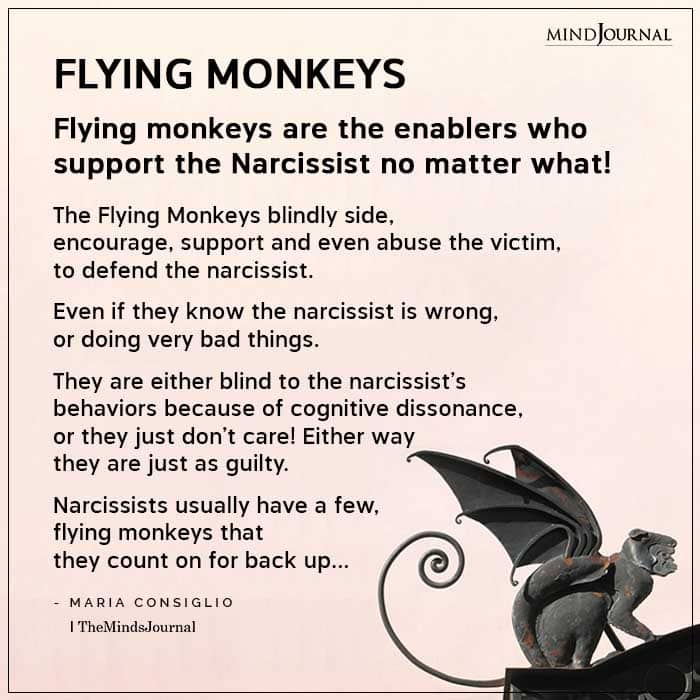
Flying Monkeys are unknowing people who are used by the narcissist to bolster the narcissist’s perspective. The flying monkeys in the Wizard of Oz accomplished the Wicked Witch’s purposes. Similarly, flying monkeys in the world of narcissism are friends or family who the narcissist uses to persuade you of their point of view.

A narcissist, for example, might “confide” in your mother about how you are “mistreating” him, knowing that your mother will pressure you in his favor. Or, instead of a personal apology after hurting you, a narcissist may post something romantic on social media, because she knows that mutual friends will all respond by telling you how lucky you are to have her in your life.
flying monkeys narcissism

2. Gaslighting

It refers to a movie in which a manipulative husband secretly and gradually turned down the gas lamp in the home, calling his wife’s sanity into question when she observed that the light was getting dimmer.

Gaslighting refers to a narcissist denying that something is true, causing you to wonder whose perception of reality is correct. Statements such as “I never said that,” “you’re imagining things,” and “you’re over-reacting” are all common gaslighting techniques.

Related: 121 Things Narcissists Say When They’re Gaslighting You

3. Future Faking.

Future faking refers to the manipulative strategy of making promises that will not be fulfilled. Future faking is one form of pathological lying.

Whether the narcissist believes at the moment that she will fulfill her promises or not, is beside the point. “I’ll never do that again,” or “I promise I will change” could be future faking, especially when such promises are made repeatedly without accompanying improvement in behavior.


4. Love Bombing.

Love bombing refers to a narcissist’s excessive, one-sided gestures of love and affection, which pressure you to commit to something you might not otherwise have been ready for.

5. Gray Rock.

Gray rock refers to one widely-accepted strategy for dealing with a narcissist. Making yourself respond to a narcissist flatly and without emotion (with as much “feeling” as a gray rock) can cause the narcissist to lose interest in your relationship more effectively and more quickly than trying to drive the narcissist away through direct assertiveness.

narcissism

6. Hoovering.

In narcissistic slang, hoovering is when the narcissist vacuums or sucks you back into a relationship after you have been discarded or have chosen to distance yourself.

Hoovering is often accomplished through love bombing. Indeed, the only real difference between hoovering and love bombing is that hoovering refers to sucking someone back into a previous relationship while love bombing refers to sucking someone into a new relationship.

Hoovering may be accomplished through texting, gifts, compliments, and even profuse apologies and promises (future faking) for an improved future. Be wary of pressure to forgive or trust based on words instead of actions: “Please give me one more chance, you won’t regret it, I promise, I know you must hate me but I can’t live without you.”


Related: What Is Hoovering? How Does a Narcissist Reel You Back In?

7. Triangulation.

Triangulation is when a narcissist attempts to manipulate you by involving another person or group of people in your relationship. (“M— warned me that you would do this” or “T— was right about you” or even “most people would agree with me that…”).

Triangulation might also involve the narcissist talking behind your back and trying to turn friends and family against you.

Knowing how to talk about a problem has empowered many people to address and overcome the challenges of negotiating with someone who exhibits narcissistic tendencies. These clever slang terms are often used by nonprofessionals to chart a new course and change their lives for the better.


Written By Rebecca Zung
Originally Appeared On Rebecca Zung
clever slang terms for discussing narcissism pinop
clever slang terms for discussing narcissism pin


Published On:

Last updated on:

Rebecca Zung

Rebecca Zung is a Narcissism Negotiation Expert and one of the Top 1% of attorneys in the nation, having been recognized by U.S. News and World Report as a “Best Lawyer in America”, as “Legal Elite” by Trend Magazine, and recognized by her peers and the judiciary as AV preeminent rated in family law, the highest possible rating for an attorney by Martindale Hubbell. She is the author of bestselling books, Negotiate Like You M.A.T.T.E.R: The Sure Fire Method To Step Up And Win (foreword by Robert Shapiro), and Breaking Free: A Step-By-Step Divorce Guide For Achieving Emotional, Physical, And Spiritual Freedom, and is a sought-after major media contributor. Her perspectives are in high demand by television and print outlets, as she has been featured in or on Extra, Forbes, Huffington Post, Newsweek, Time, Dr. Drew, NPR Talk Radio, Good Day New York, and CBS Los Angeles among others. Now based in Los Angeles, she is continuing to serve through her very popular YouTube channel, media appearances, podcast, articles, and on-demand programs such as S.L.A.Y Your Negotiation TM with a Narcissist and Breaking Free TM Divorce Masterclasses.

Disclaimer: The informational content on The Minds Journal have been created and reviewed by qualified mental health professionals. They are intended solely for educational and self-awareness purposes and should not be used as a substitute for professional medical advice, diagnosis, or treatment. If you are experiencing emotional distress or have concerns about your mental health, please seek help from a licensed mental health professional or healthcare provider.

Leave a Comment

Today's Horoscope

Weekly Horoscope PART one

Weekly Horoscope 15 March to 21 March 2026

Read your zodiac sign’s prediction to understand the energy surrounding you and how to make the most of the days ahead!

Latest Quizzes

Interesting Finger Personality Test: 4 Finger Lines

Finger Personality Test: Join Your Fingers And Reveal A Hidden Personality Secret!

Look closely at your finger lines. Which pattern do you see? This personality test might surprise you!

Latest Quotes

How Men Show Love Through Actions (Male Psychology in Relationships)

How Men Show Love Through Actions (Male Psychology in Relationships)

Male psychology in relationships shows that men express love through presence, protection, and peace more than poetry. Decode his actions so you can see how deeply he actually cares.

Readers Blog

Caption This Image and Selected Wisepicks – 15 March 2026

Caption This Image and Selected Wisepicks – 15 March 2026

Ready to unleash your inner wordsmith? ✨??☺️ Now’s your chance to show off your wit, charm, or sheer genius in just one line! Whether it’s laugh-out-loud funny or surprisingly deep, we want to hear it.Submit your funniest, wittiest, or most thought-provoking caption in the comments. We’ll pick 15+ winners to be featured on our website…

Latest Articles

If you are reading this article, you are likely aware of the active online conversation about narcissists and narcissism. Narcissism, or Narcissistic Personality Disorder (NPD), is a serious psychological condition that affects a small percentage of people.


NPD requires a professional for proper diagnosis, but an understanding of the basic traits and characteristics of narcissism can help many people who are dealing with borderline narcissists. Non-technical discussions around narcissism are useful for describing individuals who often resort to narcissistic behavior in relationships, even if these individuals don’t have a proper NPD diagnosis.

Professional therapists, counselors, and psychologists might be wary if they hear you, as a layperson, bringing up narcissism. A mental health professional may view your non-clinical use of the terminology as revealing a lack of knowledge, rather than as the helpful professional tip you thought it would be.


You may get more respect from mental health professionals if you clarify whether your narcissist has been properly diagnosed with NPD or whether your narcissist exhibits behavior that you believe demonstrates narcissistic tendencies which create problems for you.

In Chapter 1 of Brene Brown’s popular book, The Power of Vulnerability, Brown muses about the current flurry of interest in narcissism and states that “as a mental health professional . . . it makes me wince a little.” She suggests that many people are tagging toxic behavior as narcissism without realizing that narcissism is a defined and serious mental health disorder.

To account for the lay interest in narcissism, she offers the conjecture that, when viewed through a lens of vulnerability, narcissistic traits might be a manifestation of “the shame-based fear of being ordinary.”


Brown theorizes that widespread narcissistic tendencies are a logical extension of living in a culture defined by “never-enough.” Never good enough, never powerful enough, never safe enough, never relevant enough, never extraordinary enough.

Related: Heavy Lies The Crown Of A Narcissist

Rather than dismissing narcissism as a junk diagnosis, most professionals recognize that when laypeople refer to a narcissist, they are referring to someone who exhibits many narcissistic traits, someone who is “on the spectrum,” so to speak. The narcissistic traits seem to fit a pattern, and these traits seem to be causing relationship problems. The non-narcissist finds solace and power in naming a problem and learning the terminology needed to talk about it.

As large numbers of laypeople have engaged in the online debate about narcissism, colorful terminology has sprung up to support the conversation. Mental health professionals like Elinor Greenberg, Ph.D., recognize that the slang terminology around narcissism can be helpful for people who are dealing with manipulative relationships, whether or not that person has any real understanding of what mental health professionals mean by an NPD diagnosis.

As Dr. Greenberg writes, “some of these [slang terms] are actually quite clever and capture important aspects of the experience of loving someone with NPD – such as gaslighting, hoovering, and flying monkeys. However, many of these terms are being misused in much the same way that uninformed people casually label people as narcissists without any real understanding of what mental health professionals mean by that diagnosis.”

We’ve chosen seven of the most common slang terms used in the narcissism conversation. You might find these slang terms helpful, whether you are dealing with someone with a professional NPD diagnosis or whether you are dealing with someone on the spectrum.


7 Clever Slang Terms For Discussing Narcissism

1. Flying Monkeys

Flying Monkeys are unknowing people who are used by the narcissist to bolster the narcissist’s perspective. The flying monkeys in the Wizard of Oz accomplished the Wicked Witch’s purposes. Similarly, flying monkeys in the world of narcissism are friends or family who the narcissist uses to persuade you of their point of view.

A narcissist, for example, might “confide” in your mother about how you are “mistreating” him, knowing that your mother will pressure you in his favor. Or, instead of a personal apology after hurting you, a narcissist may post something romantic on social media, because she knows that mutual friends will all respond by telling you how lucky you are to have her in your life.

flying monkeys narcissism

2. Gaslighting

It refers to a movie in which a manipulative husband secretly and gradually turned down the gas lamp in the home, calling his wife’s sanity into question when she observed that the light was getting dimmer.

Gaslighting refers to a narcissist denying that something is true, causing you to wonder whose perception of reality is correct. Statements such as “I never said that,” “you’re imagining things,” and “you’re over-reacting” are all common gaslighting techniques.

Related: 121 Things Narcissists Say When They’re Gaslighting You

3. Future Faking.

Future faking refers to the manipulative strategy of making promises that will not be fulfilled. Future faking is one form of pathological lying.

Whether the narcissist believes at the moment that she will fulfill her promises or not, is beside the point. “I’ll never do that again,” or “I promise I will change” could be future faking, especially when such promises are made repeatedly without accompanying improvement in behavior.


4. Love Bombing.

Love bombing refers to a narcissist’s excessive, one-sided gestures of love and affection, which pressure you to commit to something you might not otherwise have been ready for.

5. Gray Rock.

Gray rock refers to one widely-accepted strategy for dealing with a narcissist. Making yourself respond to a narcissist flatly and without emotion (with as much “feeling” as a gray rock) can cause the narcissist to lose interest in your relationship more effectively and more quickly than trying to drive the narcissist away through direct assertiveness.

narcissism

6. Hoovering.

In narcissistic slang, hoovering is when the narcissist vacuums or sucks you back into a relationship after you have been discarded or have chosen to distance yourself.

Hoovering is often accomplished through love bombing. Indeed, the only real difference between hoovering and love bombing is that hoovering refers to sucking someone back into a previous relationship while love bombing refers to sucking someone into a new relationship.

Hoovering may be accomplished through texting, gifts, compliments, and even profuse apologies and promises (future faking) for an improved future. Be wary of pressure to forgive or trust based on words instead of actions: “Please give me one more chance, you won’t regret it, I promise, I know you must hate me but I can’t live without you.”


Related: What Is Hoovering? How Does a Narcissist Reel You Back In?

7. Triangulation.

Triangulation is when a narcissist attempts to manipulate you by involving another person or group of people in your relationship. (“M— warned me that you would do this” or “T— was right about you” or even “most people would agree with me that…”).

Triangulation might also involve the narcissist talking behind your back and trying to turn friends and family against you.

Knowing how to talk about a problem has empowered many people to address and overcome the challenges of negotiating with someone who exhibits narcissistic tendencies. These clever slang terms are often used by nonprofessionals to chart a new course and change their lives for the better.


Written By Rebecca Zung
Originally Appeared On Rebecca Zung
clever slang terms for discussing narcissism pinop
clever slang terms for discussing narcissism pin


Published On:

Last updated on:

Rebecca Zung

Rebecca Zung is a Narcissism Negotiation Expert and one of the Top 1% of attorneys in the nation, having been recognized by U.S. News and World Report as a “Best Lawyer in America”, as “Legal Elite” by Trend Magazine, and recognized by her peers and the judiciary as AV preeminent rated in family law, the highest possible rating for an attorney by Martindale Hubbell. She is the author of bestselling books, Negotiate Like You M.A.T.T.E.R: The Sure Fire Method To Step Up And Win (foreword by Robert Shapiro), and Breaking Free: A Step-By-Step Divorce Guide For Achieving Emotional, Physical, And Spiritual Freedom, and is a sought-after major media contributor. Her perspectives are in high demand by television and print outlets, as she has been featured in or on Extra, Forbes, Huffington Post, Newsweek, Time, Dr. Drew, NPR Talk Radio, Good Day New York, and CBS Los Angeles among others. Now based in Los Angeles, she is continuing to serve through her very popular YouTube channel, media appearances, podcast, articles, and on-demand programs such as S.L.A.Y Your Negotiation TM with a Narcissist and Breaking Free TM Divorce Masterclasses.

Leave a Comment

    Leave a Comment