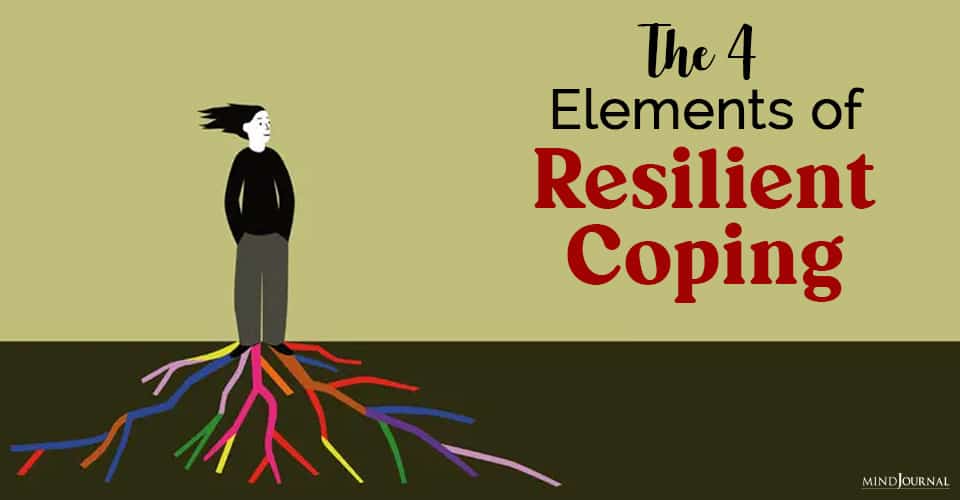
The 4 Elements Of Resilient Coping

Author : Gregg Henriques, Ph.D

This blog reviews four elements associated with resilient coping.
When the world disrupts our plans and hopes and reveals to us how fragile and vulnerable we are, we can be terrified, humbled, saddened, humiliated, and traumatized.


First, my heart goes out to all who are suffering. Second, as a psychotherapist and a trainer of psychological doctors, here are some thoughts for fostering an adjustment that is as adaptive as possible to this wave of pain.

1. Understand The Situation You Are In And The Negative Emotions It Will Trigger.

We, humans, are behavioral investors, and we spend efforts with the desire to accomplish things. We work to develop competencies, relationships, and businesses in an effort to make a difference and matter to the world.


Of course, to succeed, we need to be embedded in a system that affords us that path. And when a wave of change crashes over that path and blocks many of the anticipated ways forward, it is only natural that we will react with some waves of negative emotions.

  • First, there will be anxiety and fear about what might be coming next. Anxiety is the sense, often ill-defined, that something threatening is about to happen; fear is when we are confronted with something we want to escape from.
  • Second, there will be the frustration of not being able to reach expected goals, which can often give rise to destructive, angry feelings.
  • Third, there will be the stress of trying to find new ways to solve problems and stressors stemming from disruptions of past comforts.
  • Fourth, there will be the sadness associated with the lost events that will never be realized—and perhaps even more dramatically, lost loved ones.    

Read How To Be A More Resilient Person?

2. Resilient Coping Is The Process Of Effectively Dealing With Injury, Suffering, And Setbacks.

Underneath our doorbell next to the entry to our home hangs a sign, “So it is not home sweet home…Adjust.” The intended message is a reminder that life is far from perfect, and that we should be prepared to be bumped around. As such, it is important to develop what I call “emotional callouses.”


This means that if you are faced with pain, disappointment, failure, and not getting what you deserve, you do not just complain and expect the world to conform. Instead, it means you develop emotional maturity. This involves developing skills the capacity to hold emotions in the sweet spot between awareness and attunement on the one hand, and adaptive regulation on the other.

Being resilient: Resilience Is Knowing That You Are The Only One

This will enable one to develop the ability to accept the hand the world deals you and have the courage and competency to manage the pain and adjust to the best of your ability. It also means developing adaptive interpretations and not being rigid or extreme in one’s thinking style. And it means that when an emotional wave of an intense magnitude hits you, you realize where you are and accept that is the reality you are in, and you look for help and support as needed. This process is one of the main elements of resilient coping.

Read 13 Signs You Have Negative Energy and How To Get Rid Of It

3. Resilient Copers Need Love, Acceptance, And Compassion.

It is almost impossible to develop into a healthy, resilient coper without the love and support, and encouragement of others. We each have a deep-seated need to be known and valued by important others; this is what truly nourishes the soul. We need that mirroring and acceptance.

So, whereas point two somewhat emphasizes the need for emotional toughness (i.e., the capacity to accept and tolerate emotional pain, and still hold oneself accountable for growing and changing in a positive way), this point emphasizes the need for relational love and support from important others.

This point thus highlights what we need from others and what we can give to others during this difficult time.


Read 4 Strategies That Will Make Coping With Coronavirus Stress Easier

So, when you are having difficulty, share those painful feelings with someone who can mirror back to you acceptance, loving compassion, and the deep recognition of what you are going through. And it serves as a reminder to be there for someone else when they need you.   

4. Develop A Vision For Valued Outcomes In The Short And Long Term, And Work Toward Them The Best You Can.

I will often ask clients to reflect on the following: Given the who you are, the situation that you are in, and your core values, how do you want to be, and where do you want to be, in the short term and over a longer period? Sometimes the answer in the short term is obvious. Often, this is a complicated question that requires significant reflection. But investing the time in breaking it down and developing the answer is well worth the effort. It creates an “imaginal” representation that can serve as a template regarding what you want to be as you continue to learn and grow.

Read Top 3 Tips To Create A Meaningful Vision In Your Life

Ultimately, finding one’s path, especially in the face of much disruption, can be highly challenging. Thus, it requires systematic effort and reflection. Then it requires courage and commitment to attempt to realize it. 


Reference
For more detailed information on resilient coping, see the following:
A PT Magazine article on how many folks react negatively to negative feelings and how to reverse that cycle.  On turning your inner critic into a metacognitive observer that is curious, accepting, loving, motivated. A guided blog tour on learning to process negative emotions A guided blog tour on what to do if you are depressed

Written by: Gregg Henriques
Originally appeared on: Psychology Today
Republished with permission.
elements of resilient coping pin


Published On:

Last updated on:

Gregg Henriques, Ph.D

Dr. Gregg Henriques is a Professor of Graduate Psychology at James Madison University in the Combined-Integrated Doctoral Program in Clinical and School Psychology. He received Ph.D. in Clinical Psychology from the University of Vermont and did his post-doctoral training at the University of Pennsylvania, working with Dr. Aaron T. Beck. His primary area of scholarly interest is in developing a “unified metapsychology framework” for both the science and practice of psychology. Toward that end, he has authored the book, A New Unified Theory of Psychology and developed a popular blog on Psychology Today, Theory of Knowledge, where he has authored over 350 essays on psychology, philosophy, politics, and mental health. He is the founder of the Theory of Knowledge Society, a Fellow of the American Psychological Association, and has won numerous awards for teaching, scholarship, and service, and published dozens of articles in leading academic journals, including the Journal of the American Medical Association, American Psychologist, and Review of General Psychology. A licensed clinical psychologist, he has expertise in theoretical psychology, unified approaches to psychotherapy, psychological well-being, personality functioning, depression, and suicidal behavior. See his home page at gregghenriques.com.

Disclaimer: The informational content on The Minds Journal have been created and reviewed by qualified mental health professionals. They are intended solely for educational and self-awareness purposes and should not be used as a substitute for professional medical advice, diagnosis, or treatment. If you are experiencing emotional distress or have concerns about your mental health, please seek help from a licensed mental health professional or healthcare provider.

Leave a Comment

Today's Horoscope

Weekly Horoscope PART one

Weekly Horoscope 15 March to 21 March 2026

Read your zodiac sign’s prediction to understand the energy surrounding you and how to make the most of the days ahead!

Latest Quizzes

Interesting Finger Personality Test: 4 Finger Lines

Finger Personality Test: Join Your Fingers And Reveal A Hidden Personality Secret!

Look closely at your finger lines. Which pattern do you see? This personality test might surprise you!

Latest Quotes

How Men Show Love Through Actions (Male Psychology in Relationships)

How Men Show Love Through Actions (Male Psychology in Relationships)

Male psychology in relationships shows that men express love through presence, protection, and peace more than poetry. Decode his actions so you can see how deeply he actually cares.

Readers Blog

Caption This Image and Selected Wisepicks – 15 March 2026

Caption This Image and Selected Wisepicks – 15 March 2026

Ready to unleash your inner wordsmith? ✨??☺️ Now’s your chance to show off your wit, charm, or sheer genius in just one line! Whether it’s laugh-out-loud funny or surprisingly deep, we want to hear it.Submit your funniest, wittiest, or most thought-provoking caption in the comments. We’ll pick 15+ winners to be featured on our website…

Latest Articles

This blog reviews four elements associated with resilient coping.
When the world disrupts our plans and hopes and reveals to us how fragile and vulnerable we are, we can be terrified, humbled, saddened, humiliated, and traumatized.


First, my heart goes out to all who are suffering. Second, as a psychotherapist and a trainer of psychological doctors, here are some thoughts for fostering an adjustment that is as adaptive as possible to this wave of pain.

1. Understand The Situation You Are In And The Negative Emotions It Will Trigger.

We, humans, are behavioral investors, and we spend efforts with the desire to accomplish things. We work to develop competencies, relationships, and businesses in an effort to make a difference and matter to the world.


Of course, to succeed, we need to be embedded in a system that affords us that path. And when a wave of change crashes over that path and blocks many of the anticipated ways forward, it is only natural that we will react with some waves of negative emotions.

  • First, there will be anxiety and fear about what might be coming next. Anxiety is the sense, often ill-defined, that something threatening is about to happen; fear is when we are confronted with something we want to escape from.
  • Second, there will be the frustration of not being able to reach expected goals, which can often give rise to destructive, angry feelings.
  • Third, there will be the stress of trying to find new ways to solve problems and stressors stemming from disruptions of past comforts.
  • Fourth, there will be the sadness associated with the lost events that will never be realized—and perhaps even more dramatically, lost loved ones.    

Read How To Be A More Resilient Person?

2. Resilient Coping Is The Process Of Effectively Dealing With Injury, Suffering, And Setbacks.

Underneath our doorbell next to the entry to our home hangs a sign, “So it is not home sweet home…Adjust.” The intended message is a reminder that life is far from perfect, and that we should be prepared to be bumped around. As such, it is important to develop what I call “emotional callouses.”


This means that if you are faced with pain, disappointment, failure, and not getting what you deserve, you do not just complain and expect the world to conform. Instead, it means you develop emotional maturity. This involves developing skills the capacity to hold emotions in the sweet spot between awareness and attunement on the one hand, and adaptive regulation on the other.

Being resilient: Resilience Is Knowing That You Are The Only One

This will enable one to develop the ability to accept the hand the world deals you and have the courage and competency to manage the pain and adjust to the best of your ability. It also means developing adaptive interpretations and not being rigid or extreme in one’s thinking style. And it means that when an emotional wave of an intense magnitude hits you, you realize where you are and accept that is the reality you are in, and you look for help and support as needed. This process is one of the main elements of resilient coping.

Read 13 Signs You Have Negative Energy and How To Get Rid Of It

3. Resilient Copers Need Love, Acceptance, And Compassion.

It is almost impossible to develop into a healthy, resilient coper without the love and support, and encouragement of others. We each have a deep-seated need to be known and valued by important others; this is what truly nourishes the soul. We need that mirroring and acceptance.

So, whereas point two somewhat emphasizes the need for emotional toughness (i.e., the capacity to accept and tolerate emotional pain, and still hold oneself accountable for growing and changing in a positive way), this point emphasizes the need for relational love and support from important others.

This point thus highlights what we need from others and what we can give to others during this difficult time.


Read 4 Strategies That Will Make Coping With Coronavirus Stress Easier

So, when you are having difficulty, share those painful feelings with someone who can mirror back to you acceptance, loving compassion, and the deep recognition of what you are going through. And it serves as a reminder to be there for someone else when they need you.   

4. Develop A Vision For Valued Outcomes In The Short And Long Term, And Work Toward Them The Best You Can.

I will often ask clients to reflect on the following: Given the who you are, the situation that you are in, and your core values, how do you want to be, and where do you want to be, in the short term and over a longer period? Sometimes the answer in the short term is obvious. Often, this is a complicated question that requires significant reflection. But investing the time in breaking it down and developing the answer is well worth the effort. It creates an “imaginal” representation that can serve as a template regarding what you want to be as you continue to learn and grow.

Read Top 3 Tips To Create A Meaningful Vision In Your Life

Ultimately, finding one’s path, especially in the face of much disruption, can be highly challenging. Thus, it requires systematic effort and reflection. Then it requires courage and commitment to attempt to realize it. 


Reference
For more detailed information on resilient coping, see the following:
A PT Magazine article on how many folks react negatively to negative feelings and how to reverse that cycle.  On turning your inner critic into a metacognitive observer that is curious, accepting, loving, motivated. A guided blog tour on learning to process negative emotions A guided blog tour on what to do if you are depressed

Written by: Gregg Henriques
Originally appeared on: Psychology Today
Republished with permission.
elements of resilient coping pin


Published On:

Last updated on:

Gregg Henriques, Ph.D

Dr. Gregg Henriques is a Professor of Graduate Psychology at James Madison University in the Combined-Integrated Doctoral Program in Clinical and School Psychology. He received Ph.D. in Clinical Psychology from the University of Vermont and did his post-doctoral training at the University of Pennsylvania, working with Dr. Aaron T. Beck. His primary area of scholarly interest is in developing a “unified metapsychology framework” for both the science and practice of psychology. Toward that end, he has authored the book, A New Unified Theory of Psychology and developed a popular blog on Psychology Today, Theory of Knowledge, where he has authored over 350 essays on psychology, philosophy, politics, and mental health. He is the founder of the Theory of Knowledge Society, a Fellow of the American Psychological Association, and has won numerous awards for teaching, scholarship, and service, and published dozens of articles in leading academic journals, including the Journal of the American Medical Association, American Psychologist, and Review of General Psychology. A licensed clinical psychologist, he has expertise in theoretical psychology, unified approaches to psychotherapy, psychological well-being, personality functioning, depression, and suicidal behavior. See his home page at gregghenriques.com.

Leave a Comment

    Leave a Comment