The 5 Causes of Shame

Author : S. Rufus

All of us experience shame at various points in our lives. But what is a shame, and what are the causes of shame? Shame can be an emotionally crippling thing to experience, especially when you are feeling ashamed of yourself. That’s why it’s important to know the causes of shame or shame triggers so that you can deal with your feelings in a much better manner.

KEY POINTS

  • Guilt is part of the shame profile, but not all of it.
  • Shame maintains moral codes, but morals are highly subjective.
  • Used as a tool to control, contain and train, shame can become toxic and chronic.
  • Shame can freeze us into long-term inaction: Better to do nothing, we think, than risk doing something shameful.

Shame is a raging cold-sweat dread about things we deem vile yet which we have done, said, thought, desired, been, or still are.

Shame is a punch-your-forehead cocktail of emotions that simmers and swells inside of us and refuses to be talked away.

Shame is not bland embarrassment. Shame is not wishing we had ordered soup instead. Shame is not wide-eyed cringe emojis on a screen.

Shame is the freefall-whiplash shock of believing that we have broken rules, caused harm, and/or are unacceptable, deserving punishment.

This punishment might come from others or oneself, and might take its ultimate form: Feelings of shame increase the risk of suicide in some, studies show.

Related: How to Stop Being Controlled by Shame and Judgement

Mainly, shame is fear — of rejection, humiliation, unacceptability, unwantedness, or being bad in a good world.

Charles Darwin studied blushing. Noting that it was caused by states of “self-attention” under the real or imagined gaze of others, he decreed this cutaneous red flag “the most peculiar of all expressions,” which “makes the blusher…suffer and the beholder uncomfortable, without being of the least service to either of them.”

Yet blushing is evolutionary. So is a shame. It has arguably shaped civilizations: Fear of burning in hell for theft lessens theft. Fear of being pinioned in stocks and pelted with spoiled fruit for public drunkenness reduces public drunkenness. But how much is enough? And who decides?

Most of us met shame young, when others used it to control, contain, or train us. They hung shame like twinkly-twirly pendulums over our playpens, beds, and desks, and infused it into basics such as friendship, food, and flesh.

They yelled or whispered “Shame on you,” rescinding our permission to experience anything else.

“Shame on you” converts glee and satisfaction into terror and regret. “Shame on you” makes our every urge aggrieve us. “Shame on you” means: Ha ha, think you can relax? “Shame on you” means: Hate yourself yet?

Ashamed, we isolate — thinking ourselves unqualified for comfort, clemency, or hugs. Too much is happening inside for us to carefully unbind the razorwire netting that is a shame.

But unbind it we must, exploring one by one its toxic threads.
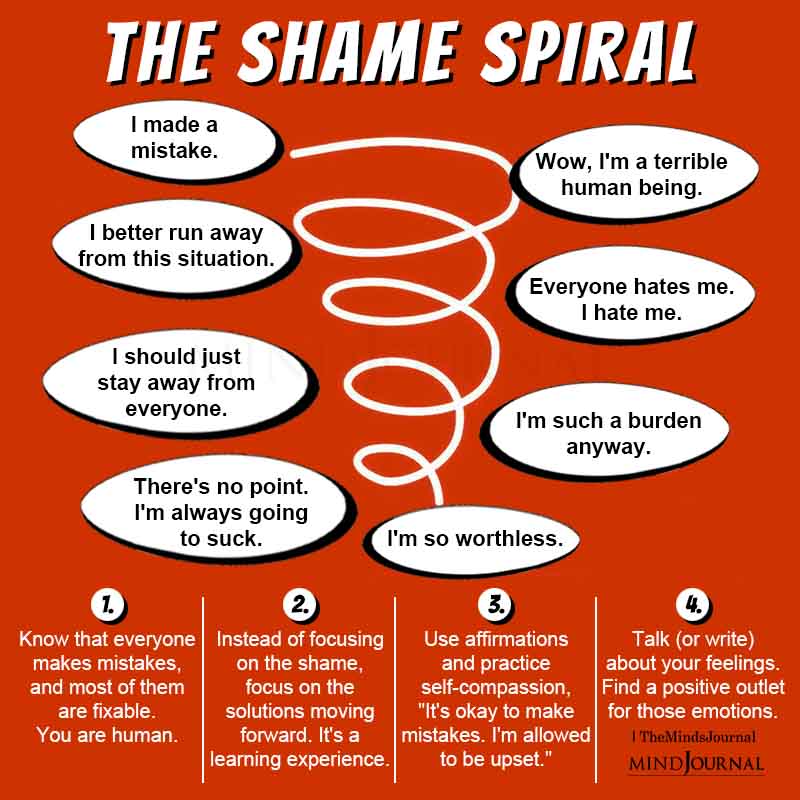
causes of shame

The 5 Causes of Shame

1. Regret

Ashamed, we wish things had gone differently — that we had shut up, spoken up, been smarter, slimmer, stronger, nicer, or just never born. Can I erase the summer of 2007? Or that text?

Related: Healthy Shame And Toxic Shame: How Do We Live With It

2. Guilt

Affecting different brain regions, guilt and shame are considered separate emotions: guilt as a sense of wrongdoing, shame as a sense of being bad — even in ways we can’t control, such as our height. But these two feelings intersect. Guilt causes shame and shame feeds guilt.

3. Self-loathing

Shame is almost synonymous with self-loathing — a crushing, wrenching sense of being unacceptable, unlovable, unfixable, and believing that others must agree. Being ashamed means being painfully embarrassed to exist.

4. Disgust

While shame is said to have evolved in order to maintain social hierarchies, disgust is said to have evolved to help humans avoid disease. But disgust focused on oneself is shame — the kind that drives eating disorders and self-harm.

5. Fear

Ashamed, we fear exposure, accusation, and punishment. Afraid that we cannot erase those deeds or thoughts or qualities that shame us, we exist on quicksand, dreading the one ticking time-bomb we cannot escape: ourselves.

Whenever shame strikes, let us try to stand fast in its blast and trace its source. In whose voices do we hear “Shame on you”? Are they the voices of society or deities or individuals real or imagined — or our own? Might those voices be bigoted, abusive, arbitrary, antiquated, cruel?

Related: What Is Toxic Shame? How It Alters Our Self-Image

Might they not be voices at all but history, collective trauma shouting what we should and should not be?

Want to know more about the causes of shame? Check this video out below!

Check out S. Rufus’s personal website to know more about her and her work.


Written By S.Rufus
Originally Appeared On Psychology Today
Ingredients of Shame pin

Published On:

Last updated on:

S. Rufus

S. Rufus, M.A., is a graduate of the University of California, Berkeley, an award-winning journalist whose work has appeared at Elle, Salon, The Daily Beast, and other venues, and — under the byline Anneli Rufus — the author of twelve books including Unworthy: How to Stop Hating Yourself; Party of One: The Loners’ Manifesto; Weird Europe; and Stuck: Why We Can’t (or Won’t) Move On. Translated into five languages and now in its fourteenth printing, Party of One has been cited as a landmark work on (and for) introverts.

Disclaimer: The informational content on The Minds Journal have been created and reviewed by qualified mental health professionals. They are intended solely for educational and self-awareness purposes and should not be used as a substitute for professional medical advice, diagnosis, or treatment. If you are experiencing emotional distress or have concerns about your mental health, please seek help from a licensed mental health professional or healthcare provider.

Leave a Comment

Today's Horoscope

Weekly Horoscope PART one

Weekly Horoscope 15 March to 21 March 2026

Read your zodiac sign’s prediction to understand the energy surrounding you and how to make the most of the days ahead!

Latest Quizzes

Interesting Finger Personality Test: 4 Finger Lines

Finger Personality Test: Join Your Fingers And Reveal A Hidden Personality Secret!

Look closely at your finger lines. Which pattern do you see? This personality test might surprise you!

Latest Quotes

How Men Show Love Through Actions (Male Psychology in Relationships)

How Men Show Love Through Actions (Male Psychology in Relationships)

Male psychology in relationships shows that men express love through presence, protection, and peace more than poetry. Decode his actions so you can see how deeply he actually cares.

Readers Blog

Caption This Image and Selected Wisepicks – 15 March 2026

Caption This Image and Selected Wisepicks – 15 March 2026

Ready to unleash your inner wordsmith? ✨??☺️ Now’s your chance to show off your wit, charm, or sheer genius in just one line! Whether it’s laugh-out-loud funny or surprisingly deep, we want to hear it.Submit your funniest, wittiest, or most thought-provoking caption in the comments. We’ll pick 15+ winners to be featured on our website…

Latest Articles

All of us experience shame at various points in our lives. But what is a shame, and what are the causes of shame? Shame can be an emotionally crippling thing to experience, especially when you are feeling ashamed of yourself. That’s why it’s important to know the causes of shame or shame triggers so that you can deal with your feelings in a much better manner.

KEY POINTS

  • Guilt is part of the shame profile, but not all of it.
  • Shame maintains moral codes, but morals are highly subjective.
  • Used as a tool to control, contain and train, shame can become toxic and chronic.
  • Shame can freeze us into long-term inaction: Better to do nothing, we think, than risk doing something shameful.

Shame is a raging cold-sweat dread about things we deem vile yet which we have done, said, thought, desired, been, or still are.

Shame is a punch-your-forehead cocktail of emotions that simmers and swells inside of us and refuses to be talked away.

Shame is not bland embarrassment. Shame is not wishing we had ordered soup instead. Shame is not wide-eyed cringe emojis on a screen.

Shame is the freefall-whiplash shock of believing that we have broken rules, caused harm, and/or are unacceptable, deserving punishment.

This punishment might come from others or oneself, and might take its ultimate form: Feelings of shame increase the risk of suicide in some, studies show.

Related: How to Stop Being Controlled by Shame and Judgement

Mainly, shame is fear — of rejection, humiliation, unacceptability, unwantedness, or being bad in a good world.

Charles Darwin studied blushing. Noting that it was caused by states of “self-attention” under the real or imagined gaze of others, he decreed this cutaneous red flag “the most peculiar of all expressions,” which “makes the blusher…suffer and the beholder uncomfortable, without being of the least service to either of them.”

Yet blushing is evolutionary. So is a shame. It has arguably shaped civilizations: Fear of burning in hell for theft lessens theft. Fear of being pinioned in stocks and pelted with spoiled fruit for public drunkenness reduces public drunkenness. But how much is enough? And who decides?

Most of us met shame young, when others used it to control, contain, or train us. They hung shame like twinkly-twirly pendulums over our playpens, beds, and desks, and infused it into basics such as friendship, food, and flesh.

They yelled or whispered “Shame on you,” rescinding our permission to experience anything else.

“Shame on you” converts glee and satisfaction into terror and regret. “Shame on you” makes our every urge aggrieve us. “Shame on you” means: Ha ha, think you can relax? “Shame on you” means: Hate yourself yet?

Ashamed, we isolate — thinking ourselves unqualified for comfort, clemency, or hugs. Too much is happening inside for us to carefully unbind the razorwire netting that is a shame.

But unbind it we must, exploring one by one its toxic threads.

causes of shame

The 5 Causes of Shame

1. Regret

Ashamed, we wish things had gone differently — that we had shut up, spoken up, been smarter, slimmer, stronger, nicer, or just never born. Can I erase the summer of 2007? Or that text?

Related: Healthy Shame And Toxic Shame: How Do We Live With It

2. Guilt

Affecting different brain regions, guilt and shame are considered separate emotions: guilt as a sense of wrongdoing, shame as a sense of being bad — even in ways we can’t control, such as our height. But these two feelings intersect. Guilt causes shame and shame feeds guilt.

3. Self-loathing

Shame is almost synonymous with self-loathing — a crushing, wrenching sense of being unacceptable, unlovable, unfixable, and believing that others must agree. Being ashamed means being painfully embarrassed to exist.

4. Disgust

While shame is said to have evolved in order to maintain social hierarchies, disgust is said to have evolved to help humans avoid disease. But disgust focused on oneself is shame — the kind that drives eating disorders and self-harm.

5. Fear

Ashamed, we fear exposure, accusation, and punishment. Afraid that we cannot erase those deeds or thoughts or qualities that shame us, we exist on quicksand, dreading the one ticking time-bomb we cannot escape: ourselves.

Whenever shame strikes, let us try to stand fast in its blast and trace its source. In whose voices do we hear “Shame on you”? Are they the voices of society or deities or individuals real or imagined — or our own? Might those voices be bigoted, abusive, arbitrary, antiquated, cruel?

Related: What Is Toxic Shame? How It Alters Our Self-Image

Might they not be voices at all but history, collective trauma shouting what we should and should not be?

Want to know more about the causes of shame? Check this video out below!

Check out S. Rufus’s personal website to know more about her and her work.


Written By S.Rufus
Originally Appeared On Psychology Today
Ingredients of Shame pin

Published On:

Last updated on:

S. Rufus

S. Rufus, M.A., is a graduate of the University of California, Berkeley, an award-winning journalist whose work has appeared at Elle, Salon, The Daily Beast, and other venues, and — under the byline Anneli Rufus — the author of twelve books including Unworthy: How to Stop Hating Yourself; Party of One: The Loners’ Manifesto; Weird Europe; and Stuck: Why We Can’t (or Won’t) Move On. Translated into five languages and now in its fourteenth printing, Party of One has been cited as a landmark work on (and for) introverts.

Leave a Comment

    Leave a Comment