The Narcissistic Family Tree: 12 Common Dynamics of a Dysfunctional Family

Author : Karyl Mc Bride PhD, LMFT

People belonging to a narcissistic family tree end up having hugely dysfunctional and traumatic childhoods, which haunts them even when they become adults.

Clinical experience and research show that adult children of narcissists have a difficult time putting their finger on what is wrong because denial is rampant in the narcissistic family system.

โ€œThe typical adult from a narcissistic family is filled with unacknowledged anger, feels like a hollow person, feels inadequate and defective, suffers from periodic anxiety and depression, and has no clue about how he or she got that way.โ€ โ€” Pressman and Pressman, The Narcissistic Family
The narcissistic family tree

It is common for adult children of narcissists to enter treatment with emotional symptoms or relationship issues, but simultaneously display a lack of awareness of the deeper etiology or cause.

The narcissistic family hides profound pain. Such families tend to operate according to an unspoken set of rules. Children learn to live with those rules, but never stop being confused and pained by them, for these rules block their emotional access to their parents.

They basically become invisibleโ€”neither heard, seen, or nurtured. Conversely, and tragically, this set of rules allows the parents to have no boundaries with the children and to use (or abuse) them as they see fit.

The following are some common dynamics of this profoundly dysfunctional intergenerational system. (Keep in mind there are always degrees of dysfunction on a spectrum depending on the level of narcissism in the parents.)

Related: How To Deal With A Dysfunctional Family and Find Your Happiness

12 Common Dynamics Of A Narcissistic Family Tree
narcissistic family tree

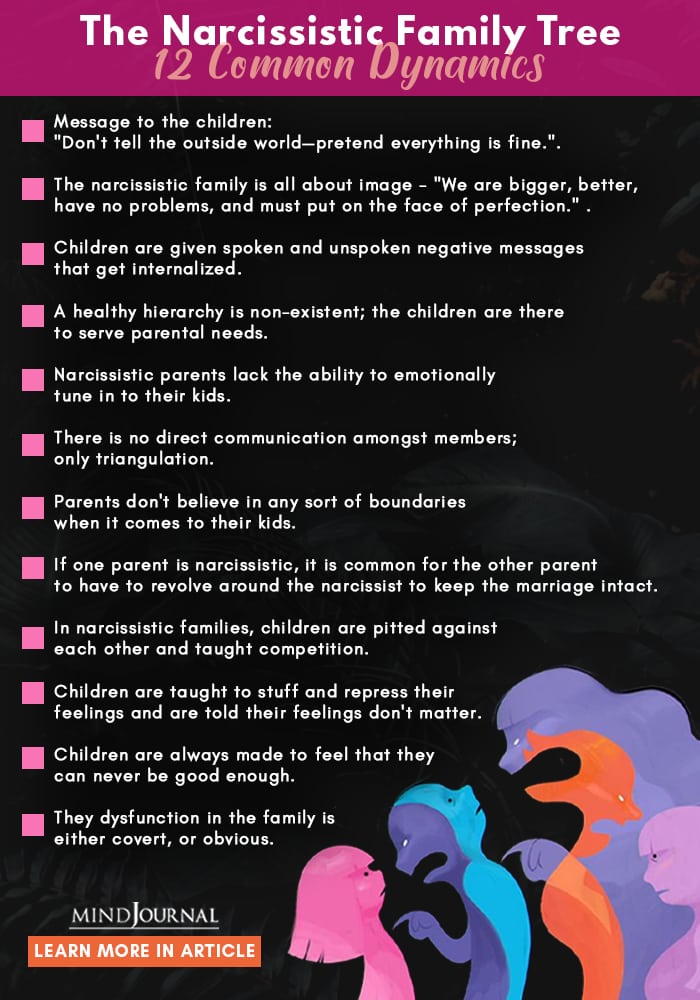
1. Secrets.

The family secret is that the parents are not meeting the childrenโ€™s emotional needs, or that they are abusive in some way. This is the norm in the narcissistic family. The message to the children: โ€œDonโ€™t tell the outside worldโ€”pretend everything is fine.โ€

2. Image.

The narcissistic family is all about image. The message is: โ€œWe are bigger, better, have no problems, and must put on the face of perfection.โ€

Children get the messages: โ€œWhat would the neighbors think?โ€ โ€œWhat would the relatives think?โ€ What would our friends think?โ€ These are common fears in the family: โ€œAlways put a smile on that pretty little face.โ€

Related: How Toxic Family Dynamics Can Cause C-PTSD In Emotionally Intense Children

3. Negative Messages.

Children are given spoken and unspoken messages that get internalized, typically: โ€œYouโ€™re not good enoughโ€; โ€œYou donโ€™t measure upโ€; โ€œYou are valued for what you do rather than for who you are.โ€

4. Lack of Parental Hierarchy.

In healthy families, there is a strong parental hierarchy in which the parents are in charge and shine love, light, guidance, and direction down to the children. In narcissistic families, this hierarchy is non-existent; the children are there to serve parental needs.

5. Lack of Emotional Tune-In.

Narcissistic parents lack the ability to emotionally tune in to their kids. They cannot feel and show empathy or unconditional love. They are typically critical and judgmental.

narcissistic family tree

6. Lack of Effective Communication.

The most common means of communication in narcissistic families is triangulation. Information is not direct. It is told through one party about another in hopes it will get back to the other party.

Family members talk about each other to other members of the family but donโ€™t confront each other directly. This creates passive-aggressive behavior, tension, and mistrust. When communication is direct, it is often in the form of anger or rage.

Related: 11 Ways To Cope With A Toxic And Estranged Family Relationship

7. Unclear Boundaries.

There are few boundaries in the narcissistic family. Childrenโ€™s feelings are not considered important. Private diaries are read, physical boundaries are not kept, and emotional boundaries are not respected. The right to privacy is not typically a part of family history.

8. One Parent Narcissistic, the Other Orbiting.

If one parent is narcissistic, it is common for the other parent to have to revolve around the narcissist to keep the marriage intact.

Often, this other parent has redeeming qualities to offer the children but is tied up meeting the needs of the narcissistic spouse, leaving the childrenโ€™s needs unmet. Who is there for them?

9. Siblings Not Encouraged to Be Close.

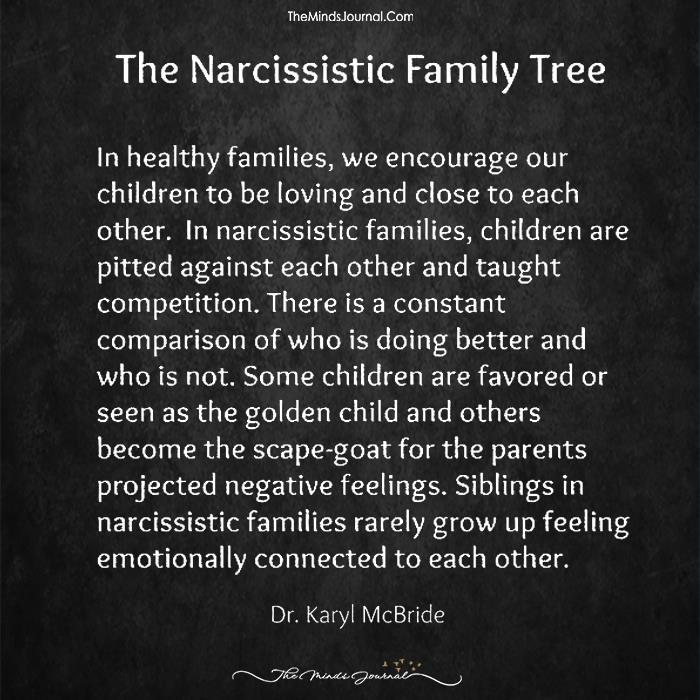
In healthy families, we encourage our children to be loving and close to each other. In narcissistic families, children are pitted against each other and taught competition. There is a constant comparison of who is doing better and who is not.

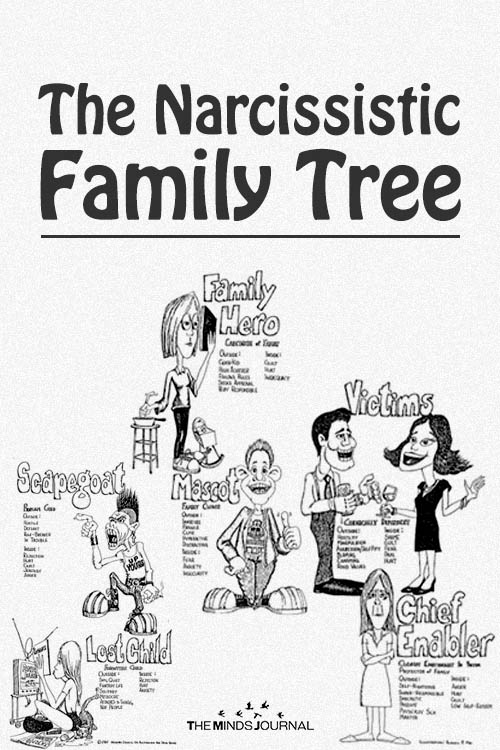
Some are favored or seen as โ€œthe golden child,โ€ and others become the scapegoat for a parentโ€™s projected negative feelings. Siblings in narcissistic families rarely grow up feeling emotionally connected to each other.

narcissistic family tree

10. Feelings.

Feelings are denied and not discussed. Children are not taught to embrace their emotions and process them in realistic ways. They are taught to stuff and repress them and are told their feelings donโ€™t matter.

Narcissistic parents are typically not in touch with their own feelings and therefore project them onto others. This causes a lack of accountability and honesty, not to mention other psychological disorders. If we donโ€™t process feelings, they do leak out in other unhealthy ways.

Related: The Narcissistic Family Roles: The Roles Cast by the Narcissist

11. โ€œNot Good Enoughโ€ Messages.

These messages come across loud and clear in the narcissistic family. Some parents actually speak this message in various ways; others just model it to their children.

Even if they display arrogant and boastful behavior, under the veneer of a narcissist is a self-loathing psycheโ€”that gets passed to the child.

12. Dysfunctionโ€”Obvious or Covert.

In narcissist families, the dynamics can be seen or disguised. The dysfunction displayed in violent and abusive homes is usually obvious, but emotional and psychological abuse, as well as neglectful parenting, are often hidden. While the drama is not displayed as openly to the outside world, it is just as, if not, more damaging to the children.

Reviewing these dynamics, one can see how this kind of family can look pretty but be decaying at the same time. If you recognize your family in this description, know that there is hope and recovery. We canโ€™t change the past, but we can take control of the now. We do not have to be defined by the wounds in our family systems.

As Mark Twain defines the optimist, I see the recovering adult child: โ€œA person who travels on nothing from nowhere to happiness.โ€

We can create a new life that will flow through us to the future and stop the legacy of distorted love learned in the narcissistic family. If we choose recovery, we can defy intergenerational statistics.

We Can!

Want to know more about the narcissistic family tree and narcissistic family dynamics? Check this video out below!


Written By Dr. Karyl McBride, Ph.D., L.M.F.T.
Originally appeared on Psychology Today
Printed with Permission from the author
The Narcissistic Family Tree
The Narcissistic Family Tree Pin
The Narcissistic Family Tree pin

Published On:

Last updated on:

Karyl Mc Bride PhD, LMFT

Karyl McBride, PhD, LMFT Author of: Will I Ever Be Good Enough? Healing the Daughters of Narcissistic Mothers and Will I Ever Be Free of You? How to Navigate a High-Conflict Divorce from a Narcissist and Heal Your Family. Karyl McBride, Ph.D., L.M.F.T., is a licensed Marriage and Family Therapist in Denver, Colorado with over 28 years in public and private practice. She specializes in treating clients with dysfunctional family issues. For the past seventeen years, Dr. McBride has been involved in private research concerning children of narcissistic parents, with a primary focus on women raised by narcissistic mothers. She has treated many daughters of narcissistic mothers in her private practice.Dr. McBride also has extensive clinical experience in the fields of trauma, abuse, domestic violence, divorce and step family therapy, marital and family therapy, specialized trauma treatment in Eye Movement Desensitization Reprocessing (EMDR), and individual adjustment issues related to anxiety, depression, and life transitions. Surveys โ€œ50 Ways to tell if you are in a Relationship with a Narcissistโ€ Survey: โ€œDo You Have a Narcissistic Parent?โ€ Survey: โ€œIs this your Mom?โ€ Survey:

Disclaimer: The informational content on The Minds Journal have been created and reviewed by qualified mental health professionals. They are intended solely for educational and self-awareness purposes and should not be used as a substitute for professional medical advice, diagnosis, or treatment. If you are experiencing emotional distress or have concerns about your mental health, please seek help from a licensed mental health professional or healthcare provider.

Leave a Comment

Today's Horoscope

Weekly Horoscope 21 March to 28 March 2026

Weekly Horoscope 21 March to 28 March 2026

Ready to see what this week will bring for your zodiac sign? Check out your weekly horoscope below!

Latest Quizzes

Free Vase Personality Test: 3 Options; Choose A Vase

Vase Personality Test: Your First Pick Reveals Your Main Character Trait

Take a moment, look closely, and pick an object that represents you.

Latest Quotes

Weโ€™re Not Antisocial: Weโ€™re Craving True Belonging, Not Shallow Interactions

Weโ€™re Not Antisocial: Weโ€™re Craving True Belonging, Not Shallow Interactions

Weโ€™re not antisocial; weโ€™re just tired of shallow interactions. When youโ€™re craving belonging, small talk feels empty, and your mind longs for deeper, authentic connection that truly sees you.

Readers Blog

Caption This Image and Selected Wisepicks โ€“ 22 March 2026

Caption This Image and Selected Wisepicks โ€“ 22 March 2026

Ready to unleash your inner wordsmith? โœจ??โ˜บ๏ธ Nowโ€™s your chance to show off your wit, charm, or sheer genius in just one line! Whether itโ€™s laugh-out-loud funny or surprisingly deep, we want to hear it.Submit your funniest, wittiest, or most thought-provoking caption in the comments. Weโ€™ll pick 15+ winners to be featured on our website…

Latest Articles

People belonging to a narcissistic family tree end up having hugely dysfunctional and traumatic childhoods, which haunts them even when they become adults.

Clinical experience and research show that adult children of narcissists have a difficult time putting their finger on what is wrong because denial is rampant in the narcissistic family system.

โ€œThe typical adult from a narcissistic family is filled with unacknowledged anger, feels like a hollow person, feels inadequate and defective, suffers from periodic anxiety and depression, and has no clue about how he or she got that way.โ€ โ€” Pressman and Pressman, The Narcissistic Family

The narcissistic family tree

It is common for adult children of narcissists to enter treatment with emotional symptoms or relationship issues, but simultaneously display a lack of awareness of the deeper etiology or cause.

The narcissistic family hides profound pain. Such families tend to operate according to an unspoken set of rules. Children learn to live with those rules, but never stop being confused and pained by them, for these rules block their emotional access to their parents.

They basically become invisibleโ€”neither heard, seen, or nurtured. Conversely, and tragically, this set of rules allows the parents to have no boundaries with the children and to use (or abuse) them as they see fit.

The following are some common dynamics of this profoundly dysfunctional intergenerational system. (Keep in mind there are always degrees of dysfunction on a spectrum depending on the level of narcissism in the parents.)

Related: How To Deal With A Dysfunctional Family and Find Your Happiness

12 Common Dynamics Of A Narcissistic Family Tree

narcissistic family tree

1. Secrets.

The family secret is that the parents are not meeting the childrenโ€™s emotional needs, or that they are abusive in some way. This is the norm in the narcissistic family. The message to the children: โ€œDonโ€™t tell the outside worldโ€”pretend everything is fine.โ€

2. Image.

The narcissistic family is all about image. The message is: โ€œWe are bigger, better, have no problems, and must put on the face of perfection.โ€

Children get the messages: โ€œWhat would the neighbors think?โ€ โ€œWhat would the relatives think?โ€ What would our friends think?โ€ These are common fears in the family: โ€œAlways put a smile on that pretty little face.โ€

Related: How Toxic Family Dynamics Can Cause C-PTSD In Emotionally Intense Children

3. Negative Messages.

Children are given spoken and unspoken messages that get internalized, typically: โ€œYouโ€™re not good enoughโ€; โ€œYou donโ€™t measure upโ€; โ€œYou are valued for what you do rather than for who you are.โ€

4. Lack of Parental Hierarchy.

In healthy families, there is a strong parental hierarchy in which the parents are in charge and shine love, light, guidance, and direction down to the children. In narcissistic families, this hierarchy is non-existent; the children are there to serve parental needs.

5. Lack of Emotional Tune-In.

Narcissistic parents lack the ability to emotionally tune in to their kids. They cannot feel and show empathy or unconditional love. They are typically critical and judgmental.

narcissistic family tree

6. Lack of Effective Communication.

The most common means of communication in narcissistic families is triangulation. Information is not direct. It is told through one party about another in hopes it will get back to the other party.

Family members talk about each other to other members of the family but donโ€™t confront each other directly. This creates passive-aggressive behavior, tension, and mistrust. When communication is direct, it is often in the form of anger or rage.

Related: 11 Ways To Cope With A Toxic And Estranged Family Relationship

7. Unclear Boundaries.

There are few boundaries in the narcissistic family. Childrenโ€™s feelings are not considered important. Private diaries are read, physical boundaries are not kept, and emotional boundaries are not respected. The right to privacy is not typically a part of family history.

8. One Parent Narcissistic, the Other Orbiting.

If one parent is narcissistic, it is common for the other parent to have to revolve around the narcissist to keep the marriage intact.

Often, this other parent has redeeming qualities to offer the children but is tied up meeting the needs of the narcissistic spouse, leaving the childrenโ€™s needs unmet. Who is there for them?

9. Siblings Not Encouraged to Be Close.

In healthy families, we encourage our children to be loving and close to each other. In narcissistic families, children are pitted against each other and taught competition. There is a constant comparison of who is doing better and who is not.

Some are favored or seen as โ€œthe golden child,โ€ and others become the scapegoat for a parentโ€™s projected negative feelings. Siblings in narcissistic families rarely grow up feeling emotionally connected to each other.

narcissistic family tree

10. Feelings.

Feelings are denied and not discussed. Children are not taught to embrace their emotions and process them in realistic ways. They are taught to stuff and repress them and are told their feelings donโ€™t matter.

Narcissistic parents are typically not in touch with their own feelings and therefore project them onto others. This causes a lack of accountability and honesty, not to mention other psychological disorders. If we donโ€™t process feelings, they do leak out in other unhealthy ways.

Related: The Narcissistic Family Roles: The Roles Cast by the Narcissist

11. โ€œNot Good Enoughโ€ Messages.

These messages come across loud and clear in the narcissistic family. Some parents actually speak this message in various ways; others just model it to their children.

Even if they display arrogant and boastful behavior, under the veneer of a narcissist is a self-loathing psycheโ€”that gets passed to the child.

12. Dysfunctionโ€”Obvious or Covert.

In narcissist families, the dynamics can be seen or disguised. The dysfunction displayed in violent and abusive homes is usually obvious, but emotional and psychological abuse, as well as neglectful parenting, are often hidden. While the drama is not displayed as openly to the outside world, it is just as, if not, more damaging to the children.

Reviewing these dynamics, one can see how this kind of family can look pretty but be decaying at the same time. If you recognize your family in this description, know that there is hope and recovery. We canโ€™t change the past, but we can take control of the now. We do not have to be defined by the wounds in our family systems.

As Mark Twain defines the optimist, I see the recovering adult child: โ€œA person who travels on nothing from nowhere to happiness.โ€

We can create a new life that will flow through us to the future and stop the legacy of distorted love learned in the narcissistic family. If we choose recovery, we can defy intergenerational statistics.

We Can!

Want to know more about the narcissistic family tree and narcissistic family dynamics? Check this video out below!


Written By Dr. Karyl McBride, Ph.D., L.M.F.T.
Originally appeared on Psychology Today
Printed with Permission from the author
The Narcissistic Family Tree
The Narcissistic Family Tree Pin
The Narcissistic Family Tree pin

Published On:

Last updated on:

Karyl Mc Bride PhD, LMFT

Karyl McBride, PhD, LMFT Author of: Will I Ever Be Good Enough? Healing the Daughters of Narcissistic Mothers and Will I Ever Be Free of You? How to Navigate a High-Conflict Divorce from a Narcissist and Heal Your Family. Karyl McBride, Ph.D., L.M.F.T., is a licensed Marriage and Family Therapist in Denver, Colorado with over 28 years in public and private practice. She specializes in treating clients with dysfunctional family issues. For the past seventeen years, Dr. McBride has been involved in private research concerning children of narcissistic parents, with a primary focus on women raised by narcissistic mothers. She has treated many daughters of narcissistic mothers in her private practice.Dr. McBride also has extensive clinical experience in the fields of trauma, abuse, domestic violence, divorce and step family therapy, marital and family therapy, specialized trauma treatment in Eye Movement Desensitization Reprocessing (EMDR), and individual adjustment issues related to anxiety, depression, and life transitions. Surveys โ€œ50 Ways to tell if you are in a Relationship with a Narcissistโ€ Survey: โ€œDo You Have a Narcissistic Parent?โ€ Survey: โ€œIs this your Mom?โ€ Survey:

Leave a Comment

    Leave a Comment