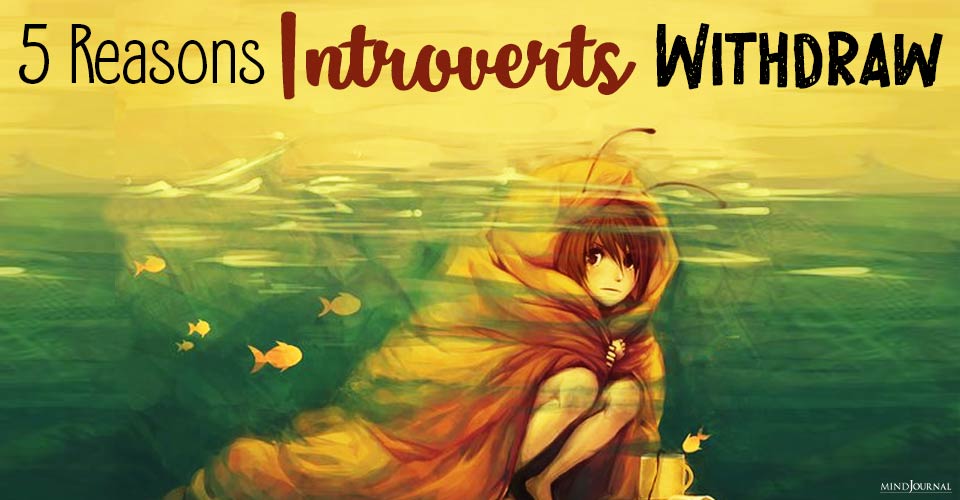
Introverts and Withdrawal: 5 Reasons Introverts Withdraw

Author : Brenda Knowles

When things become too much, and the world gets chaotic, introverts withdraw into their own personal bubble to get away from all of it and their need for space is what makes them function.

Last week, I had an overwhelming desire to withdraw from everything. Like the mustard-hued sludge the EPA workers inadvertently released down the Colorado River, my emotions colored and flooded my mind. My motherโ€™s recent death; the humbling number of edits necessary to make my manuscript work and the start of the back-to-school shuffle, all put me in a draining state of high alert.

Non-stop action and endless decision-making wore me out. I needed positive energy inflow and a stoppage of outflow.

I needed to slow down. I needed to read. I needed to rest.

Like the early spring plants, fiddlehead ferns, I needed to curl up tightly before I could unfurl into the lacy frond capable of freely greeting the world.

This is not the first time Iโ€™ve had a deep need to retreat.

At the end of my marriage, I withdrew. I withdrew from my husband and even from my children. The tension and internal conflict I felt in my husbandโ€™s presence were almost unbearable. I physically withdrew by hiding out in my home office or by spending extra time at the gym, but withdrawal does not require you to leave the room.

One of the hardest things I ever endured hearing was a stranger telling me that my kids said, Mom is there but not really there. Meaning, I was physically present but not really tuned in to them. Ouch. I hadnโ€™t realized how detached I had become.

Related: 20+ Things That Make An Introvert Feel Stressed and How To Deal

5 Reasons Why Introverts Withdraw

1. An introvertโ€™s first home is within.

According to the authors (Intimacy and Type) and marriage therapists, Jane Hardy Jones and Ruth G. Sherman, introverts are always receiving and processing information from two sources: their inner world and the outer world.

Hence, the predisposition to become overstimulated easily. Our best abilities (thinking or feeling or sensing or intuiting) are aimed at our inner worlds.

Engaging and negotiating with the outside world with our second-best functions is daunting and draining. We need to be alone in order to eliminate stimulation, the process for clarity, and replenish our energy.

Introverts withdraw

2. We need a safe space in order to engage.

The less safe and more vulnerable an introvert feels, the less they tend to share. We need to feel especially secure and confident before revealing our personal thoughts.

Critical and judgmental people will push us further into ourselves. It is extremely difficult to be around people who cause us inner conflict.

If we dislike or often disagree with someone but have to pretend we donโ€™t (think co-worker or family member), this will cause dire fatigue for the introvert. So much so, that we will want to escape from the place and person involved.

โ€œWe ourselves are the substance we withdraw to, not from, as we pull our overextended and misplaced creative energy back into our own core.โ€ โ€”Julia Cameron

3. Our creative energy exists inside us.

Introverts thrive on stillness. Within stillness, ideas bubble up and our inner voice whispers vital messages we can hear. These vital messages need expression. They are the basis of our creativity. 

Withdrawal leads to self-awareness and ultimately our creativity.

Related: 13 Extraordinary Things Introverts Love To Do In Their Leisure Time

4. We have to clear emotions.

Emotions can get the best of a sensitive introvert. They swell and flood our brains. Added stress or stimulation only prolongs the emotional overwhelm. Processing and alone time is crucial to recovery and relief from the flood.

We get ourselves together by moving away from the genesis of the emotional tidal wave. Solid sleep goes a long way towards relieving emotional exhaustion as well.

5. We are navigating change or the unknown.

If there is a lot of change going on in our lives, we may hole up for a while in order to sort through what is going on and prepare ourselves for new situations. Introverts like to be prepared.

Prior knowledge soothes our sensitive systems. We require space to mentally work through the process of meeting new people, navigating unfamiliar places, and surviving different experiences.

At first, new situations will feel overwhelming, possibly driving us underground to recharge and sift through all the foreign material filling our minds.

But, as Emily White says in her article on QuietRev.com titled, Leave Your House, Change Your Life, newness is only overwhelming in the beginning. After a couple of sessions with a new situation, you will have information to draw from and a much better idea of what to expect.
Introverts withdraw

Itโ€™s a challenge to retreat

As many of us already know, it is difficult to ask for and obtain time to re-charge. Almost everyone in your immediate circle will ask and expect you to keep on plugging on. Theyโ€™ll expect you to get over whatever is bothering you and be there for them with a smile.

The message being that self-care is selfish. The message being that work and others are always first. Introverts spend a fair amount of time feeling bad for needing a break.

Although I didnโ€™t get a real break last week, I did spend quality time with generous, positive, and inspiring friends this week. The emotional flooding is beginning to subside.

I know there will be more healing space in the near future.

Related: 7 Things All Quiet People Will Understand

What needs to happen after the withdrawal?

I felt extra sensitive and tired last week. I was burned out when my marriage ended. Both times I wanted to fill myself up with swaths of uninterrupted time, positive support, meaningful work, and expansive ideas. While itโ€™s vital to take time for self-care, eventually space needs to lead to action.

What makes you want to withdraw? How does your need for space affect those you love? What gets you out of this mode?

If this post spoke to you in a meaningful way, please pass it on.

Thank you,
Brenda

Brenda Knowles is a personal coach who helps introverts gain the confidence to be their true selves and enhance intimacy and understanding in their relationships. Learn more at BrendaKnowles.com.


Written by Brenda Knowles
This article has been republished from Brendaknowles.com, click here to view the original copy.

Published On:

Last updated on:

Brenda Knowles

Creator of space2live and brendaknowles.com. Introvert and highly sensitive person champion. Individual and relationship coach. Myers Briggs Practitioner. Lover of books, music and butterscotch.

Disclaimer: The informational content on The Minds Journal have been created and reviewed by qualified mental health professionals. They are intended solely for educational and self-awareness purposes and should not be used as a substitute for professional medical advice, diagnosis, or treatment. If you are experiencing emotional distress or have concerns about your mental health, please seek help from a licensed mental health professional or healthcare provider.

Leave a Comment

Today's Horoscope

Your Daily Horoscope For 2 April, 2026: Free Predictions

Daily Horoscope 2 April, 2026: Prediction For Each Zodiac Sign

Don't think of this free horoscope like a rulebook, but more like a roadmap. Use it to understand your energy today and move forward with purpose!

Latest Quizzes

What Kind Of Karma Do You Have? 3 Markings Reveal Truths

3 Types of Karma Exist โ€” Which One Were You Born With? Look for These Palm Signs

Spot an M, Y, or X on your palm? This hidden sign reveals your karma type!

Latest Quotes

When Hard Choices Hurt: Healing After You Choose Yourself

When Hard Choices Hurt: Healing After You Choose Yourself

Healing after difficult decisions often comes with sadness, guilt, and doubtโ€”yet that doesnโ€™t mean you chose wrong. Discover how self-compassion and choosing yourself can turn painful endings into growth.

Readers Blog

Caption This Image and Selected Wisepicks โ€“ 29 March 2026

Caption This Image and Selected Wisepicks โ€“ 29 March 2026

Ready to unleash your inner wordsmith? โœจ??โ˜บ๏ธ Nowโ€™s your chance to show off your wit, charm, or sheer genius in just one line! Whether itโ€™s laugh-out-loud funny or surprisingly deep, we want to hear it.Submit your funniest, wittiest, or most thought-provoking caption in the comments. Weโ€™ll pick 15+ winners to be featured on our website…

Latest Articles

When things become too much, and the world gets chaotic, introverts withdraw into their own personal bubble to get away from all of it and their need for space is what makes them function.

Last week, I had an overwhelming desire to withdraw from everything. Like the mustard-hued sludge the EPA workers inadvertently released down the Colorado River, my emotions colored and flooded my mind. My motherโ€™s recent death; the humbling number of edits necessary to make my manuscript work and the start of the back-to-school shuffle, all put me in a draining state of high alert.

Non-stop action and endless decision-making wore me out. I needed positive energy inflow and a stoppage of outflow.

I needed to slow down. I needed to read. I needed to rest.

Like the early spring plants, fiddlehead ferns, I needed to curl up tightly before I could unfurl into the lacy frond capable of freely greeting the world.

This is not the first time Iโ€™ve had a deep need to retreat.

At the end of my marriage, I withdrew. I withdrew from my husband and even from my children. The tension and internal conflict I felt in my husbandโ€™s presence were almost unbearable. I physically withdrew by hiding out in my home office or by spending extra time at the gym, but withdrawal does not require you to leave the room.

One of the hardest things I ever endured hearing was a stranger telling me that my kids said, Mom is there but not really there. Meaning, I was physically present but not really tuned in to them. Ouch. I hadnโ€™t realized how detached I had become.

Related: 20+ Things That Make An Introvert Feel Stressed and How To Deal

5 Reasons Why Introverts Withdraw

1. An introvertโ€™s first home is within.

According to the authors (Intimacy and Type) and marriage therapists, Jane Hardy Jones and Ruth G. Sherman, introverts are always receiving and processing information from two sources: their inner world and the outer world.

Hence, the predisposition to become overstimulated easily. Our best abilities (thinking or feeling or sensing or intuiting) are aimed at our inner worlds.

Engaging and negotiating with the outside world with our second-best functions is daunting and draining. We need to be alone in order to eliminate stimulation, the process for clarity, and replenish our energy.

Introverts withdraw

2. We need a safe space in order to engage.

The less safe and more vulnerable an introvert feels, the less they tend to share. We need to feel especially secure and confident before revealing our personal thoughts.

Critical and judgmental people will push us further into ourselves. It is extremely difficult to be around people who cause us inner conflict.

If we dislike or often disagree with someone but have to pretend we donโ€™t (think co-worker or family member), this will cause dire fatigue for the introvert. So much so, that we will want to escape from the place and person involved.

โ€œWe ourselves are the substance we withdraw to, not from, as we pull our overextended and misplaced creative energy back into our own core.โ€ โ€”Julia Cameron

3. Our creative energy exists inside us.

Introverts thrive on stillness. Within stillness, ideas bubble up and our inner voice whispers vital messages we can hear. These vital messages need expression. They are the basis of our creativity. 

Withdrawal leads to self-awareness and ultimately our creativity.

Related: 13 Extraordinary Things Introverts Love To Do In Their Leisure Time

4. We have to clear emotions.

Emotions can get the best of a sensitive introvert. They swell and flood our brains. Added stress or stimulation only prolongs the emotional overwhelm. Processing and alone time is crucial to recovery and relief from the flood.

We get ourselves together by moving away from the genesis of the emotional tidal wave. Solid sleep goes a long way towards relieving emotional exhaustion as well.

5. We are navigating change or the unknown.

If there is a lot of change going on in our lives, we may hole up for a while in order to sort through what is going on and prepare ourselves for new situations. Introverts like to be prepared.

Prior knowledge soothes our sensitive systems. We require space to mentally work through the process of meeting new people, navigating unfamiliar places, and surviving different experiences.

At first, new situations will feel overwhelming, possibly driving us underground to recharge and sift through all the foreign material filling our minds.

But, as Emily White says in her article on QuietRev.com titled, Leave Your House, Change Your Life, newness is only overwhelming in the beginning. After a couple of sessions with a new situation, you will have information to draw from and a much better idea of what to expect.

Introverts withdraw

Itโ€™s a challenge to retreat

As many of us already know, it is difficult to ask for and obtain time to re-charge. Almost everyone in your immediate circle will ask and expect you to keep on plugging on. Theyโ€™ll expect you to get over whatever is bothering you and be there for them with a smile.

The message being that self-care is selfish. The message being that work and others are always first. Introverts spend a fair amount of time feeling bad for needing a break.

Although I didnโ€™t get a real break last week, I did spend quality time with generous, positive, and inspiring friends this week. The emotional flooding is beginning to subside.

I know there will be more healing space in the near future.

Related: 7 Things All Quiet People Will Understand

What needs to happen after the withdrawal?

I felt extra sensitive and tired last week. I was burned out when my marriage ended. Both times I wanted to fill myself up with swaths of uninterrupted time, positive support, meaningful work, and expansive ideas. While itโ€™s vital to take time for self-care, eventually space needs to lead to action.

What makes you want to withdraw? How does your need for space affect those you love? What gets you out of this mode?

If this post spoke to you in a meaningful way, please pass it on.

Thank you,
Brenda

Brenda Knowles is a personal coach who helps introverts gain the confidence to be their true selves and enhance intimacy and understanding in their relationships. Learn more at BrendaKnowles.com.


Written by Brenda Knowles
This article has been republished from Brendaknowles.com, click here to view the original copy.

Published On:

Last updated on:

Brenda Knowles

Creator of space2live and brendaknowles.com. Introvert and highly sensitive person champion. Individual and relationship coach. Myers Briggs Practitioner. Lover of books, music and butterscotch.

Leave a Comment

    Leave a Comment