Things You Should Not Share With Your Kids: Healthy Parenting Boundaries

Author : Rebecca Baker

Things You Should Not Share With Your Kids: Healthy Parenting Boundaries

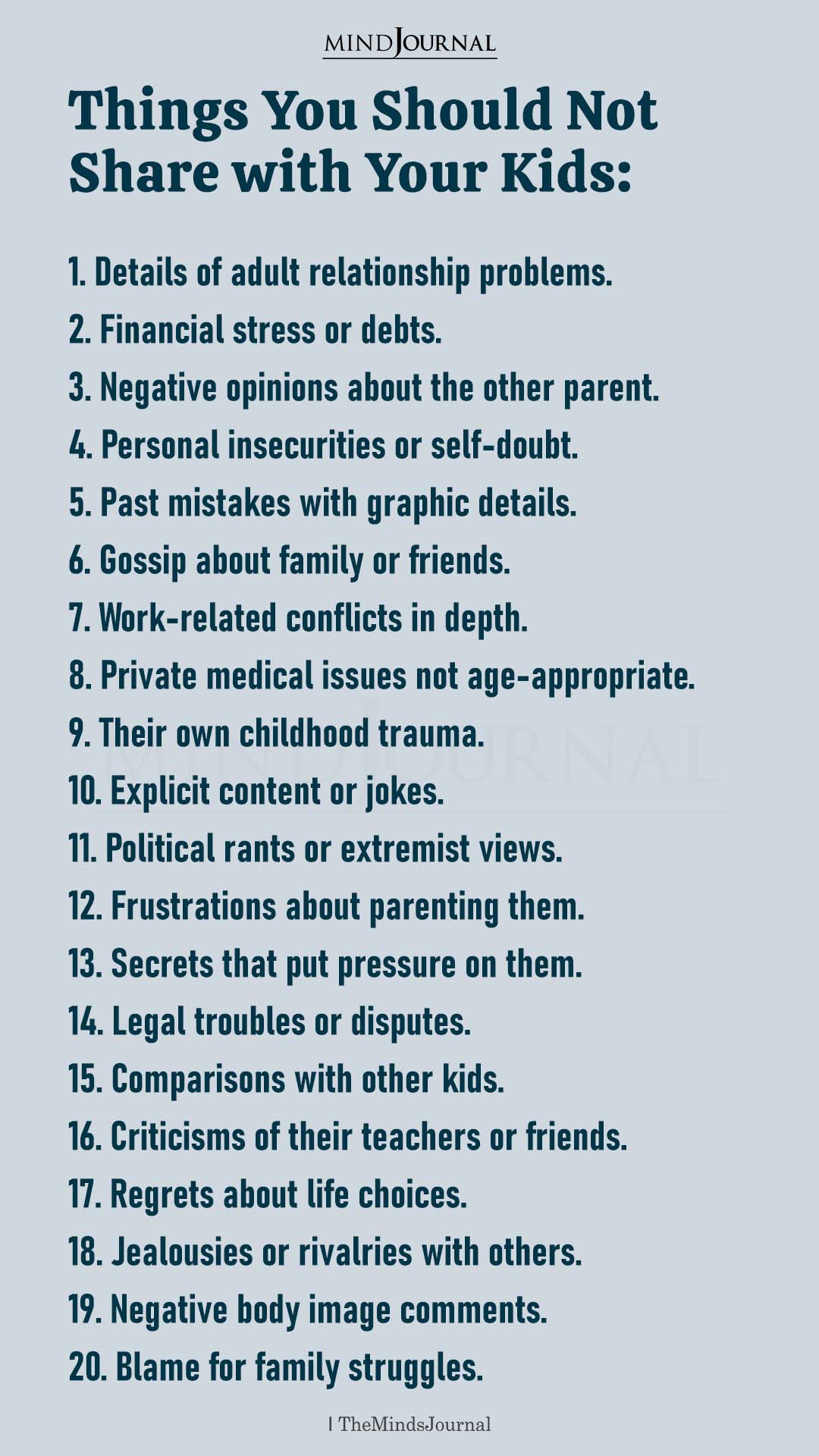
Things You Should Not Share with Your Kids:

  1. Details of adult relationship problems.
  2. Financial stress or debts.
  3. Negative opinions about the other parent.
  4. Personal insecurities or self-doubt.
  5. Past mistakes with graphic details.
  6. Gossip about family or friends.
  7. Work-related conflicts in depth.
  8. Private medical issues not age-appropriate.
  9. Their own childhood trauma.
  10. Explicit content or jokes.
  11. Political rants or extremist views.
  12. Frustrations about parenting them.
  13. Secrets that put pressure on them.
  14. Legal troubles or disputes.
  15. Comparisons with other kids.
  16. Criticisms of their teachers or friends.
  17. Regrets about life choices.
  18. Jealousies or rivalries with others.
  19. Negative body image comments.
  20. Blame for family struggles.

Things You Should Not Share with Your Kids in Daily Life

There are many things you should not share with your kids, even when you feel overwhelmed and just want to vent. Children are not emotionally equipped to carry adult burdens, and oversharing can make them anxious, guilty, or responsible for problems they did not create. Healthy parenting boundaries mean protecting their emotional safety while still being honest in an age-appropriate way.โ€‹

Here are 20 things you should not share with your kids:

  1. Details of adult relationship problems.
  2. Financial stress or debts.
  3. Negative opinions about the other parent.
  4. Personal insecurities or self-doubt.
  5. Past mistakes with graphic details.
  6. Gossip about family or friends.
  7. Work-related conflicts in depth.
  8. Private medical issues not age-appropriate.
  9. Your own unresolved childhood trauma.
  10. Explicit content or jokes.
  11. Political rants or extremist views.
  12. Frustrations about parenting them.
  13. Secrets that put pressure on them.
  14. Legal troubles or disputes.
  15. Comparisons with other kids.
  16. Criticisms of their teachers or friends.
  17. Regrets about life choices.
  18. Jealousies or rivalries with others.
  19. Negative body image comments.
  20. Blame for family struggles.โ€‹

When parents share negative information about the other parent, financial stress, or adult conflict, children can feel caught in the middle, distressed, and responsible for choosing sides. Research shows that inappropriate disclosures within families are linked to psychological distress, physical symptoms, and a sense of being โ€œbetweenโ€ parents or adults. This is why limiting disclosure of sensitive topics is a core part of protecting childrenโ€™s wellbeing.โ€‹

Things you should not share with your kids also include oversharing onlineโ€”constantly posting about their struggles, private moments, or family issues without their consent. โ€œSharentingโ€ and digital oversharing can harm a childโ€™s privacy, emotional development, and sense of safety in ways that might not be obvious at first. Children need room to grow without feeling like their life is content.

Instead of unloading adult stress onto kids, seek support from other adults, therapists, or trusted friends. With children, focus on reassurance, stability, and age-appropriate honesty. They donโ€™t need every detail of whatโ€™s wrong; they need to know they are loved, not at fault, and safe.

Read More:ย 7 Phrases That Hurt Kids More Than Parents Realizeโ€‹

Studies highlight that when parents avoid inappropriate disclosures and maintain clear boundaries, children show better emotional adjustment, feel less guilt, and are less likely to experience long-term anxiety or distress. Setting limits on things you should not share with your kids is not secrecyโ€”it is protection, and a vital part of healthy parenting boundaries.

Published On:

Last updated on:

Disclaimer: The informational content on The Minds Journal have been created and reviewed by qualified mental health professionals. They are intended solely for educational and self-awareness purposes and should not be used as a substitute for professional medical advice, diagnosis, or treatment. If you are experiencing emotional distress or have concerns about your mental health, please seek help from a licensed mental health professional or healthcare provider.

Leave a Comment

Today's Horoscope

Daily Horoscope 28 April, 2026

Daily Horoscope 28 April, 2026: Prediction For Each Zodiac Sign

Let's find out what 28th April has in store for your zodiac!

Latest Quizzes

What Is My Core Wound Quiz? 10 Signs That Expose It!

What You Notice First in Someone Isnโ€™t Randomโ€”Take This Quiz to Reveal Your Core Wound

What you notice first in others may quietly mirror your own needs that go unseen and unmet. Take this simple quiz to help you uncover the core wounds hidden beneath that actually shape you.

Latest Quotes

Human Psychology Facts: How These Cognitive Biases Quietly Shape Your Life

Human Psychology Facts: How These Cognitive Biases Quietly Shape Your Life

Human psychology facts show how your brain quietly edits reality. From the Pratfall Effect to the Halo Effect, these cognitive biases influence who you like, what you notice, and how confident you feel.

Readers Blog

Caption This Image and Selected Wisepicks โ€“ 26 April 2026

Caption This Image and Selected Wisepicks โ€“ 26 April 2026

Ready to unleash your inner wordsmith? โœจ??โ˜บ๏ธ Nowโ€™s your chance to show off your wit, charm, or sheer genius in just one line! Whether itโ€™s laugh-out-loud funny or surprisingly deep, we want to hear it.Submit your funniest, wittiest, or most thought-provoking caption in the comments. Weโ€™ll pick 15+ winners to be featured on our website…

Latest Articles

Things You Should Not Share With Your Kids: Healthy Parenting Boundaries

Things You Should Not Share with Your Kids:

  1. Details of adult relationship problems.
  2. Financial stress or debts.
  3. Negative opinions about the other parent.
  4. Personal insecurities or self-doubt.
  5. Past mistakes with graphic details.
  6. Gossip about family or friends.
  7. Work-related conflicts in depth.
  8. Private medical issues not age-appropriate.
  9. Their own childhood trauma.
  10. Explicit content or jokes.
  11. Political rants or extremist views.
  12. Frustrations about parenting them.
  13. Secrets that put pressure on them.
  14. Legal troubles or disputes.
  15. Comparisons with other kids.
  16. Criticisms of their teachers or friends.
  17. Regrets about life choices.
  18. Jealousies or rivalries with others.
  19. Negative body image comments.
  20. Blame for family struggles.

Things You Should Not Share with Your Kids in Daily Life

There are many things you should not share with your kids, even when you feel overwhelmed and just want to vent. Children are not emotionally equipped to carry adult burdens, and oversharing can make them anxious, guilty, or responsible for problems they did not create. Healthy parenting boundaries mean protecting their emotional safety while still being honest in an age-appropriate way.โ€‹

Here are 20 things you should not share with your kids:

  1. Details of adult relationship problems.
  2. Financial stress or debts.
  3. Negative opinions about the other parent.
  4. Personal insecurities or self-doubt.
  5. Past mistakes with graphic details.
  6. Gossip about family or friends.
  7. Work-related conflicts in depth.
  8. Private medical issues not age-appropriate.
  9. Your own unresolved childhood trauma.
  10. Explicit content or jokes.
  11. Political rants or extremist views.
  12. Frustrations about parenting them.
  13. Secrets that put pressure on them.
  14. Legal troubles or disputes.
  15. Comparisons with other kids.
  16. Criticisms of their teachers or friends.
  17. Regrets about life choices.
  18. Jealousies or rivalries with others.
  19. Negative body image comments.
  20. Blame for family struggles.โ€‹

When parents share negative information about the other parent, financial stress, or adult conflict, children can feel caught in the middle, distressed, and responsible for choosing sides. Research shows that inappropriate disclosures within families are linked to psychological distress, physical symptoms, and a sense of being โ€œbetweenโ€ parents or adults. This is why limiting disclosure of sensitive topics is a core part of protecting childrenโ€™s wellbeing.โ€‹

Things you should not share with your kids also include oversharing onlineโ€”constantly posting about their struggles, private moments, or family issues without their consent. โ€œSharentingโ€ and digital oversharing can harm a childโ€™s privacy, emotional development, and sense of safety in ways that might not be obvious at first. Children need room to grow without feeling like their life is content.

Instead of unloading adult stress onto kids, seek support from other adults, therapists, or trusted friends. With children, focus on reassurance, stability, and age-appropriate honesty. They donโ€™t need every detail of whatโ€™s wrong; they need to know they are loved, not at fault, and safe.

Read More:ย 7 Phrases That Hurt Kids More Than Parents Realizeโ€‹

Studies highlight that when parents avoid inappropriate disclosures and maintain clear boundaries, children show better emotional adjustment, feel less guilt, and are less likely to experience long-term anxiety or distress. Setting limits on things you should not share with your kids is not secrecyโ€”it is protection, and a vital part of healthy parenting boundaries.

Published On:

Last updated on:

Rebecca Baker

Leave a Comment

    Leave a Comment