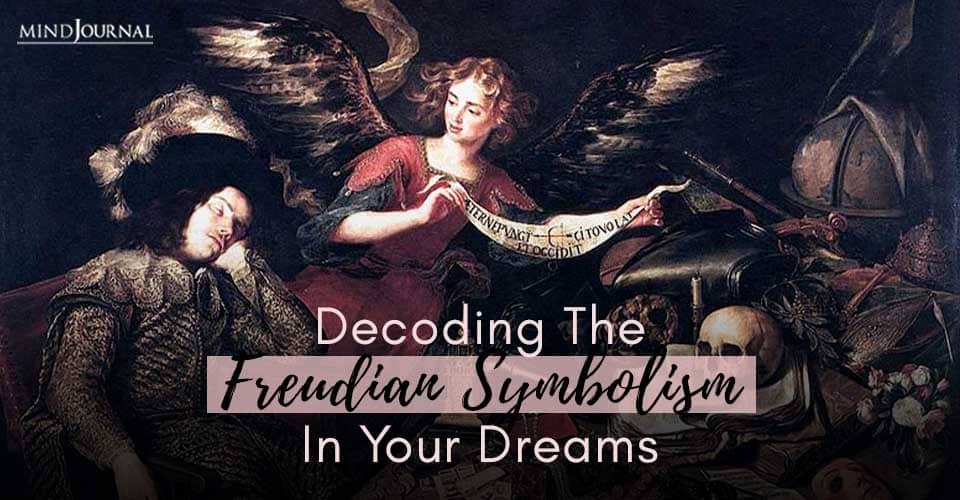
Decoding The Freudian Symbolism in Your Dreams

Author : Frank T. McAndrew Ph.D.

Dreams have always been intriguing to people, and when you add some interesting Freudian symbolism to them, it’s something else entirely.


Everyone is interested in dreaming—in my introductory psychology course, it is always one of my students’ favorite topics.

But do dreams really mean anything? 


Psychologists are genuinely divided over the function and meaning of dreaming. Some psychologists think that dreams are nothing more than the result of random brain activity that occurs while we are sleeping, while others accept the perspective of people such as Sigmund Freud and Carl Jung that dreams can reveal a person’s deepest unconscious wishes and desires.

In a nutshell, psychoanalysts such as Freud and Jung believe that we disguise disturbing impulses by substituting more acceptable symbolic objects to stand in for the latent content of our dreams.

Freudian Dream Symbols


Freud wrote about dreams in many different places, most notably in his book The Interpretation of Dreams. According to Freud, the number of things represented by symbols in dreams is not great: The human body, parents, children, siblings, birth, death, nakedness, and a few others.

1. Genders represented as parts of houses.

The person as a whole is often represented in the form of a house—houses with smooth walls are men, and those with projections and balconies to which one might cling are women. 

2. Family members represented as royalty, or animals.

Parents appear in dreams as kings, queens, or other highly respected persons; children and siblings are symbolized as small animals or vermin.

3. Birth represented in the form of water.

Birth is almost always represented by some reference to water: Either one plunges into water or climbs out of it, rescues someone from the water, or gets rescued from water (indicating a mother-like relationship to that person).

4. Death represented by journey, and nakedness by clothes.

Death is replaced in dreams by taking a journey; nakedness is symbolized by clothing, especially uniforms.

Related: 20 Interesting Facts About Dreams That You Didn’t Know About


The richest collection of symbols, however, is reserved for the sphere of sexual life. According to Freud, the great majority of symbols in dreams are sex symbols. 

5. Male genitalia represented by long objects.

The number three is a symbolic substitute for the entire male genital, whereas the penis alone is represented by long and upright objects such as sticks, umbrellas, poles, trees, or the Washington Monument. It can also be symbolized by objects that can penetrate the body and cause injury—think of knives, daggers, lances, swords, and firearms (especially revolvers). Also substituted for male genitalia are objects out of which water flows, such as faucets and fountains, or objects that can be elongated such as telescopes and collapsible pencils.

In the words of the old song by the folk singer Melanie, anything that is longer than it is wide can be a phallic symbol.

The extraordinary characteristic of an erection (in which the penis raises itself against the force of gravity) results in symbolic representation by balloons, airplanes, missiles, and rockets. In some cases, the entire person becomes a representation of the sex organ if the person pictures himself flying. Other less obvious male symbols include reptiles, especially snakes, and fish, hats, and coats.

6. Female genitalia represented by enclosed spaces that can be filled.

The female genitals are symbolically represented by objects which enclose a space capable of being filled by something—for example, pits, caves, bottles, boxes, trunks, jars, suitcases, pockets, ships, the mouth, churches, and shoes. 

7. Breasts represented by round fruits.

Wooden and paper objects are symbols of women, whereas breasts are represented by apples, peaches, and fruits in general.

8. A few more representations of dream symbols when it comes to sexual life.

Jewels and treasure may represent a beloved person, while sweets frequently stand-in for sexual delight. Masturbation may be disguised as sliding, coasting, or tearing branches off of trees. Dreaming of one’s teeth falling out (or being pulled) indicates a fear of castration as a punishment for masturbation. Sexual intercourse may be symbolized by an array of scenes and interactions between male and female symbols.


Related: 25 Common Dreams and Their Meanings

As much fun as all of this, always keep in mind that a Freudian analysis of dreams is not simple; it takes many years of training to understand the factors that need to be taken into account to conduct a proper interpretation of dreams.

And after all, as Freud himself once supposedly said, “Sometimes a cigar is just a cigar.”


Written By Frank T. McAndrew
Originally Appeared In Psychology Today

Freudian symbolism in dreams has always served as an important way of decoding even the most confusing dreams, that you might end up having. There are certain dreams that can confound you at times, but Freudian symbolism might help you understand it better. However, don’t try to look for deep meanings in every dream you have; sometimes they are just simple, weird dreams.


Decoding Freudian Symbolism Dreams Pin


Published On:

Last updated on:

Frank T. McAndrew Ph.D.

Frank McAndrew is the Cornelia H. Dudley Professor of Psychology at Knox College and an elected Fellow of several professional organizations, including the Association for Psychological Science (APS). He is also a blogger for Psychology Today Magazine. McAndrew is an evolutionary social psychologist whose research is guided by the simple desire to make sense of everyday life, and he is currently studying gossip, aggression, and creepiness. His research has appeared in dozens of professional journals and it is regularly featured in popular media outlets such as The New Yorker, NPR, the BBC, The New York Times, The Atlantic, and NBC’s Today Show. He has written for many popular prints and online magazines, including Time, CNN, The Washington Post, The Chicago Tribune, Salon, Newsweek, The Daily Beast, PBS Newshour, The Huffington Post, The Guardian, The New Republic, and Scientific American. Consistent with his long tenure at a liberal arts college, Professor McAndrew is also an award-winning teacher who is particularly proud of the fact that more than 100 of his former students have gone on to complete a doctoral degree in psychology or a closely related field.

Disclaimer: The informational content on The Minds Journal have been created and reviewed by qualified mental health professionals. They are intended solely for educational and self-awareness purposes and should not be used as a substitute for professional medical advice, diagnosis, or treatment. If you are experiencing emotional distress or have concerns about your mental health, please seek help from a licensed mental health professional or healthcare provider.

Leave a Comment

Today's Horoscope

Free Daily Horoscope 26 March For 12 Zodiac Signs

Daily Horoscope 26 March, 2026: Prediction For Each Zodiac Sign

Today is less about dramatic changes and more about small emotional shifts that can create long-term impact. Check your free horoscope for more insights!

Latest Quizzes

Image Personality Test: Which Woman Reveals Your True Self?

Which Woman Are You? A Personality Test That Reveals Your True Inner Nature

This personality test reveals your true self based on the woman you choose. Simple, fun, and surprisingly accurate!

Latest Quotes

Manipulative Tactics in Relationships: Gaslighting, Love Bombing, and Emotional Control

Manipulative Tactics in Relationships: Gaslighting, Love Bombing, and Emotional Control

Manipulative tactics in relationships often start subtly—gaslighting, love bombing, guilt trips, or mixed signals. Once you recognize these emotional manipulation patterns, you can protect your mental health and step away from toxic dynamics.

Readers Blog

Caption This Image and Selected Wisepicks – 22 March 2026

Caption This Image and Selected Wisepicks – 22 March 2026

Ready to unleash your inner wordsmith? ✨??☺️ Now’s your chance to show off your wit, charm, or sheer genius in just one line! Whether it’s laugh-out-loud funny or surprisingly deep, we want to hear it.Submit your funniest, wittiest, or most thought-provoking caption in the comments. We’ll pick 15+ winners to be featured on our website…

Latest Articles

Dreams have always been intriguing to people, and when you add some interesting Freudian symbolism to them, it’s something else entirely.


Everyone is interested in dreaming—in my introductory psychology course, it is always one of my students’ favorite topics.

But do dreams really mean anything? 


Psychologists are genuinely divided over the function and meaning of dreaming. Some psychologists think that dreams are nothing more than the result of random brain activity that occurs while we are sleeping, while others accept the perspective of people such as Sigmund Freud and Carl Jung that dreams can reveal a person’s deepest unconscious wishes and desires.

In a nutshell, psychoanalysts such as Freud and Jung believe that we disguise disturbing impulses by substituting more acceptable symbolic objects to stand in for the latent content of our dreams.

Freudian Dream Symbols


Freud wrote about dreams in many different places, most notably in his book The Interpretation of Dreams. According to Freud, the number of things represented by symbols in dreams is not great: The human body, parents, children, siblings, birth, death, nakedness, and a few others.

1. Genders represented as parts of houses.

The person as a whole is often represented in the form of a house—houses with smooth walls are men, and those with projections and balconies to which one might cling are women. 

2. Family members represented as royalty, or animals.

Parents appear in dreams as kings, queens, or other highly respected persons; children and siblings are symbolized as small animals or vermin.

3. Birth represented in the form of water.

Birth is almost always represented by some reference to water: Either one plunges into water or climbs out of it, rescues someone from the water, or gets rescued from water (indicating a mother-like relationship to that person).

4. Death represented by journey, and nakedness by clothes.

Death is replaced in dreams by taking a journey; nakedness is symbolized by clothing, especially uniforms.

Related: 20 Interesting Facts About Dreams That You Didn’t Know About


The richest collection of symbols, however, is reserved for the sphere of sexual life. According to Freud, the great majority of symbols in dreams are sex symbols. 

5. Male genitalia represented by long objects.

The number three is a symbolic substitute for the entire male genital, whereas the penis alone is represented by long and upright objects such as sticks, umbrellas, poles, trees, or the Washington Monument. It can also be symbolized by objects that can penetrate the body and cause injury—think of knives, daggers, lances, swords, and firearms (especially revolvers). Also substituted for male genitalia are objects out of which water flows, such as faucets and fountains, or objects that can be elongated such as telescopes and collapsible pencils.

In the words of the old song by the folk singer Melanie, anything that is longer than it is wide can be a phallic symbol.

The extraordinary characteristic of an erection (in which the penis raises itself against the force of gravity) results in symbolic representation by balloons, airplanes, missiles, and rockets. In some cases, the entire person becomes a representation of the sex organ if the person pictures himself flying. Other less obvious male symbols include reptiles, especially snakes, and fish, hats, and coats.

6. Female genitalia represented by enclosed spaces that can be filled.

The female genitals are symbolically represented by objects which enclose a space capable of being filled by something—for example, pits, caves, bottles, boxes, trunks, jars, suitcases, pockets, ships, the mouth, churches, and shoes. 

7. Breasts represented by round fruits.

Wooden and paper objects are symbols of women, whereas breasts are represented by apples, peaches, and fruits in general.

8. A few more representations of dream symbols when it comes to sexual life.

Jewels and treasure may represent a beloved person, while sweets frequently stand-in for sexual delight. Masturbation may be disguised as sliding, coasting, or tearing branches off of trees. Dreaming of one’s teeth falling out (or being pulled) indicates a fear of castration as a punishment for masturbation. Sexual intercourse may be symbolized by an array of scenes and interactions between male and female symbols.


Related: 25 Common Dreams and Their Meanings

As much fun as all of this, always keep in mind that a Freudian analysis of dreams is not simple; it takes many years of training to understand the factors that need to be taken into account to conduct a proper interpretation of dreams.

And after all, as Freud himself once supposedly said, “Sometimes a cigar is just a cigar.”


Written By Frank T. McAndrew
Originally Appeared In Psychology Today

Freudian symbolism in dreams has always served as an important way of decoding even the most confusing dreams, that you might end up having. There are certain dreams that can confound you at times, but Freudian symbolism might help you understand it better. However, don’t try to look for deep meanings in every dream you have; sometimes they are just simple, weird dreams.


Decoding Freudian Symbolism Dreams Pin


Published On:

Last updated on:

Frank T. McAndrew Ph.D.

Frank McAndrew is the Cornelia H. Dudley Professor of Psychology at Knox College and an elected Fellow of several professional organizations, including the Association for Psychological Science (APS). He is also a blogger for Psychology Today Magazine. McAndrew is an evolutionary social psychologist whose research is guided by the simple desire to make sense of everyday life, and he is currently studying gossip, aggression, and creepiness. His research has appeared in dozens of professional journals and it is regularly featured in popular media outlets such as The New Yorker, NPR, the BBC, The New York Times, The Atlantic, and NBC’s Today Show. He has written for many popular prints and online magazines, including Time, CNN, The Washington Post, The Chicago Tribune, Salon, Newsweek, The Daily Beast, PBS Newshour, The Huffington Post, The Guardian, The New Republic, and Scientific American. Consistent with his long tenure at a liberal arts college, Professor McAndrew is also an award-winning teacher who is particularly proud of the fact that more than 100 of his former students have gone on to complete a doctoral degree in psychology or a closely related field.

Leave a Comment

    Leave a Comment