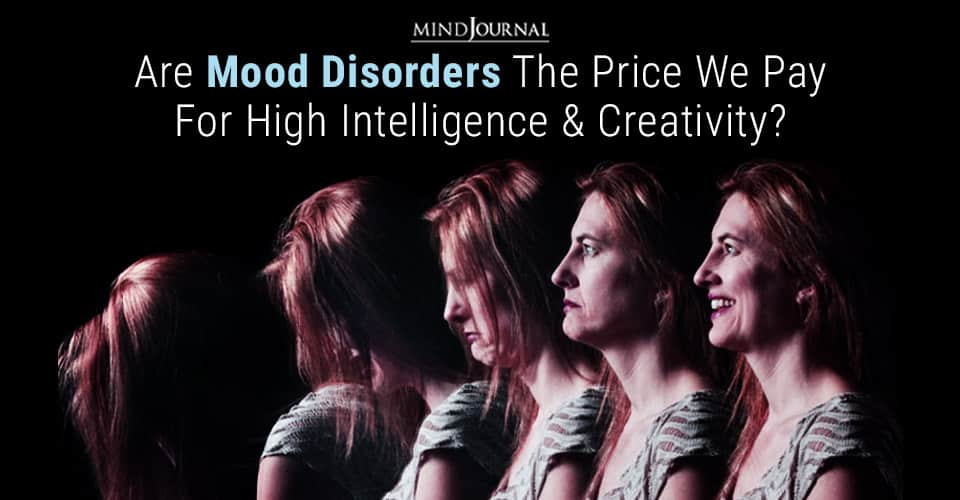
Are Mood Disorders the Price We Pay for High Intelligence and Creativity?

Author : Helen Noronha

Do you think highly intelligent and creative people commonly suffer from mood disorders?


History is peppered with famous artists, actors, and musicians who were highly intelligent and creative, and experienced significant mood swings. Some are quite notorious for their outbursts; painter Vincent Van Gogh and the composer Beethoven are two examples. Writers like Virginia Woolf and Silvia Plath also seemed to suffer from their exceptional level of creativity, where episodes of unstable behavior were common.

Related: 12 Symptoms of Post Relationship Stress Disorder


Sadly, if these great artists were alive today, they would most likely be coerced into taking pharmaceutical drugs to “temper” their moods. Unfortunately, this scenario doesn’t require any great stretch of the imagination, considering almost seventy-nine million Americans take some form of the psychiatric drug — including over a million children under the age of five. But at what cost?

A Modern Take on the Classic “Temperamental Artist”

Throughout history, many great thinkers and artists have been known to possess “eccentric” personalities, with behavior that could be downright bizarre. But the society at the time recognized the creative genius within and gave such individuals a relative wide-berth of freedom to express their gift.

Related: 17 Connections Between A Narcissist And Their Victim With Anxiety Disorder


Today, these same people would be classified as bipolar — a chronic mental illness of extreme changes in mood, alternating between euphoric mania and the depths of depression. The episodes can occur a couple of times a week or just a few times a year.

There are three primary types, which include:

Bipolar I: One or more manic cycles either before or after a depressive episode.

Bipolar II: One or more major depressive episodes lasting at least two weeks, with a mild manic cycle lasting at least four days.

Cyclothymic disorder: Cycles of mild mania and depressive episodes that last for two years or longer. The mood swings are generally less severe in this particular form of the disorder.

Even though there are different categories of mood disorders, the symptoms tend to be similar in most people. The following list from Healthline details common traits:

Depression

  • persistent feelings of extreme grief or despair (depression) for a long period of time
  • loss of interest in activities that were once enjoyable
  • trouble concentrating, making decisions, and remembering things
  • anxiety or irritability
  • eating too much or too little
  • sleeping too much or too little
  • thinking or talking about death or suicide
  • suicide attempt

Mania

  • overly happy or outgoing mood for a long period of time
  • severe irritability
  • talking quickly, rapidly transitioning different ideas during a conversation, or having racing thoughts
  • inability to focus
  • starting numerous new activities or projects
  • feeling very fidgety
  • sleeping too little or not at all
  • acting impulsively and partaking in dangerous behaviors

Hypomania

Hypomania symptoms are the same as mania symptoms, but they differ in two ways:


  1. With hypomania, mood swings usually aren’t severe enough to interfere significantly with a person’s ability to carry out daily activities.
  2. No psychotic symptoms occur during a hypomanic episode. During a manic episode, psychotic symptoms may include delusions, hallucinations, and paranoia.

What these clinical classifications fail to address, however, is that the disorder is also linked with high levels of creativity and intelligence.

The Flip Side of the Bipolar Coin

When an individual is experiencing a manic or hypomania episode, they often feel inspired and ambitious, which in turn, fosters a willingness to engage in a new creative endeavor. In fact, a large number of remarkably creative people are also bipolar. And now the results of several scientific studies may help explain why this may be the case.

In one study, the team examined the IQ of nearly 2,000 8-year-old children and compared the data with those same children who developed manic traits by the age of 22 or 23. What they discovered is that high childhood IQ was positively associated with bipolar symptoms later in life.

Related: Histronic Personality Disorder: How Narcissism Works In Women

“There is something about the genetics underlying the disorder that is advantageous. One possibility is that serious disorders of mood – such as bipolar disorder – are the price that human beings have had to pay for more adaptive traits such as intelligence, creativity, and verbal proficiency,” said lead researcher Daniel Smith of the University of Glasgow.

But he’s quick to add that having a high IQ is not a clear-cut risk factor for developing the disorder. Instead, other variables — such as environmental influences like exposure to maternal influenza in the womb or childhood sexual abuse — may trigger the illness if there is a genetic tendency for it.

Another study also found a link between genetics, bipolar disorder, and creativity. The researchers reviewed the DNA of over 86,000 people in the search for specific genes that increased the risk of bipolar disorder and schizophrenia.


They also documented if the individuals were involved in creative fields — like music, dancing, acting, and writing. After analyzing the data, the team found that those who are creative are up to 25 percent more likely to carry genes associated with bipolar and schizophrenia, compared to their non-creative counterparts.

Related: 9 Identifying Signs of Hypersexual Disorder (sex Addiction)

“Our findings suggest that creative people may have a genetic predisposition toward thinking differently, which, when combined with other harmful biological or environmental factors, could lead to mental illness,” said Robert A. Power of the Institute of Psychiatry, Psychology, and Neuroscience at King’s College London

For those who are diagnosed with mood disorders, we need to seriously question how many of these highly intelligent and creative individuals are sacrificed on the altar of “normalcy” by way of the pharmaceutical industry — and to what end.

Related video:


Originally appeared on Wake up world

Written by Carolanne Wright

mood disorders
Are Mood Disorders Pin


Published On:

Last updated on:

Disclaimer: The informational content on The Minds Journal have been created and reviewed by qualified mental health professionals. They are intended solely for educational and self-awareness purposes and should not be used as a substitute for professional medical advice, diagnosis, or treatment. If you are experiencing emotional distress or have concerns about your mental health, please seek help from a licensed mental health professional or healthcare provider.

Leave a Comment

Today's Horoscope

Free Daily Horoscope 26 March For 12 Zodiac Signs

Daily Horoscope 26 March, 2026: Prediction For Each Zodiac Sign

Today is less about dramatic changes and more about small emotional shifts that can create long-term impact. Check your free horoscope for more insights!

Latest Quizzes

Image Personality Test: Which Woman Reveals Your True Self?

Which Woman Are You? A Personality Test That Reveals Your True Inner Nature

This personality test reveals your true self based on the woman you choose. Simple, fun, and surprisingly accurate!

Latest Quotes

Manipulative Tactics in Relationships: Gaslighting, Love Bombing, and Emotional Control

Manipulative Tactics in Relationships: Gaslighting, Love Bombing, and Emotional Control

Manipulative tactics in relationships often start subtly—gaslighting, love bombing, guilt trips, or mixed signals. Once you recognize these emotional manipulation patterns, you can protect your mental health and step away from toxic dynamics.

Readers Blog

Caption This Image and Selected Wisepicks – 22 March 2026

Caption This Image and Selected Wisepicks – 22 March 2026

Ready to unleash your inner wordsmith? ✨??☺️ Now’s your chance to show off your wit, charm, or sheer genius in just one line! Whether it’s laugh-out-loud funny or surprisingly deep, we want to hear it.Submit your funniest, wittiest, or most thought-provoking caption in the comments. We’ll pick 15+ winners to be featured on our website…

Latest Articles

Do you think highly intelligent and creative people commonly suffer from mood disorders?


History is peppered with famous artists, actors, and musicians who were highly intelligent and creative, and experienced significant mood swings. Some are quite notorious for their outbursts; painter Vincent Van Gogh and the composer Beethoven are two examples. Writers like Virginia Woolf and Silvia Plath also seemed to suffer from their exceptional level of creativity, where episodes of unstable behavior were common.

Related: 12 Symptoms of Post Relationship Stress Disorder


Sadly, if these great artists were alive today, they would most likely be coerced into taking pharmaceutical drugs to “temper” their moods. Unfortunately, this scenario doesn’t require any great stretch of the imagination, considering almost seventy-nine million Americans take some form of the psychiatric drug — including over a million children under the age of five. But at what cost?

A Modern Take on the Classic “Temperamental Artist”

Throughout history, many great thinkers and artists have been known to possess “eccentric” personalities, with behavior that could be downright bizarre. But the society at the time recognized the creative genius within and gave such individuals a relative wide-berth of freedom to express their gift.

Related: 17 Connections Between A Narcissist And Their Victim With Anxiety Disorder


Today, these same people would be classified as bipolar — a chronic mental illness of extreme changes in mood, alternating between euphoric mania and the depths of depression. The episodes can occur a couple of times a week or just a few times a year.

There are three primary types, which include:

Bipolar I: One or more manic cycles either before or after a depressive episode.

Bipolar II: One or more major depressive episodes lasting at least two weeks, with a mild manic cycle lasting at least four days.

Cyclothymic disorder: Cycles of mild mania and depressive episodes that last for two years or longer. The mood swings are generally less severe in this particular form of the disorder.

Even though there are different categories of mood disorders, the symptoms tend to be similar in most people. The following list from Healthline details common traits:

Depression

  • persistent feelings of extreme grief or despair (depression) for a long period of time
  • loss of interest in activities that were once enjoyable
  • trouble concentrating, making decisions, and remembering things
  • anxiety or irritability
  • eating too much or too little
  • sleeping too much or too little
  • thinking or talking about death or suicide
  • suicide attempt

Mania

  • overly happy or outgoing mood for a long period of time
  • severe irritability
  • talking quickly, rapidly transitioning different ideas during a conversation, or having racing thoughts
  • inability to focus
  • starting numerous new activities or projects
  • feeling very fidgety
  • sleeping too little or not at all
  • acting impulsively and partaking in dangerous behaviors

Hypomania

Hypomania symptoms are the same as mania symptoms, but they differ in two ways:


  1. With hypomania, mood swings usually aren’t severe enough to interfere significantly with a person’s ability to carry out daily activities.
  2. No psychotic symptoms occur during a hypomanic episode. During a manic episode, psychotic symptoms may include delusions, hallucinations, and paranoia.

What these clinical classifications fail to address, however, is that the disorder is also linked with high levels of creativity and intelligence.

The Flip Side of the Bipolar Coin

When an individual is experiencing a manic or hypomania episode, they often feel inspired and ambitious, which in turn, fosters a willingness to engage in a new creative endeavor. In fact, a large number of remarkably creative people are also bipolar. And now the results of several scientific studies may help explain why this may be the case.

In one study, the team examined the IQ of nearly 2,000 8-year-old children and compared the data with those same children who developed manic traits by the age of 22 or 23. What they discovered is that high childhood IQ was positively associated with bipolar symptoms later in life.

Related: Histronic Personality Disorder: How Narcissism Works In Women

“There is something about the genetics underlying the disorder that is advantageous. One possibility is that serious disorders of mood – such as bipolar disorder – are the price that human beings have had to pay for more adaptive traits such as intelligence, creativity, and verbal proficiency,” said lead researcher Daniel Smith of the University of Glasgow.

But he’s quick to add that having a high IQ is not a clear-cut risk factor for developing the disorder. Instead, other variables — such as environmental influences like exposure to maternal influenza in the womb or childhood sexual abuse — may trigger the illness if there is a genetic tendency for it.

Another study also found a link between genetics, bipolar disorder, and creativity. The researchers reviewed the DNA of over 86,000 people in the search for specific genes that increased the risk of bipolar disorder and schizophrenia.


They also documented if the individuals were involved in creative fields — like music, dancing, acting, and writing. After analyzing the data, the team found that those who are creative are up to 25 percent more likely to carry genes associated with bipolar and schizophrenia, compared to their non-creative counterparts.

Related: 9 Identifying Signs of Hypersexual Disorder (sex Addiction)

“Our findings suggest that creative people may have a genetic predisposition toward thinking differently, which, when combined with other harmful biological or environmental factors, could lead to mental illness,” said Robert A. Power of the Institute of Psychiatry, Psychology, and Neuroscience at King’s College London

For those who are diagnosed with mood disorders, we need to seriously question how many of these highly intelligent and creative individuals are sacrificed on the altar of “normalcy” by way of the pharmaceutical industry — and to what end.

Related video:


Originally appeared on Wake up world

Written by Carolanne Wright

mood disorders
Are Mood Disorders Pin


Published On:

Last updated on:

Helen Noronha

Leave a Comment

    Leave a Comment