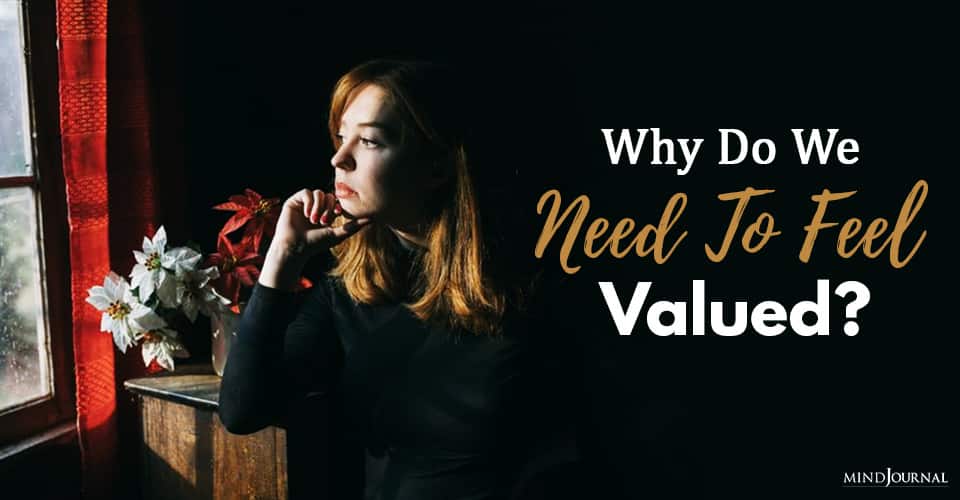
Why Do We Need To Feel Valued?

Author : Dr. Joseph Shrand

We all want the same thing: simply to be valued by somebody else. Think about every person you have ever met. They just want to feel valued. I want to feel valued, and so do you. By someone. Right? Why do we need to feel valued?


The origin of the need to feel valued

I think this universal human need has very ancient roots. Millions of years ago, we were not the fastest animal, not the strongest, not the biggest animal. We were isolated mammals scurrying around, trying not to be lunch. We were prey.

And then we formed these small social groups, and our survival potential increased so dramatically that human beings are everywhere. But to stay a member of that protective group, you have to contribute something: You have to have value.


When we sense that somebody else sees us with less value, we worry that we will be kicked out of our protective group, and some predator will come and eat us. That we will be lunch. That we will not survive.

Read 3 Human Desires To Thrive: How To Make Someone Feel Seen, Loved, And Understood

This survival mode explains why I get angry, anxious, or sad when I feel less valued. The limbic part of my brain worries I may get kicked out of my protective group and be easier prey. Right or wrong, just the perception of being devalued activates our ancient, irrational, emotional, and impulsive limbic response.


At that moment in time, it’s the best you can do. But if you don’t like it, you can change it. 
we need to feel valued

What to do when you feel less valued?

You can retain your self-worth and value. Instead of seeing people as doing less than they can, see people as doing the best that they can.

Rather than getting defensive when feeling devalued, you can wonder why a person is trying to make you feel less valuable. We all want the same thing: to feel valued. Why is this person trying to feel valuable by putting me down? What is going on? 

I don’t like it. But rather than worry, I will wonder. And after being reflexive, I can be reflective. I can look again at why they do what they do.

Look again. Again look. Re-spect. Treat that person with respect. I will respect that they see me as less valuable, but I don’t have to agree with it.

When is the last time you got angry at someone treating you with respect? You don’t.


Read 7 Ways To Make Your Partner Feel Appreciated: The Obvious And Not So Obvious

When I feel respected, I feel valued. So will that other person. When I feel valued, I am more likely to trust. So does that other person. Respect leads to value, and value leads to trust. A person who feels valued develops trust in that person. 

And now you have formed a group. And are less likely to be lunch for some predator. Respect leads to value, and value leads to trust, the very foundation of a group. By treating each other with respect, we are decreasing those fearful limbic responses, and that is a contribution to the group.

You can use value to remain valuable.

At each and every moment, you can remind someone of their value. And whenever you remind someone of their value, you increase your own value. 

We can all relate to each other. This common thread binds us. At each and every moment in time, you can remind someone of their value. And whenever you remind someone of their value, you increase your own value. 

You control no one; you influence everyone. 


What kind of influence do you want to be?

Being judged usually makes you feel less valuable, activating a defensive limbic response. In a polarized world, divided into contentious groups, one tribe begins to devalue another tribe. Now millions of people may feel disrespected and distrusted by each other. What happens then? how to fulfill the need to feel valued?

We do not need to continue going down that road.  

Now more than ever, the coronavirus has shown us how much more we have in common than separates us. We all want the same thing—to survive. But we no longer need to have someone else perish to thrive or die to survive. We are all stronger when we cooperate than when we compete.

Respect leads to value, and value leads to trust. People who trust feel safer than those who fear. You can use value to make someone less stressed, less angry, anxious, or sad, and more confident that they can remain in their protective group.
without trust, most things aren't possible.

Try it today, at home, during these crazy days of Corona. Remind someone of their value and see what happens. Watch how they respond and how you feel.


We all want the same thing. we all need to feel valued. We are more alike than different. At our core, we are all part of one group, one tribe: It’s called humanity. 

To know more about how to control anger when you don’t feel valued, refer to Outsmarting Anger: 7 Strategies for Defusing our Most Dangerous Emotion


References
I believe we are always doing the best we can. I call this our I-M. This is who I am and I Matter. Our I-M is always adapting to Four Domains. Our Home Domain, our Social Domain, our Biological Domain of our brain and body, and our Ic Domain or how I see myself and how I think other people see me.  Using the I-M lens there is no pathology, there is no sickness.  No one is broken.  We are at our I-M, doing the best we can at this moment in time, always adapting to even the smallest change in any of the Domains in the very next second to another I-M.

Written by: Dr. Joseph Shrand
Drug Story Theater  
Podcast
Originally appeared on: Psychology Today
Republished with permission
Need To Feel Valued pin


Published On:

Last updated on:

Dr. Joseph Shrand

Dr. Joseph Shrand is Chief Medical Officer of Riverside Community Care headquartered in Dedham MA. He is a Lecturer of Psychiatry at Harvard Medical School, and triple board certified in adult psychiatry, child and adolescent psychiatry, and a diplomate of the American Board of Addiction Medicine. Dr. Shrand has developed a strength-based model called The I-M Approach that suggests a fundamental paradigm shift, moving away from pathology to viewing a patient at a current maximum potential. Dr. Shrand is the founder of Drug Story Theater, Inc., a non-profit organization that takes teenagers in the early stages of recovery from drugs and alcohol and teaches them improvisational theater techniques. The teenagers then create their own shows which they perform in middle and high schools, so the treatment of one becomes the prevention of many. Dr Shrand has a weekly radio show on WATD 95.9 FM, The Dr. Joe Show: Exploring who we are and why we do what we do. Invited experts discuss a range of topics in addiction, mental health, and the state of the world! The Dr. Joe Show is now available as a podcast. Dr. Shrand is the author of Manage Your Stress: Overcoming Stress in the Modern World, Outsmarting Anger: Seven Strategies to Defuse our most Dangerous Emotion, the winner of the 2013 Books for a Better Life Awards, 2013 Psychology self-help category, The Fear Reflex: Five Ways to Overcome it and Trust your Imperfect Self, and Do You Really Get me? Finding Value in Yourself through Empathy and connection published by Hazelden Press. Among colleagues and staff, he is affectionately called “Doctor Joe,” as he was “Joe” in the original children’s cast of the PBS series ZOOM.

Disclaimer: The informational content on The Minds Journal have been created and reviewed by qualified mental health professionals. They are intended solely for educational and self-awareness purposes and should not be used as a substitute for professional medical advice, diagnosis, or treatment. If you are experiencing emotional distress or have concerns about your mental health, please seek help from a licensed mental health professional or healthcare provider.

Leave a Comment

Today's Horoscope

Daily Horoscope 17 March 2026: Prediction for Zodiac Signs

Daily Horoscope 17 March, 2026: Prediction for Each Zodiac Sign

Today carries a calm, thoughtful kind of energy that may not be obvious at first.

Latest Quizzes

Interesting Finger Personality Test: 4 Finger Lines

Finger Personality Test: Join Your Fingers And Reveal A Hidden Personality Secret!

Look closely at your finger lines. Which pattern do you see? This personality test might surprise you!

Latest Quotes

Secure Attachment: The Steady Foundation of Healthy Love

Secure Attachment: The Steady Foundation of Healthy Love

Secure attachment feels like missing someone without panic, trusting without constant reassurance. Explore why this steady love fosters emotional security and true intimacy.

Readers Blog

Caption This Image and Selected Wisepicks – 15 March 2026

Caption This Image and Selected Wisepicks – 15 March 2026

Ready to unleash your inner wordsmith? ✨??☺️ Now’s your chance to show off your wit, charm, or sheer genius in just one line! Whether it’s laugh-out-loud funny or surprisingly deep, we want to hear it.Submit your funniest, wittiest, or most thought-provoking caption in the comments. We’ll pick 15+ winners to be featured on our website…

Latest Articles

We all want the same thing: simply to be valued by somebody else. Think about every person you have ever met. They just want to feel valued. I want to feel valued, and so do you. By someone. Right? Why do we need to feel valued?


The origin of the need to feel valued

I think this universal human need has very ancient roots. Millions of years ago, we were not the fastest animal, not the strongest, not the biggest animal. We were isolated mammals scurrying around, trying not to be lunch. We were prey.

And then we formed these small social groups, and our survival potential increased so dramatically that human beings are everywhere. But to stay a member of that protective group, you have to contribute something: You have to have value.


When we sense that somebody else sees us with less value, we worry that we will be kicked out of our protective group, and some predator will come and eat us. That we will be lunch. That we will not survive.

Read 3 Human Desires To Thrive: How To Make Someone Feel Seen, Loved, And Understood

This survival mode explains why I get angry, anxious, or sad when I feel less valued. The limbic part of my brain worries I may get kicked out of my protective group and be easier prey. Right or wrong, just the perception of being devalued activates our ancient, irrational, emotional, and impulsive limbic response.


At that moment in time, it’s the best you can do. But if you don’t like it, you can change it. 

we need to feel valued

What to do when you feel less valued?

You can retain your self-worth and value. Instead of seeing people as doing less than they can, see people as doing the best that they can.

Rather than getting defensive when feeling devalued, you can wonder why a person is trying to make you feel less valuable. We all want the same thing: to feel valued. Why is this person trying to feel valuable by putting me down? What is going on? 

I don’t like it. But rather than worry, I will wonder. And after being reflexive, I can be reflective. I can look again at why they do what they do.

Look again. Again look. Re-spect. Treat that person with respect. I will respect that they see me as less valuable, but I don’t have to agree with it.

When is the last time you got angry at someone treating you with respect? You don’t.


Read 7 Ways To Make Your Partner Feel Appreciated: The Obvious And Not So Obvious

When I feel respected, I feel valued. So will that other person. When I feel valued, I am more likely to trust. So does that other person. Respect leads to value, and value leads to trust. A person who feels valued develops trust in that person. 

And now you have formed a group. And are less likely to be lunch for some predator. Respect leads to value, and value leads to trust, the very foundation of a group. By treating each other with respect, we are decreasing those fearful limbic responses, and that is a contribution to the group.

You can use value to remain valuable.

At each and every moment, you can remind someone of their value. And whenever you remind someone of their value, you increase your own value. 

We can all relate to each other. This common thread binds us. At each and every moment in time, you can remind someone of their value. And whenever you remind someone of their value, you increase your own value. 

You control no one; you influence everyone. 


What kind of influence do you want to be?

Being judged usually makes you feel less valuable, activating a defensive limbic response. In a polarized world, divided into contentious groups, one tribe begins to devalue another tribe. Now millions of people may feel disrespected and distrusted by each other. What happens then? how to fulfill the need to feel valued?

We do not need to continue going down that road.  

Now more than ever, the coronavirus has shown us how much more we have in common than separates us. We all want the same thing—to survive. But we no longer need to have someone else perish to thrive or die to survive. We are all stronger when we cooperate than when we compete.

Respect leads to value, and value leads to trust. People who trust feel safer than those who fear. You can use value to make someone less stressed, less angry, anxious, or sad, and more confident that they can remain in their protective group.

without trust, most things aren't possible.

Try it today, at home, during these crazy days of Corona. Remind someone of their value and see what happens. Watch how they respond and how you feel.


We all want the same thing. we all need to feel valued. We are more alike than different. At our core, we are all part of one group, one tribe: It’s called humanity. 

To know more about how to control anger when you don’t feel valued, refer to Outsmarting Anger: 7 Strategies for Defusing our Most Dangerous Emotion


References
I believe we are always doing the best we can. I call this our I-M. This is who I am and I Matter. Our I-M is always adapting to Four Domains. Our Home Domain, our Social Domain, our Biological Domain of our brain and body, and our Ic Domain or how I see myself and how I think other people see me.  Using the I-M lens there is no pathology, there is no sickness.  No one is broken.  We are at our I-M, doing the best we can at this moment in time, always adapting to even the smallest change in any of the Domains in the very next second to another I-M.

Written by: Dr. Joseph Shrand
Drug Story Theater  
Podcast
Originally appeared on: Psychology Today
Republished with permission
Need To Feel Valued pin


Published On:

Last updated on:

Dr. Joseph Shrand

Dr. Joseph Shrand is Chief Medical Officer of Riverside Community Care headquartered in Dedham MA. He is a Lecturer of Psychiatry at Harvard Medical School, and triple board certified in adult psychiatry, child and adolescent psychiatry, and a diplomate of the American Board of Addiction Medicine. Dr. Shrand has developed a strength-based model called The I-M Approach that suggests a fundamental paradigm shift, moving away from pathology to viewing a patient at a current maximum potential. Dr. Shrand is the founder of Drug Story Theater, Inc., a non-profit organization that takes teenagers in the early stages of recovery from drugs and alcohol and teaches them improvisational theater techniques. The teenagers then create their own shows which they perform in middle and high schools, so the treatment of one becomes the prevention of many. Dr Shrand has a weekly radio show on WATD 95.9 FM, The Dr. Joe Show: Exploring who we are and why we do what we do. Invited experts discuss a range of topics in addiction, mental health, and the state of the world! The Dr. Joe Show is now available as a podcast. Dr. Shrand is the author of Manage Your Stress: Overcoming Stress in the Modern World, Outsmarting Anger: Seven Strategies to Defuse our most Dangerous Emotion, the winner of the 2013 Books for a Better Life Awards, 2013 Psychology self-help category, The Fear Reflex: Five Ways to Overcome it and Trust your Imperfect Self, and Do You Really Get me? Finding Value in Yourself through Empathy and connection published by Hazelden Press. Among colleagues and staff, he is affectionately called “Doctor Joe,” as he was “Joe” in the original children’s cast of the PBS series ZOOM.

Leave a Comment

    Leave a Comment