What Should You Do vs. What Would You Do

Author : Dr. Jamie Schwandt

Sometimes there is a thin line between the ideas – what should you do and what would you do – and most people tend to get confused with this. They might seem to hold the same meaning, but if you think about it a bit and dive a bit deeper, you will realize that they are completely different concepts.


I was recently presented with an article by the best-selling author Bruce Weinstein. He is the author of books such as Ethical Intelligence and The Good Ones. His article Should vs. Would was a question and answer discussion that first appeared via Knight-Ridder Tribune News Service and later via Kansascity.com.

The question posed to Weinstein was as follows: What is the difference between asking, “What would you do?” and “What should you do?”


To me, this is a very intriguing, yet simple discussion on ethics and morality. Let’s take a quick look at Weinstein’s answer.

Psychological vs Ethical

Weinstein informs us that the first part of the question, “What would you do?” is a psychological question. He informs us that psychology explains why we do what we do. The second part of the question, “What should you do?” is an ethical question. He explains that ethics help us to understand whether we have made the right decision.

Let’s take a look at how Weinstein uses this in an example. He comments, “If you are a parent, ask your child what he or she would do if they saw someone cheating on a test. If they’re like most students, they will say – I would keep it to myself.”


He then proposes a simple switch in the way you word the question. He advises that we should ask, “What should you do?” By doing this, he says that you will probably receive a different response from your child, such as: I should talk with the person and probably even tell the teacher. A completely different response by changing one simple word (would to should).

Weinstein explains that this example is one of many examples explaining the difference between how we “actually” behave and how we “ought” to behave.

Related: Morality Of Wisdom: There Is No Such Thing As Good Or Bad

One simple word changes everything

Weinstein advises us that the next time we ask a friend for help with a problem, we should pay specific attention to the language our friend responds with. For example, he says they will most likely respond with, “What I would do is this…” yet what you are really asking is something more in line with, “What is the right thing to do?”

If we reframe our question or ask them specifically, “What should you do?” or “What is the right thing to do?” you might find that there is more of a desire to tell the truth. He informs us that, by reframing the question your friend will have to appeal to ethical principles in justifying their response.

So, make sure to pay attention to how you word your question and how someone responds to a question. A simple change in one word dictates the type of question being asked and the type of response received.


Essentially, the question, “What would you do?” is an appeal to psychology; whereas, “What should you do?” is an appeal to ethics. Simple questions, yet both possess a profound impact.

I will leave you with the following quote,

“We ask a simple question And that is all we wish: Are fishermen all liars? Or do only liars fish?” – William Sherwood Fox


Written By Jamie Schwandt
Originally Appeared In Lifehack

The simple question of what you should do vs what you would do might seem a bit confusing at times, but it really isn’t. Ultimately, it all boils down to ethics and human psychology. They might be straightforward and simple questions, but they can have a deep impact on a person’s psyche, and give you a glimpse into who they are as a person.
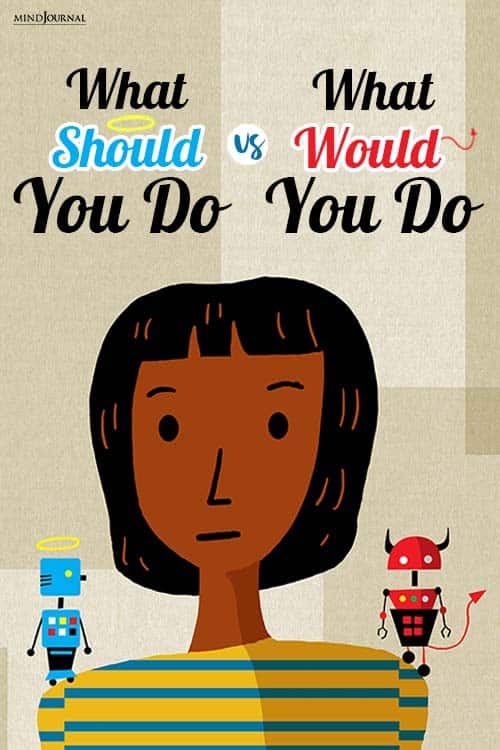
What Should You Do vs What Would You Do pin
Should You Do Pin


Published On:

Last updated on:

Dr. Jamie Schwandt

Dr. Jamie Schwandt is a professor, American author, motivational speaker, TV show host, lean six sigma master black belt, red team critical thinker, and systems thinker.

Disclaimer: The informational content on The Minds Journal have been created and reviewed by qualified mental health professionals. They are intended solely for educational and self-awareness purposes and should not be used as a substitute for professional medical advice, diagnosis, or treatment. If you are experiencing emotional distress or have concerns about your mental health, please seek help from a licensed mental health professional or healthcare provider.

Leave a Comment

Today's Horoscope

Weekly Horoscope PART one

Weekly Horoscope 15 March to 21 March 2026

Read your zodiac sign’s prediction to understand the energy surrounding you and how to make the most of the days ahead!

Latest Quizzes

Interesting Finger Personality Test: 4 Finger Lines

Finger Personality Test: Join Your Fingers And Reveal A Hidden Personality Secret!

Look closely at your finger lines. Which pattern do you see? This personality test might surprise you!

Latest Quotes

How Men Show Love Through Actions (Male Psychology in Relationships)

How Men Show Love Through Actions (Male Psychology in Relationships)

Male psychology in relationships shows that men express love through presence, protection, and peace more than poetry. Decode his actions so you can see how deeply he actually cares.

Readers Blog

Caption This Image and Selected Wisepicks – 8 March 2026

Caption This Image and Selected Wisepicks – 8 March 2026

Provide a creative, relevant caption for the picture below and get selected and featured with your name and caption.  Selected Wisepicks We have selected 11 comments as Wisepicks from our Facebook, Facebook Group and Instagram as on 15 March 2026 Lou Angelique Heruela Listen to your inner child,not the angry voices in your mind. Bloom…

Latest Articles

Sometimes there is a thin line between the ideas – what should you do and what would you do – and most people tend to get confused with this. They might seem to hold the same meaning, but if you think about it a bit and dive a bit deeper, you will realize that they are completely different concepts.


I was recently presented with an article by the best-selling author Bruce Weinstein. He is the author of books such as Ethical Intelligence and The Good Ones. His article Should vs. Would was a question and answer discussion that first appeared via Knight-Ridder Tribune News Service and later via Kansascity.com.

The question posed to Weinstein was as follows: What is the difference between asking, “What would you do?” and “What should you do?”


To me, this is a very intriguing, yet simple discussion on ethics and morality. Let’s take a quick look at Weinstein’s answer.

Psychological vs Ethical

Weinstein informs us that the first part of the question, “What would you do?” is a psychological question. He informs us that psychology explains why we do what we do. The second part of the question, “What should you do?” is an ethical question. He explains that ethics help us to understand whether we have made the right decision.

Let’s take a look at how Weinstein uses this in an example. He comments, “If you are a parent, ask your child what he or she would do if they saw someone cheating on a test. If they’re like most students, they will say – I would keep it to myself.”


He then proposes a simple switch in the way you word the question. He advises that we should ask, “What should you do?” By doing this, he says that you will probably receive a different response from your child, such as: I should talk with the person and probably even tell the teacher. A completely different response by changing one simple word (would to should).

Weinstein explains that this example is one of many examples explaining the difference between how we “actually” behave and how we “ought” to behave.

Related: Morality Of Wisdom: There Is No Such Thing As Good Or Bad

One simple word changes everything

Weinstein advises us that the next time we ask a friend for help with a problem, we should pay specific attention to the language our friend responds with. For example, he says they will most likely respond with, “What I would do is this…” yet what you are really asking is something more in line with, “What is the right thing to do?”

If we reframe our question or ask them specifically, “What should you do?” or “What is the right thing to do?” you might find that there is more of a desire to tell the truth. He informs us that, by reframing the question your friend will have to appeal to ethical principles in justifying their response.

So, make sure to pay attention to how you word your question and how someone responds to a question. A simple change in one word dictates the type of question being asked and the type of response received.


Essentially, the question, “What would you do?” is an appeal to psychology; whereas, “What should you do?” is an appeal to ethics. Simple questions, yet both possess a profound impact.

I will leave you with the following quote,

“We ask a simple question And that is all we wish: Are fishermen all liars? Or do only liars fish?” – William Sherwood Fox


Written By Jamie Schwandt
Originally Appeared In Lifehack

The simple question of what you should do vs what you would do might seem a bit confusing at times, but it really isn’t. Ultimately, it all boils down to ethics and human psychology. They might be straightforward and simple questions, but they can have a deep impact on a person’s psyche, and give you a glimpse into who they are as a person.

What Should You Do vs What Would You Do pin
Should You Do Pin


Published On:

Last updated on:

Dr. Jamie Schwandt

Dr. Jamie Schwandt is a professor, American author, motivational speaker, TV show host, lean six sigma master black belt, red team critical thinker, and systems thinker.

Leave a Comment

    Leave a Comment