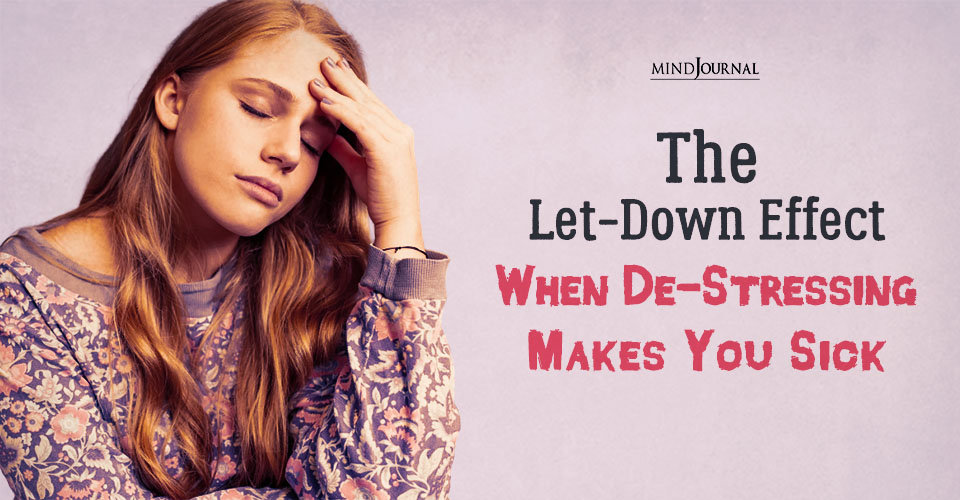
The Let-Down Effect: When De-Stressing Makes You Sick

Author : Marc Schoen Ph.D.

Let-Down Effect: 4 Alarming Post-Stress Illnesses

What you need to know about the let-down effect now.

Key points

  • The price of struggle is not paid during the battle; it is collected afterward.
  • Illness may be less about how much stress you face, and more about how much threat you feel.
  • Stress is the surface, and fear is the toxin underneath.

Twenty-five years have passed since I first described the syndrome I later called The Let-Down Effect in my book When Relaxation Is Hazardous to Your Health (2001). At the time, the relationship of stress and illness had been well established. What had not been discussed was the relationship between relaxation and illness, and the Let- Down Effect was not even a searchable term in Google. Today, however, the idea resonates with many people who recognize a familiar pattern in their own lives: They become ill, exhausted, or emotionally depleted not during stressful periods, but immediately after the pressure lifts and they begin to relax.

Over the past two decades, through clinical practice, teaching, research discussions, and thousands of communications from readers and patients, I have come to appreciate how widely this pattern appears. What began as an observation about post-stress illness over weekends and holidays now seems connected to a broad range of health and performance problems.

Read More Here: 10 โ€˜Silent Burnoutโ€™ Symptoms That Sneak Up On High Achievers

What Is the Let-Down Effect?

The Let-Down Effect: When De-Stressing Makes You Sick

The Let-Down Effect (LDE) occurs when a period of sustained activationโ€”whether from positive excitement or negative excitementโ€”is followed by a sudden drop in physiological arousal. A useful analogy is a car traveling at high speed that abruptly slams on the brakes. The body has difficulty adjusting instantly to the shift.

During prolonged stress, the body mobilizes energy through hormones such as cortisol and other adrenal stress chemicals. These substances help the body cope with immediate demands by increasing alertness, boosting immune activity (upregulated), and suppressing certain inflammatory responses.

When the stressful period suddenly ends and the body shifts toward relaxation, the immune soldiers go offline, or, more technically, are โ€œdownregulated.โ€ For a subset of the population, this transition period creates vulnerability to illness, fatigue, pain, and emotional symptoms. Ironically, the moment we expect to feel relief can sometimes become the moment our body struggles most.

Retirement: A Major Let-Down Risk

One of the most significant life transitions associated with the Let-Down Effect is retirement. While retirement is often viewed as a reward after decades of work, it can also represent a sudden loss of structure, purpose, and daily activation. In some individuals, this transition coincides with increased risk of cardiac events, strokes, chronic fatigue, and depression. Understanding this pattern, I have spent years helping executives and professionals prepare psychologically and physiologically for retirement before it occurs.

Retirement without preparation can inadvertently create the conditions for a powerful let-down response. Having a planโ€”maintaining purpose, routines, and meaningful activityโ€”can greatly reduce the risk.

Performance Let-Down in Athletics

The Let-Down Effect is also evident in sports. While working with UCLA athletic teams, I frequently observed that athletes or teams that achieved a highly emotional victory often struggled in their next performance. After the intense focus and adrenaline of a major win, the body and mind can enter a post-activation drop that produces sluggishness, reduced concentration, and diminished intensity. Fans sometimes interpret this as lack of motivation, but physiologically it may represent a classic let-down response.

Migraines, Panic Attacks, and Immune Conditions

Another surprising feature of the Let-Down Effect is that many stress-related conditions occur after stress subsides, not during it. Migraines, panic attacks, and autoimmune flare-ups often emerge during periods when individuals finally relaxโ€”such as weekends, vacations, or immediately after major deadlines.

Other conditions for which flare-ups can frequently be associated with let-down periods include:

  • Irritable Bowel Syndrome (IBS)
  • Crohnโ€™s disease and ulcerative colitis
  • Eczema and inflammatory skin disorders
  • chronic fatigue and diffuse pain conditions

During my early years teaching in UCLAโ€™s Department of Gastroenterology, I observed how often IBS symptoms intensified following periods of stress reduction rather than during the stress itself. Many patients reported becoming symptomatic during weekends, vacations, or immediately after completing demanding tasks.

The Role of the Survival Instinct

In my book Your Survival Instinct Is Killing You (2014), I describe how fear and anger can keep the body in a state of excessive activation. When the survival instinct is repeatedly triggered, stress tolerance decreases. The body begins reacting strongly even to relatively minor challenges. As this heightened reactivity grows, the cycle of intense activation followed by sharp let-down becomes more frequent.

Over time, this pattern can contribute to repeated inflammatory episodes and reduced resilience. Because chronic inflammation is now widely recognized as a contributor to aging and disease, poorly managed let-down cycles may also play a role in long-term health decline.

A Different Approach: Discomfort Training

The solution is not to eliminate stress entirelyโ€”an impossible goalโ€”but to change how the brain interprets pressure and discomfort.

Many people automatically interpret discomfort as danger. When this happens, the survival instinct activates unnecessarily, driving the body into high physiological arousal.

I refer to the process of retraining this response as discomfort training.

Discomfort training helps individuals experience pressure, challenge, and physical discomfort without triggering the full survival response. As the brain begins to interpret these sensations as manageable rather than threatening, activation levels stabilize, reducing the likelihood of let-downs.

Rewiring the Stress Response

The encouraging news is that the brain and body are remarkably adaptable. With proper training, individuals can learn to tolerate stress more calmly and recover from it more smoothly.

Instead of dramatic spikes and crashes, the nervous system begins to operate more smoothly. The body runs โ€œcooler,โ€ recovery improves, and let-down episodes may become significantly less frequent. When this occurs, the cycle of excessive activation followed by debilitating let-down can be interrupted.

Rewiring the brain in this manner is not necessarily complex and can often be learned relatively quickly. Yet its implications may be profoundโ€”improving not only health and emotional resilience but also performance, longevity, and quality of life.

Read More Here: Suffering from AI Fatigue? Youโ€™re Not Alone!

Bottom Line

The Let-Down Effect may actually reveal a hidden rule of human biology: We do not break down under stress; we break down when we no longer need to hold it together. The body has evolved to prioritize survival over healing. Sometimes the key to avoiding illness after stress is not simply learning how to relax afterward, but learning how to manage discomfort without triggering the survival instinctโ€™s fear reaction in the first place.


Written by Marc Schoen, Ph.D.
Originally Appeared on Psychology Today
let-down response

Published On:

Last updated on:

Marc Schoen Ph.D.

Marc Schoen, Ph.D. is an Assistant Clinical Professor of Medicine at UCLA Geffen School of Medicine where he teaches courses to medical students on Performance and Decision Making Under Pressure, as well as Hypnosis and Medicine. He is the author of Your Survival Instinct is Killing You (Hudson Street Press, March 2013).

Disclaimer: The informational content on The Minds Journal have been created and reviewed by qualified mental health professionals. They are intended solely for educational and self-awareness purposes and should not be used as a substitute for professional medical advice, diagnosis, or treatment. If you are experiencing emotional distress or have concerns about your mental health, please seek help from a licensed mental health professional or healthcare provider.

Leave a Comment

Today's Horoscope

Weekly Horoscope 26 April To 2 May 2026

Weekly Horoscope 26 April To 2 May 2026

The stars are aligning differently this week, bringing emotional clarity, unexpected shifts in love, and powerful inner growth. Check your zodiac below!

Latest Quizzes

What Is My Core Wound Quiz? 10 Signs That Expose It!

What You Notice First in Someone Isnโ€™t Randomโ€”Take This Quiz to Reveal Your Core Wound

What you notice first in others may quietly mirror your own needs that go unseen and unmet. Take this simple quiz to help you uncover the core wounds hidden beneath that actually shape you.

Latest Quotes

Human Psychology Facts: How These Cognitive Biases Quietly Shape Your Life

Human Psychology Facts: How These Cognitive Biases Quietly Shape Your Life

Human psychology facts show how your brain quietly edits reality. From the Pratfall Effect to the Halo Effect, these cognitive biases influence who you like, what you notice, and how confident you feel.

Readers Blog

Caption This Image and Selected Wisepicks โ€“ 26 April 2026

Caption This Image and Selected Wisepicks โ€“ 26 April 2026

Ready to unleash your inner wordsmith? โœจ??โ˜บ๏ธ Nowโ€™s your chance to show off your wit, charm, or sheer genius in just one line! Whether itโ€™s laugh-out-loud funny or surprisingly deep, we want to hear it.Submit your funniest, wittiest, or most thought-provoking caption in the comments. Weโ€™ll pick 15+ winners to be featured on our website…

Latest Articles

Let-Down Effect: 4 Alarming Post-Stress Illnesses

What you need to know about the let-down effect now.

Key points

  • The price of struggle is not paid during the battle; it is collected afterward.
  • Illness may be less about how much stress you face, and more about how much threat you feel.
  • Stress is the surface, and fear is the toxin underneath.

Twenty-five years have passed since I first described the syndrome I later called The Let-Down Effect in my book When Relaxation Is Hazardous to Your Health (2001). At the time, the relationship of stress and illness had been well established. What had not been discussed was the relationship between relaxation and illness, and the Let- Down Effect was not even a searchable term in Google. Today, however, the idea resonates with many people who recognize a familiar pattern in their own lives: They become ill, exhausted, or emotionally depleted not during stressful periods, but immediately after the pressure lifts and they begin to relax.

Over the past two decades, through clinical practice, teaching, research discussions, and thousands of communications from readers and patients, I have come to appreciate how widely this pattern appears. What began as an observation about post-stress illness over weekends and holidays now seems connected to a broad range of health and performance problems.

Read More Here: 10 โ€˜Silent Burnoutโ€™ Symptoms That Sneak Up On High Achievers

What Is the Let-Down Effect?

The Let-Down Effect: When De-Stressing Makes You Sick

The Let-Down Effect (LDE) occurs when a period of sustained activationโ€”whether from positive excitement or negative excitementโ€”is followed by a sudden drop in physiological arousal. A useful analogy is a car traveling at high speed that abruptly slams on the brakes. The body has difficulty adjusting instantly to the shift.

During prolonged stress, the body mobilizes energy through hormones such as cortisol and other adrenal stress chemicals. These substances help the body cope with immediate demands by increasing alertness, boosting immune activity (upregulated), and suppressing certain inflammatory responses.

When the stressful period suddenly ends and the body shifts toward relaxation, the immune soldiers go offline, or, more technically, are โ€œdownregulated.โ€ For a subset of the population, this transition period creates vulnerability to illness, fatigue, pain, and emotional symptoms. Ironically, the moment we expect to feel relief can sometimes become the moment our body struggles most.

Retirement: A Major Let-Down Risk

One of the most significant life transitions associated with the Let-Down Effect is retirement. While retirement is often viewed as a reward after decades of work, it can also represent a sudden loss of structure, purpose, and daily activation. In some individuals, this transition coincides with increased risk of cardiac events, strokes, chronic fatigue, and depression. Understanding this pattern, I have spent years helping executives and professionals prepare psychologically and physiologically for retirement before it occurs.

Retirement without preparation can inadvertently create the conditions for a powerful let-down response. Having a planโ€”maintaining purpose, routines, and meaningful activityโ€”can greatly reduce the risk.

Performance Let-Down in Athletics

The Let-Down Effect is also evident in sports. While working with UCLA athletic teams, I frequently observed that athletes or teams that achieved a highly emotional victory often struggled in their next performance. After the intense focus and adrenaline of a major win, the body and mind can enter a post-activation drop that produces sluggishness, reduced concentration, and diminished intensity. Fans sometimes interpret this as lack of motivation, but physiologically it may represent a classic let-down response.

Migraines, Panic Attacks, and Immune Conditions

Another surprising feature of the Let-Down Effect is that many stress-related conditions occur after stress subsides, not during it. Migraines, panic attacks, and autoimmune flare-ups often emerge during periods when individuals finally relaxโ€”such as weekends, vacations, or immediately after major deadlines.

Other conditions for which flare-ups can frequently be associated with let-down periods include:

  • Irritable Bowel Syndrome (IBS)
  • Crohnโ€™s disease and ulcerative colitis
  • Eczema and inflammatory skin disorders
  • chronic fatigue and diffuse pain conditions

During my early years teaching in UCLAโ€™s Department of Gastroenterology, I observed how often IBS symptoms intensified following periods of stress reduction rather than during the stress itself. Many patients reported becoming symptomatic during weekends, vacations, or immediately after completing demanding tasks.

The Role of the Survival Instinct

In my book Your Survival Instinct Is Killing You (2014), I describe how fear and anger can keep the body in a state of excessive activation. When the survival instinct is repeatedly triggered, stress tolerance decreases. The body begins reacting strongly even to relatively minor challenges. As this heightened reactivity grows, the cycle of intense activation followed by sharp let-down becomes more frequent.

Over time, this pattern can contribute to repeated inflammatory episodes and reduced resilience. Because chronic inflammation is now widely recognized as a contributor to aging and disease, poorly managed let-down cycles may also play a role in long-term health decline.

A Different Approach: Discomfort Training

The solution is not to eliminate stress entirelyโ€”an impossible goalโ€”but to change how the brain interprets pressure and discomfort.

Many people automatically interpret discomfort as danger. When this happens, the survival instinct activates unnecessarily, driving the body into high physiological arousal.

I refer to the process of retraining this response as discomfort training.

Discomfort training helps individuals experience pressure, challenge, and physical discomfort without triggering the full survival response. As the brain begins to interpret these sensations as manageable rather than threatening, activation levels stabilize, reducing the likelihood of let-downs.

Rewiring the Stress Response

The encouraging news is that the brain and body are remarkably adaptable. With proper training, individuals can learn to tolerate stress more calmly and recover from it more smoothly.

Instead of dramatic spikes and crashes, the nervous system begins to operate more smoothly. The body runs โ€œcooler,โ€ recovery improves, and let-down episodes may become significantly less frequent. When this occurs, the cycle of excessive activation followed by debilitating let-down can be interrupted.

Rewiring the brain in this manner is not necessarily complex and can often be learned relatively quickly. Yet its implications may be profoundโ€”improving not only health and emotional resilience but also performance, longevity, and quality of life.

Read More Here: Suffering from AI Fatigue? Youโ€™re Not Alone!

Bottom Line

The Let-Down Effect may actually reveal a hidden rule of human biology: We do not break down under stress; we break down when we no longer need to hold it together. The body has evolved to prioritize survival over healing. Sometimes the key to avoiding illness after stress is not simply learning how to relax afterward, but learning how to manage discomfort without triggering the survival instinctโ€™s fear reaction in the first place.


Written by Marc Schoen, Ph.D.
Originally Appeared on Psychology Today
let-down response

Published On:

Last updated on:

Marc Schoen Ph.D.

Marc Schoen, Ph.D. is an Assistant Clinical Professor of Medicine at UCLA Geffen School of Medicine where he teaches courses to medical students on Performance and Decision Making Under Pressure, as well as Hypnosis and Medicine. He is the author of Your Survival Instinct is Killing You (Hudson Street Press, March 2013).

Leave a Comment

    Leave a Comment