
4 Ways Gaslighters Attempt To Ruin Your Self Esteem

Author : Amelia Kelley Ph.D.

4 Ways Gaslighters Attempt To Ruin Your Self Esteem

Do you know why gaslighters attempt to ruin your self esteem? So that itโ€™s easier for them to control you. The more they control you, the more your self esteem gets affected. So, whatโ€™s the link between gaslighting and low self esteem, and how does gaslighting ruins self esteem? Letโ€™s find out!

Few people are entirely immune to the effects of gaslighting because its tactics are highly effective. Gaslighting is an attempt made by someone to instil doubt in your perception of reality. It can present in any relationship in which an imbalance of power existsโ€”not just romantic relationships but also relationships with family and friends, at work, in the medical field, in academia or in societal structures as a whole.

The aim to negatively impact ego strengths and personal values causes confusion that makes it difficult to determine when gaslighting is even happening.

The payoff for the gaslighter is the erosion of their targetโ€™s self-esteem, which allows them to gain control over the other person and perpetuate various cycles of abuse. Someone who displays strong self-esteem is threatening to a gaslighter or emotional abuser, as it is more difficult to manipulate them.

In those cases, the gaslighter may double down on their efforts, which is why awareness is key to self-protection.

Related: The Truth About Gaslighting: 10 Things I Wish Iโ€™d Known Before It Happened To Me

4 Ways Gaslighters Attempt to Ruin Your Self Esteem

1. Deception.

Even when presented with evidence, gaslighters will blatantly deny personal wrongdoing, commonly by manipulating the truth. The gaslighter will attempt to make their victim think they are crazy for thinking they would do anything negative in the first place, no matter how bizarre the situation appears.

This form of gaslighting leads to confusion and self-doubt, as the targetโ€™s thoughts will become distorted to fit the gaslighterโ€™s version of reality. An example was when my co-author, survivor and podcast host Kendall Ann Combs, confronted her ex-abuser after he โ€œaccidentallyโ€ cut a chunk of hair off her head.

The situation was so bizarre and startling that when he gaslit her using deception to make her think she was being unreasonable and paranoid, his tactics worked.

Having a firm sense of oneโ€™s own reality is important when considering self-esteem. Studies have shown that reality therapy, which is a client-centred form of cognitive behavioural therapy, is an effective therapy for improving self-esteem. It focuses on improving current situations in our lives, as opposed to fixating on problems from the past, and helping us get needs met in the present.

A gaslighter wants nothing to do with the reality of the present and will instead continue to fixate on the past, which is more difficult to organize and defend.

Gaslighters attempt to ruin your self esteem

2. Indirect Persuasion

This form of gaslighting typically occurs after the early stages of love-bombing when one grows to idealize their abuser. Once they have your trust, they can more effectively make suggestions that are not conducive to your actual desires, appearing innocent while doing so.

Jackson MacKenzie outlined this tactic in his book, Psychopath Free: A gaslighter insults someone from a past relationship, while complimenting you in order to get you to comply with things they want from you now.

Some examples MacKenzie cites include:

  • My ex and I always fought. We never fight.
  • My ex always needed to talk on the phone. Youโ€™re not needy or demanding.
  • My ex would always nag me about getting a job. Youโ€™re so much more understanding.

These โ€œcomplimentsโ€ are actually forms of manipulation meant to silence your desires, needs, and emotions. If you choose to express contrasting thoughts, an abuser will likely counter with the silent treatment or other blatant or passive forms of verbal aggression.

Having your own opinion puts you at risk of losing the idealized version of you theyโ€™ve created, but constantly censoring your thoughts and emotions is harmful for your self-esteem, as it impedes your ability to think for yourself and assert your own needs.

3. Projection

This is a tactic used by a gaslighter who struggles with their own self-esteem, so they aim to ruin yours. The gaslighter will defend their insecurities by denying personal issues and โ€œpushingโ€ them onto others. The phrase, โ€œthe pot calling the kettle blackโ€ is an effective way to describe this form of gaslighting.

Once your self-esteem is negatively impacted, causing self-doubt, it makes accusations about your character flaws more believable.

No one should intentionally want to make you feel bad about yourself or diminish your self-esteem or self-worth, and if you find yourself in a cycle in which someone constantly is, it is likely you are experiencing gaslighting in the form of projection.

Related: 5 Things That Someone Who Is Gaslighting You Will Say

4. Aligning people against the victim

The gaslighter will work to make their target believe that others think they are just as crazy or defective as the gaslighter says they are. This tactic is neither casual nor passive; it is overtly dismissive and aggressive, further eroding self-esteem and making it difficult to connect with positive feelings about oneself.

Imagine if you woke up one day, hospitalized, and were told that you had suffered a mental breakdown and everything you thought happened last week was a dream.

Now imagine it was not just one person who told you this but a collection of people, including those you trust and care about. The effects of a thorough gaslighting regimen can feel just as disarming.

By aligning others against you, it is less likely you will reach out, even though processing your experience and getting support from the people you trust is exactly what is needed.

Reclaiming Your Self-Esteem and Sense of Reality

The last person who will help you reclaim your self-esteem is the one who is gaslighting you. They do not want you to have confidence in your right to joy and love, and so any efforts you make to defend yourself will likely be weaponized with other forms of gaslighting.

Choosing not to go to the gaslighter for confirmation is the first step in reclaiming your self-esteem. Next is addressing your inner self-talk and cognitions. Because self-esteem is an experience realized through thoughts and perceptions, engaging in compassionate self-talk can be a powerful way to regain your self-worth and sense of reality. Self-compassion expert, author and professor Kristen Neff, suggests talking to yourself as you would a friend.
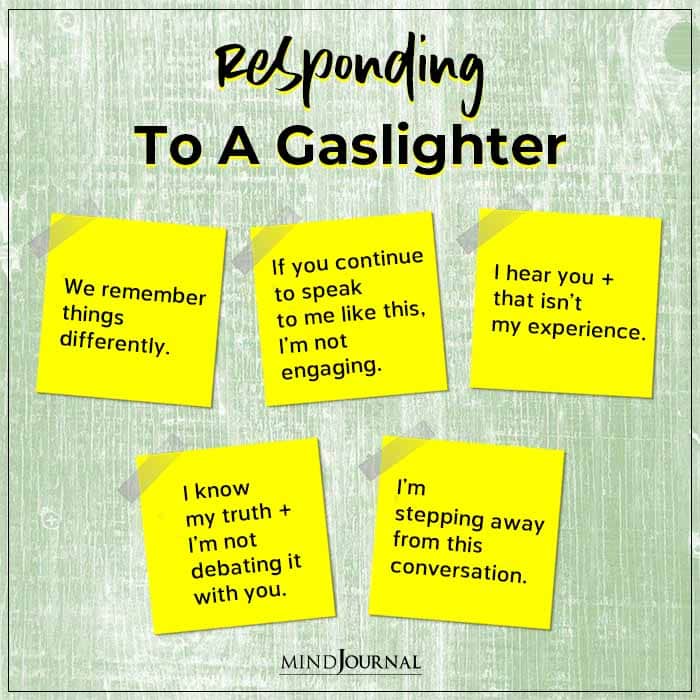
What to do when gaslighters attempt to ruin your self esteem

Try thinking of a goal you are struggling to accomplish and check in about how you normally speak to yourself about it. Now ask yourself if you would say these things to a friend or loved one. If not, how can you reframe these statements to be more compassionate? Having a growth mindset and allowing for mistakes will result in more creative thinking and proactive action.

Finally, and potentially most important, is choosing to surround yourself with supportive people. Get perspectives from others about the gaslighting, and fact check with yourself and with them. If you are not ready to reach out and delve into your painful experiences, spend time with your inner self through journaling, meditation, or speaking out loud.

Related: 15 Signs You Might Be A Victim of Gaslighting

Sorting through your feelings can help you regain your reality, allowing you to remember that you are not crazy, you are not alone, and you are not broken.

Portions of this post were adapted from my book co-authored with Kendall Ann Combs, What I Wish I Knew: Surviving and Thriving After an Abusive Relationship and my forthcoming book, Gaslighting Recovery for Women: The Complete Guide to Recognizing Manipulation and Achieving Freedom from Emotional Abuse.

Check out Ameliaโ€™s Instagram and website, if you are interested to learn more about gaslighting, trauma and the likes. Also, donโ€™t forget to check out her new book, Gaslighting Recovery for Women: The Complete Guide to Recognizing Manipulation and Achieving Freedom from Emotional Abuse.


Written By Amelia Kelley Ph.D.
Originally Appeared On Psychology Today

Published On:

Last updated on:

Amelia Kelley Ph.D.

Amelia Kelley, PhD, MS, LCMHC, ATR, RYT is an author, therapist, teacher, and explorer. Dr. Kelley is a trauma-informed therapist, author, podcaster and researcher. Her specialties include Art therapy, Internal Family Systems (IFS), EMDR and Brainspotting as well as being a certified meditation and Yoga instructor. Her work focuses on womenโ€™s issues, empowering survivors of abuse and relationship trauma, Highly Sensitive Persons, motivation, healthy living, and adult ADHD. She is currently a psychology professor at Yorkville University as well as a nationally recognized relationship expert featured on XM Radioโ€™s Doctor Channel on โ€œThe Psychiatry Showโ€. Her private practice is part of the Traumatic Stress Research Consortium at the Kinsey Institute. She is the author of Gaslighting Recovery for Women: The Complete Guide to Recognizing Manipulation and Achieving Freedom from Emotional Abuse, as well as co-author of What I Wish I Knew: Surviving and Thriving After an Abusive Relationship and a contributing author for Psychology Today as well as the Highly Sensitive Refuge. Her work has been featured in Teen Vogue, Yahoo News, Life Hacker and the Insider.

Disclaimer: The informational content on The Minds Journal have been created and reviewed by qualified mental health professionals. They are intended solely for educational and self-awareness purposes and should not be used as a substitute for professional medical advice, diagnosis, or treatment. If you are experiencing emotional distress or have concerns about your mental health, please seek help from a licensed mental health professional or healthcare provider.

Leave a Comment

Today's Horoscope

Your Daily Horoscope For 30 March, 2026: Free Predictions

Daily Horoscope 30 March, 2026: Prediction For Each Zodiac Sign

Do you want to know what 30 March 2026 has in store for you? Hereโ€™s your daily horoscope!

Latest Quizzes

Fun Bird Personality Test: What Will Happen To You In 3 Days

The Bird Personality Test: Pick A Dove And Reveal What Will Happen To You In The Next 3 Days

Ever wonder how your choices reflect your energy? Take this bird personality test and see what the next 3 days have in store!

Latest Quotes

She Is Who She Is: When Feeling Replaceable Shapes Your Heart

She Is Who She Is: When Feeling Replaceable Shapes Your Heart

She is who she is because she keeps feeling replaceable in relationships. Repeated rejection reshapes your self-worth, but with awareness and healing, you can stop treating yourself like an option.

Readers Blog

Caption This Image and Selected Wisepicks โ€“ 29 March 2026

Caption This Image and Selected Wisepicks โ€“ 29 March 2026

Ready to unleash your inner wordsmith? โœจ??โ˜บ๏ธ Nowโ€™s your chance to show off your wit, charm, or sheer genius in just one line! Whether itโ€™s laugh-out-loud funny or surprisingly deep, we want to hear it.Submit your funniest, wittiest, or most thought-provoking caption in the comments. Weโ€™ll pick 15+ winners to be featured on our website…

Latest Articles

4 Ways Gaslighters Attempt To Ruin Your Self Esteem

Do you know why gaslighters attempt to ruin your self esteem? So that itโ€™s easier for them to control you. The more they control you, the more your self esteem gets affected. So, whatโ€™s the link between gaslighting and low self esteem, and how does gaslighting ruins self esteem? Letโ€™s find out!

Few people are entirely immune to the effects of gaslighting because its tactics are highly effective. Gaslighting is an attempt made by someone to instil doubt in your perception of reality. It can present in any relationship in which an imbalance of power existsโ€”not just romantic relationships but also relationships with family and friends, at work, in the medical field, in academia or in societal structures as a whole.

The aim to negatively impact ego strengths and personal values causes confusion that makes it difficult to determine when gaslighting is even happening.

The payoff for the gaslighter is the erosion of their targetโ€™s self-esteem, which allows them to gain control over the other person and perpetuate various cycles of abuse. Someone who displays strong self-esteem is threatening to a gaslighter or emotional abuser, as it is more difficult to manipulate them.

In those cases, the gaslighter may double down on their efforts, which is why awareness is key to self-protection.

Related: The Truth About Gaslighting: 10 Things I Wish Iโ€™d Known Before It Happened To Me

4 Ways Gaslighters Attempt to Ruin Your Self Esteem

1. Deception.

Even when presented with evidence, gaslighters will blatantly deny personal wrongdoing, commonly by manipulating the truth. The gaslighter will attempt to make their victim think they are crazy for thinking they would do anything negative in the first place, no matter how bizarre the situation appears.

This form of gaslighting leads to confusion and self-doubt, as the targetโ€™s thoughts will become distorted to fit the gaslighterโ€™s version of reality. An example was when my co-author, survivor and podcast host Kendall Ann Combs, confronted her ex-abuser after he โ€œaccidentallyโ€ cut a chunk of hair off her head.

The situation was so bizarre and startling that when he gaslit her using deception to make her think she was being unreasonable and paranoid, his tactics worked.

Having a firm sense of oneโ€™s own reality is important when considering self-esteem. Studies have shown that reality therapy, which is a client-centred form of cognitive behavioural therapy, is an effective therapy for improving self-esteem. It focuses on improving current situations in our lives, as opposed to fixating on problems from the past, and helping us get needs met in the present.

A gaslighter wants nothing to do with the reality of the present and will instead continue to fixate on the past, which is more difficult to organize and defend.

Gaslighters attempt to ruin your self esteem

2. Indirect Persuasion

This form of gaslighting typically occurs after the early stages of love-bombing when one grows to idealize their abuser. Once they have your trust, they can more effectively make suggestions that are not conducive to your actual desires, appearing innocent while doing so.

Jackson MacKenzie outlined this tactic in his book, Psychopath Free: A gaslighter insults someone from a past relationship, while complimenting you in order to get you to comply with things they want from you now.

Some examples MacKenzie cites include:

  • My ex and I always fought. We never fight.
  • My ex always needed to talk on the phone. Youโ€™re not needy or demanding.
  • My ex would always nag me about getting a job. Youโ€™re so much more understanding.

These โ€œcomplimentsโ€ are actually forms of manipulation meant to silence your desires, needs, and emotions. If you choose to express contrasting thoughts, an abuser will likely counter with the silent treatment or other blatant or passive forms of verbal aggression.

Having your own opinion puts you at risk of losing the idealized version of you theyโ€™ve created, but constantly censoring your thoughts and emotions is harmful for your self-esteem, as it impedes your ability to think for yourself and assert your own needs.

3. Projection

This is a tactic used by a gaslighter who struggles with their own self-esteem, so they aim to ruin yours. The gaslighter will defend their insecurities by denying personal issues and โ€œpushingโ€ them onto others. The phrase, โ€œthe pot calling the kettle blackโ€ is an effective way to describe this form of gaslighting.

Once your self-esteem is negatively impacted, causing self-doubt, it makes accusations about your character flaws more believable.

No one should intentionally want to make you feel bad about yourself or diminish your self-esteem or self-worth, and if you find yourself in a cycle in which someone constantly is, it is likely you are experiencing gaslighting in the form of projection.

Related: 5 Things That Someone Who Is Gaslighting You Will Say

4. Aligning people against the victim

The gaslighter will work to make their target believe that others think they are just as crazy or defective as the gaslighter says they are. This tactic is neither casual nor passive; it is overtly dismissive and aggressive, further eroding self-esteem and making it difficult to connect with positive feelings about oneself.

Imagine if you woke up one day, hospitalized, and were told that you had suffered a mental breakdown and everything you thought happened last week was a dream.

Now imagine it was not just one person who told you this but a collection of people, including those you trust and care about. The effects of a thorough gaslighting regimen can feel just as disarming.

By aligning others against you, it is less likely you will reach out, even though processing your experience and getting support from the people you trust is exactly what is needed.

Reclaiming Your Self-Esteem and Sense of Reality

The last person who will help you reclaim your self-esteem is the one who is gaslighting you. They do not want you to have confidence in your right to joy and love, and so any efforts you make to defend yourself will likely be weaponized with other forms of gaslighting.

Choosing not to go to the gaslighter for confirmation is the first step in reclaiming your self-esteem. Next is addressing your inner self-talk and cognitions. Because self-esteem is an experience realized through thoughts and perceptions, engaging in compassionate self-talk can be a powerful way to regain your self-worth and sense of reality. Self-compassion expert, author and professor Kristen Neff, suggests talking to yourself as you would a friend.

What to do when gaslighters attempt to ruin your self esteem

Try thinking of a goal you are struggling to accomplish and check in about how you normally speak to yourself about it. Now ask yourself if you would say these things to a friend or loved one. If not, how can you reframe these statements to be more compassionate? Having a growth mindset and allowing for mistakes will result in more creative thinking and proactive action.

Finally, and potentially most important, is choosing to surround yourself with supportive people. Get perspectives from others about the gaslighting, and fact check with yourself and with them. If you are not ready to reach out and delve into your painful experiences, spend time with your inner self through journaling, meditation, or speaking out loud.

Related: 15 Signs You Might Be A Victim of Gaslighting

Sorting through your feelings can help you regain your reality, allowing you to remember that you are not crazy, you are not alone, and you are not broken.

Portions of this post were adapted from my book co-authored with Kendall Ann Combs, What I Wish I Knew: Surviving and Thriving After an Abusive Relationship and my forthcoming book, Gaslighting Recovery for Women: The Complete Guide to Recognizing Manipulation and Achieving Freedom from Emotional Abuse.

Check out Ameliaโ€™s Instagram and website, if you are interested to learn more about gaslighting, trauma and the likes. Also, donโ€™t forget to check out her new book, Gaslighting Recovery for Women: The Complete Guide to Recognizing Manipulation and Achieving Freedom from Emotional Abuse.


Written By Amelia Kelley Ph.D.
Originally Appeared On Psychology Today

Published On:

Last updated on:

Amelia Kelley Ph.D.

Amelia Kelley, PhD, MS, LCMHC, ATR, RYT is an author, therapist, teacher, and explorer. Dr. Kelley is a trauma-informed therapist, author, podcaster and researcher. Her specialties include Art therapy, Internal Family Systems (IFS), EMDR and Brainspotting as well as being a certified meditation and Yoga instructor. Her work focuses on womenโ€™s issues, empowering survivors of abuse and relationship trauma, Highly Sensitive Persons, motivation, healthy living, and adult ADHD. She is currently a psychology professor at Yorkville University as well as a nationally recognized relationship expert featured on XM Radioโ€™s Doctor Channel on โ€œThe Psychiatry Showโ€. Her private practice is part of the Traumatic Stress Research Consortium at the Kinsey Institute. She is the author of Gaslighting Recovery for Women: The Complete Guide to Recognizing Manipulation and Achieving Freedom from Emotional Abuse, as well as co-author of What I Wish I Knew: Surviving and Thriving After an Abusive Relationship and a contributing author for Psychology Today as well as the Highly Sensitive Refuge. Her work has been featured in Teen Vogue, Yahoo News, Life Hacker and the Insider.

Leave a Comment

    Leave a Comment