Why Some People Attract Dysfunctional Relationships

Author : Sherry Gaba, LCSW

The roots of dysfunctional relationships often lie in childhood. The way we see and interact with relationships is intertwined with our past and that is why we are drawn to repeating those patterns of dysfunctional relationships in our life.


“I found myself in a pattern of being attracted to people who were somehow unavailable, and what I realized was that I was protecting myself because I equate the idea of connection and love with trauma and death.” ― Zachary Quinto

This quote perfectly captures the essence of a dysfunctional relationship.


Most of us tend to pick partners who reflect the vision we have of ourselves and our world. When you think about it, it makes a lot of sense. Compatibility and a sense of ease in a relationship come from having similar preferences, ideas, and values about things like money, religion, monogamy, parenting, and even what makes for good sex.

The Legacy Project at Cornell University even did a study on this. They interviewed hundreds of people who had been married 40 or 50 years, and even longer. Most agreed that shared values are at the core of a healthy, long-lasting marriage.

But we don’t pick the people we’re with based on values alone. We also choose people who have similar ideas about what relationships look like and how they should play out. This sounds good but it can also backfire.


Related: The Kind Of Toxic People You Attract Based on Your Zodiac Sign

The Reason You Tend To Attract Dysfuctional Relationships

If your caregivers never really modeled what healthy relationships look like, that could mean you end up being attracted to partners who remind you of your dysfunctional family relationships – relationships where you never got what you needed.

In other words, if you have a worldview that never really worked for you, you’re more likely to be in a relationship with someone who ultimately can’t give you what you need.

These kinds of choices fulfill that need to stick with what we’re familiar with. So we pick partners who remind us of the dysfunctional parental-child bonds we know so well. There’s a subconscious need to repeat that dysfunction, only this time with a different outcome–a kind of do-over.

In other words, we’ll marry someone who is just like mom and dad (demanding, nurturing, unresponsive to us), but this time they will give us just what we need. We’ll get to live our childhood over, only this time with a happy ending.

But that’s a fantasy. And people who seek out these types of relationships often end up trying to change their partner and control the relationship. The problem is, that never works. If your parents disappointed you, and you pair up with someone who is just like your parents, that person will also disappoint you.
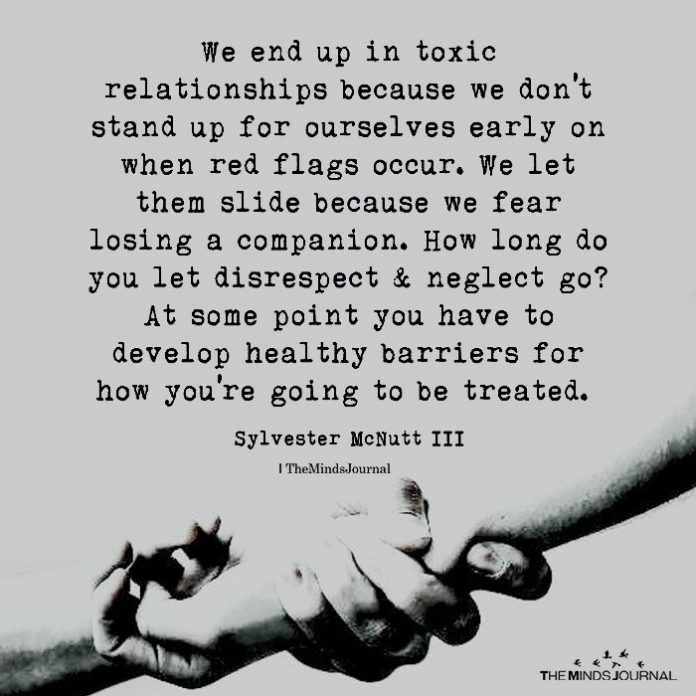


Dysfunctional relationship

Because we tend to pick partners who reflect our worldview, people who are willing to give endlessly, often with little in return, tend to attract people who are happy to take endlessly and give back very little.

When we’re disappointed, though, rather than move on, we start making excuses for our partner. And when we deny what is real in a partner–the bad as well as the good–we lose the ability to assess who we are picking and become more vulnerable to being exploited and even abused.

At the very least, we end up preventing our partners from growing and making the changes they really need to make. After all, if you keep making it easy for your partner to exploit you, they’ve got no reason to change.

Related: 7 Common Traits Shared By People Who Grew Up In Dysfunctional Families

The truth is that you’re powerless to change anyone but yourself, and you’re kidding yourself if you think you can. Only your partner can change themselves, and only if they really want to change.

We might long for a partner to parent the child deep within us – the one who is still angry and unfulfilled – the way we were never parented. But healthy relationships between adults are not about parenting. They are partnerships between equals. As long as we yearn for parents rather than true partners, we will never be able to pick partners who can truly (and realistically) give us what we need as adults.

What this all means is that whenever you focus on fixing someone else, an alarm should go off. It’s a warning that there is something inside of you that needs to be addressed. Focusing on fixing another person is just a way to avoid focusing on yourself and on fixing your own issues.


Sherry Gaba, LCSW is also the author of Love Smacked: How to Stop the Cycle of Relationship Addiction and Codependency to find Everlasting Love and Wake Up Recovery for Codependents.


Written By Sherry Gaba   
Originally Appeared In Sherry Gaba
Why Some People Attract Dysfunctional Relationships pin
some people attract dysfunctional relationship pin


Published On:

Last updated on:

Sherry Gaba, LCSW

Sherry Gaba is a Psychotherapist, Life Coach, and Certified Recovery Coach specializing in individual, couples, family, and group psychotherapy and maintains a private practice in Westlake Village, CA, as well as providing phone and skype appointments. With over twenty years of experience as a clinician, and a graduate of USC specializing in addictions, relationships, co-dependency, trauma, parenting, divorce, and single parenting, she is currently serving as a private practitioner working with a broad spectrum of clients. Sherry is the author of the ground-breaking and award-winning book, The Law of Sobriety: Attracting Positive Energy for a Powerful Recovery.

Disclaimer: The informational content on The Minds Journal have been created and reviewed by qualified mental health professionals. They are intended solely for educational and self-awareness purposes and should not be used as a substitute for professional medical advice, diagnosis, or treatment. If you are experiencing emotional distress or have concerns about your mental health, please seek help from a licensed mental health professional or healthcare provider.

Leave a Comment

Today's Horoscope

Your Daily Horoscope For 4 April, 2026: Free Predictions

Daily Horoscope 4 April, 2026: Prediction For Each Zodiac Sign

Look at your daily prediction and see what the stars have in store for your love life and your future!

Latest Quizzes

How Many Circles Do You See? A Simple Test of Thinking Style

How Many Circles Do You See? Your Answer Might Reveal Narcissistic Traits! 

Take a closer look at this simple image and discover what your circle count reveals about your thinking style, perception, and attention in this fun and engaging visual test.

Latest Quotes

Real Signs Your Body Is Actually in Good Health: How to Know You’re Truly Well

Real Signs Your Body Is Actually in Good Health: How to Know You’re Truly Well

Real signs your body is healthy don’t always show up on lab reports. From good sleep and clear skin to regular digestion and a stable mood, your body is constantly sending quiet signals of wellness.

Readers Blog

Caption This Image and Selected Wisepicks – 5 April 2026

Caption This Image and Selected Wisepicks – 5 April 2026

Ready to unleash your inner wordsmith? ✨??☺️ Now’s your chance to show off your wit, charm, or sheer genius in just one line! Whether it’s laugh-out-loud funny or surprisingly deep, we want to hear it.Submit your funniest, wittiest, or most thought-provoking caption in the comments. We’ll pick 15+ winners to be featured on our website…

Latest Articles

The roots of dysfunctional relationships often lie in childhood. The way we see and interact with relationships is intertwined with our past and that is why we are drawn to repeating those patterns of dysfunctional relationships in our life.


“I found myself in a pattern of being attracted to people who were somehow unavailable, and what I realized was that I was protecting myself because I equate the idea of connection and love with trauma and death.” ― Zachary Quinto

This quote perfectly captures the essence of a dysfunctional relationship.


Most of us tend to pick partners who reflect the vision we have of ourselves and our world. When you think about it, it makes a lot of sense. Compatibility and a sense of ease in a relationship come from having similar preferences, ideas, and values about things like money, religion, monogamy, parenting, and even what makes for good sex.

The Legacy Project at Cornell University even did a study on this. They interviewed hundreds of people who had been married 40 or 50 years, and even longer. Most agreed that shared values are at the core of a healthy, long-lasting marriage.

But we don’t pick the people we’re with based on values alone. We also choose people who have similar ideas about what relationships look like and how they should play out. This sounds good but it can also backfire.


Related: The Kind Of Toxic People You Attract Based on Your Zodiac Sign

The Reason You Tend To Attract Dysfuctional Relationships

If your caregivers never really modeled what healthy relationships look like, that could mean you end up being attracted to partners who remind you of your dysfunctional family relationships – relationships where you never got what you needed.

In other words, if you have a worldview that never really worked for you, you’re more likely to be in a relationship with someone who ultimately can’t give you what you need.

These kinds of choices fulfill that need to stick with what we’re familiar with. So we pick partners who remind us of the dysfunctional parental-child bonds we know so well. There’s a subconscious need to repeat that dysfunction, only this time with a different outcome–a kind of do-over.

In other words, we’ll marry someone who is just like mom and dad (demanding, nurturing, unresponsive to us), but this time they will give us just what we need. We’ll get to live our childhood over, only this time with a happy ending.

But that’s a fantasy. And people who seek out these types of relationships often end up trying to change their partner and control the relationship. The problem is, that never works. If your parents disappointed you, and you pair up with someone who is just like your parents, that person will also disappoint you.


Dysfunctional relationship

Because we tend to pick partners who reflect our worldview, people who are willing to give endlessly, often with little in return, tend to attract people who are happy to take endlessly and give back very little.

When we’re disappointed, though, rather than move on, we start making excuses for our partner. And when we deny what is real in a partner–the bad as well as the good–we lose the ability to assess who we are picking and become more vulnerable to being exploited and even abused.

At the very least, we end up preventing our partners from growing and making the changes they really need to make. After all, if you keep making it easy for your partner to exploit you, they’ve got no reason to change.

Related: 7 Common Traits Shared By People Who Grew Up In Dysfunctional Families

The truth is that you’re powerless to change anyone but yourself, and you’re kidding yourself if you think you can. Only your partner can change themselves, and only if they really want to change.

We might long for a partner to parent the child deep within us – the one who is still angry and unfulfilled – the way we were never parented. But healthy relationships between adults are not about parenting. They are partnerships between equals. As long as we yearn for parents rather than true partners, we will never be able to pick partners who can truly (and realistically) give us what we need as adults.

What this all means is that whenever you focus on fixing someone else, an alarm should go off. It’s a warning that there is something inside of you that needs to be addressed. Focusing on fixing another person is just a way to avoid focusing on yourself and on fixing your own issues.


Sherry Gaba, LCSW is also the author of Love Smacked: How to Stop the Cycle of Relationship Addiction and Codependency to find Everlasting Love and Wake Up Recovery for Codependents.


Written By Sherry Gaba   
Originally Appeared In Sherry Gaba
Why Some People Attract Dysfunctional Relationships pin
some people attract dysfunctional relationship pin


Published On:

Last updated on:

Sherry Gaba, LCSW

Sherry Gaba is a Psychotherapist, Life Coach, and Certified Recovery Coach specializing in individual, couples, family, and group psychotherapy and maintains a private practice in Westlake Village, CA, as well as providing phone and skype appointments. With over twenty years of experience as a clinician, and a graduate of USC specializing in addictions, relationships, co-dependency, trauma, parenting, divorce, and single parenting, she is currently serving as a private practitioner working with a broad spectrum of clients. Sherry is the author of the ground-breaking and award-winning book, The Law of Sobriety: Attracting Positive Energy for a Powerful Recovery.

Leave a Comment

    Leave a Comment