Why You Need To Stop Asking Yourself “Am I An Alcoholic?” The Wrong Question Most People Ask When They Try To Stop Drinking 

Author : Jeanette Hu, AMFT

Are you an alcoholic, and someone who is trying to stop drinking? You must have googled this question at least once “Am I an alcoholic?” This article is going to talk about why asking yourself that question might be doing more harm than good.

Key Points

  • Almost all drinkers focus on the question, “Am I an Alcoholic?” because, in our society, we are conditioned to believe there is an arbitrary line between normal drinkers and problematic drinkers.
  • The question “Am I an Alcoholic” carries a crushing weight, which hinders a drinker’s ability to reflect on their drinking with full honesty.
  • Once we stop fixating on the question, “Am I an Alcoholic?” we can shift our focus to the more important question, “Will my life be better without alcohol?”

Do you know what is the one question almost all people ask before they quit drinking?

“Am I an alcoholic?” is a question many drinkers are too familiar with. As a therapist and an ex-drinker, I have dealt with the question intimately both on a personal and professional level.

As an ex-drinker, only I know how many hours I spent in front of my computer screen, obsessively clicking on link after link, searching for answers that I didn’t want to know.

As a therapist, almost all the individuals I worked with bring up this very question in one way or another, some wish that I would let them off the invisible hook, and others are determined to “prove” to me that they “don’t have a problem.”

As Catherine Gray, the author of The Unexpected Joy of Being Sober, brilliantly pointed out, “The most common thing to do in the year before quitting booze is to hunch over a laptop and miserably type Am I an alcoholic? Into Google at 1 am.”

Related: Does Drinking Really Help You Relax?

Why Do We Fixate On “Am I an Alcoholic?”

Of course, drinkers ask this question for a good reason. Our society is conditioned to separate drinkers into two categories – the “responsible drinkers” vs. the “alcoholics,” or put in a more professionally accepted way, normal drinkers vs. problematic drinkers.

We chose to believe if one falls into the normal drinker category, they are somehow immune to this horrible disease called “alcoholism.” Consuming alcohol on a regular basis is not just acceptable, but also encouraged.

On the other hand, if one falls into the problematic drinker category, all of sudden they become another species that, for whatever reason, can not behave safely around alcohol the way everyone else seems to be able to.

Even professionals sometimes get caught up in the question of whether someone has an alcohol use disorder.” We often conveniently forget the fact that all problem drinkers, at some point, have been normal drinkers.

None of us were born with an alcohol dependency. Yet, we continue to collectively fixate on a question that aims to single out the “problem drinkers” so the rest of the “normal drinkers” can continue to drink “responsibly.”
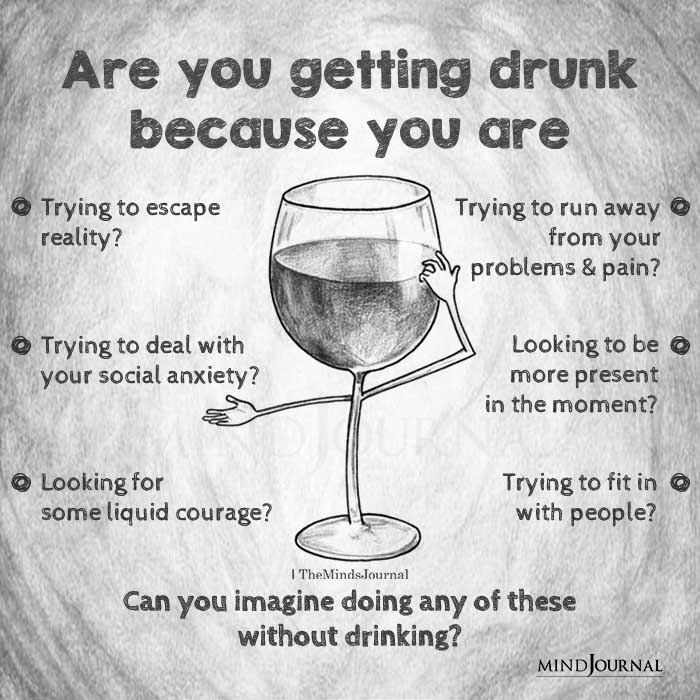
Asking yourself the question, am I an alcoholic?

What’s the Cost of Asking “Am I an Alcoholic?”

One major cost of asking the question, “Am I an alcoholic?” is that the answer “yes” comes with such a high price. The seemingly simple question carries a crushing weight. The label “alcoholic” is extremely alienating.

Not only does it carry an unspeakable amount of shame and stigma, but it is also seen by many as an incurable disease. Answering “yes” to the question is almost like taking on a life sentence that would pronounce one as the “others” who can never again live a life that the rest of the world gets to live.

No wonder drinkers often tend to deny their drinking issue or become highly defensive when challenged. If you ask me, it’s quite an adaptive response to be reluctant to take on such an alienating label.

The unspeakable weight of the question hinders the drinkers’ ability to reflect on their relationships with alcohol with full honesty.

Related: 20 Things People Realize When They Quit Drinking Alcohol

What Would Happen If We Stop Asking “Am I an Alcoholic?”

As an ex-drinker and a therapist who helps other drinkers break their alcohol use patterns, I believe there lies little real value in the question, “Does someone has a substance use disorder?” The answer draws only an arbitrary line among drinkers on a spectrum.

A “normal drinker” today is not immune to becoming a “problem drinker” tomorrow. The only thing such a question accomplishes is to alienate one group or drinkers from another and gives some a false sense of security to continue to consume a socially approved addictive substance.

Both professionals and individuals need to start to shift to the only real question that matters – whether your life would be better with less alcohol. This new question removes the weight that the previous question carries.

Related: 3 Powerful Pointers That Will Help In Preventing Substance Abuse

The answer no longer bears the power to define someone and how they would live the rest of their life. One would finally have the permission to answer the question with full honesty, and free from the fear of repercussions from judgment and stigma.

If you are curious about changing your relationship with alcohol, grab my free 30-Day Toolkit and start to cut down on drinking today.

If you are curious about changing your relationship with alcohol, I created this free 30-Day toolkit to help you cut down on drinking.”(Link to the toolkit: https://youcanhealwellness.com/toolkit/)&nbsp


Written By Jeanette Hu
alcohol use disorder

Published On:

Last updated on:

Jeanette Hu, AMFT

Born in the US and grew up in China, Jeanette moved to the US in her early twenties to pursue a career in Psychology. She knew she wanted to be a therapist since she was a teenager. Growing up in boarding school, she had to navigate the pain of abandonment, institutionalization, and complex attachment trauma at a young age. Jeanette has her share of struggles with addiction. For many years, alcohol was her secret remedy for soothing the unspoken pain within. What started off as a solution later became a problem. Today, Jeanette has been able to find peace and healing in her recovery. With deep empathy and compassion, she is committed to hearing the untold stories of many others who struggle with addiction and helping them to cultivate a new, healthy, and more mindful relationship with substances, and with themselves.

Disclaimer: The informational content on The Minds Journal have been created and reviewed by qualified mental health professionals. They are intended solely for educational and self-awareness purposes and should not be used as a substitute for professional medical advice, diagnosis, or treatment. If you are experiencing emotional distress or have concerns about your mental health, please seek help from a licensed mental health professional or healthcare provider.

Leave a Comment

Today's Horoscope

Weekly Horoscope PART one

Weekly Horoscope 15 March to 21 March 2026

Read your zodiac sign’s prediction to understand the energy surrounding you and how to make the most of the days ahead!

Latest Quizzes

Interesting Finger Personality Test: 4 Finger Lines

Finger Personality Test: Join Your Fingers And Reveal A Hidden Personality Secret!

Look closely at your finger lines. Which pattern do you see? This personality test might surprise you!

Latest Quotes

How Men Show Love Through Actions (Male Psychology in Relationships)

How Men Show Love Through Actions (Male Psychology in Relationships)

Male psychology in relationships shows that men express love through presence, protection, and peace more than poetry. Decode his actions so you can see how deeply he actually cares.

Readers Blog

Caption This Image and Selected Wisepicks – 8 March 2026

Caption This Image and Selected Wisepicks – 8 March 2026

Provide a creative, relevant caption for the picture below and get selected and featured with your name and caption.  Selected Wisepicks We have selected 11 comments as Wisepicks from our Facebook, Facebook Group and Instagram as on 15 March 2026 Lou Angelique Heruela Listen to your inner child,not the angry voices in your mind. Bloom…

Latest Articles

Are you an alcoholic, and someone who is trying to stop drinking? You must have googled this question at least once “Am I an alcoholic?” This article is going to talk about why asking yourself that question might be doing more harm than good.

Key Points

  • Almost all drinkers focus on the question, “Am I an Alcoholic?” because, in our society, we are conditioned to believe there is an arbitrary line between normal drinkers and problematic drinkers.
  • The question “Am I an Alcoholic” carries a crushing weight, which hinders a drinker’s ability to reflect on their drinking with full honesty.
  • Once we stop fixating on the question, “Am I an Alcoholic?” we can shift our focus to the more important question, “Will my life be better without alcohol?”

Do you know what is the one question almost all people ask before they quit drinking?

“Am I an alcoholic?” is a question many drinkers are too familiar with. As a therapist and an ex-drinker, I have dealt with the question intimately both on a personal and professional level.

As an ex-drinker, only I know how many hours I spent in front of my computer screen, obsessively clicking on link after link, searching for answers that I didn’t want to know.

As a therapist, almost all the individuals I worked with bring up this very question in one way or another, some wish that I would let them off the invisible hook, and others are determined to “prove” to me that they “don’t have a problem.”

As Catherine Gray, the author of The Unexpected Joy of Being Sober, brilliantly pointed out, “The most common thing to do in the year before quitting booze is to hunch over a laptop and miserably type Am I an alcoholic? Into Google at 1 am.”

Related: Does Drinking Really Help You Relax?

Why Do We Fixate On “Am I an Alcoholic?”

Of course, drinkers ask this question for a good reason. Our society is conditioned to separate drinkers into two categories – the “responsible drinkers” vs. the “alcoholics,” or put in a more professionally accepted way, normal drinkers vs. problematic drinkers.

We chose to believe if one falls into the normal drinker category, they are somehow immune to this horrible disease called “alcoholism.” Consuming alcohol on a regular basis is not just acceptable, but also encouraged.

On the other hand, if one falls into the problematic drinker category, all of sudden they become another species that, for whatever reason, can not behave safely around alcohol the way everyone else seems to be able to.

Even professionals sometimes get caught up in the question of whether someone has an alcohol use disorder.” We often conveniently forget the fact that all problem drinkers, at some point, have been normal drinkers.

None of us were born with an alcohol dependency. Yet, we continue to collectively fixate on a question that aims to single out the “problem drinkers” so the rest of the “normal drinkers” can continue to drink “responsibly.”

Asking yourself the question, am I an alcoholic?

What’s the Cost of Asking “Am I an Alcoholic?”

One major cost of asking the question, “Am I an alcoholic?” is that the answer “yes” comes with such a high price. The seemingly simple question carries a crushing weight. The label “alcoholic” is extremely alienating.

Not only does it carry an unspeakable amount of shame and stigma, but it is also seen by many as an incurable disease. Answering “yes” to the question is almost like taking on a life sentence that would pronounce one as the “others” who can never again live a life that the rest of the world gets to live.

No wonder drinkers often tend to deny their drinking issue or become highly defensive when challenged. If you ask me, it’s quite an adaptive response to be reluctant to take on such an alienating label.

The unspeakable weight of the question hinders the drinkers’ ability to reflect on their relationships with alcohol with full honesty.

Related: 20 Things People Realize When They Quit Drinking Alcohol

What Would Happen If We Stop Asking “Am I an Alcoholic?”

As an ex-drinker and a therapist who helps other drinkers break their alcohol use patterns, I believe there lies little real value in the question, “Does someone has a substance use disorder?” The answer draws only an arbitrary line among drinkers on a spectrum.

A “normal drinker” today is not immune to becoming a “problem drinker” tomorrow. The only thing such a question accomplishes is to alienate one group or drinkers from another and gives some a false sense of security to continue to consume a socially approved addictive substance.

Both professionals and individuals need to start to shift to the only real question that matters – whether your life would be better with less alcohol. This new question removes the weight that the previous question carries.

Related: 3 Powerful Pointers That Will Help In Preventing Substance Abuse

The answer no longer bears the power to define someone and how they would live the rest of their life. One would finally have the permission to answer the question with full honesty, and free from the fear of repercussions from judgment and stigma.

If you are curious about changing your relationship with alcohol, grab my free 30-Day Toolkit and start to cut down on drinking today.

If you are curious about changing your relationship with alcohol, I created this free 30-Day toolkit to help you cut down on drinking.”(Link to the toolkit: https://youcanhealwellness.com/toolkit/)&nbsp


Written By Jeanette Hu
alcohol use disorder

Published On:

Last updated on:

Jeanette Hu, AMFT

Born in the US and grew up in China, Jeanette moved to the US in her early twenties to pursue a career in Psychology. She knew she wanted to be a therapist since she was a teenager. Growing up in boarding school, she had to navigate the pain of abandonment, institutionalization, and complex attachment trauma at a young age. Jeanette has her share of struggles with addiction. For many years, alcohol was her secret remedy for soothing the unspoken pain within. What started off as a solution later became a problem. Today, Jeanette has been able to find peace and healing in her recovery. With deep empathy and compassion, she is committed to hearing the untold stories of many others who struggle with addiction and helping them to cultivate a new, healthy, and more mindful relationship with substances, and with themselves.

Leave a Comment

    Leave a Comment