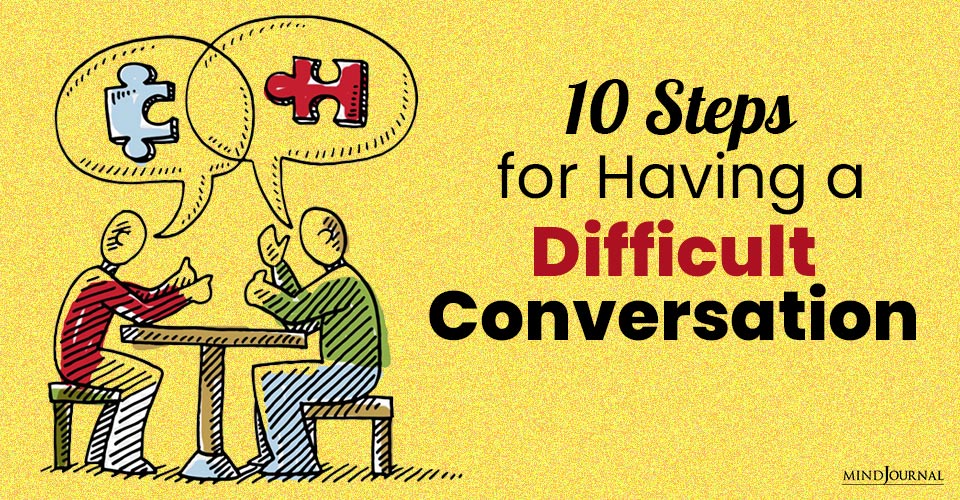
10 Steps for Having a Difficult Conversation

Author : Lauren Florko Ph.D.

It’s natural for anyone to want to avoid a difficult conversation. But given current events today, these conversations are more and more likely to occur. It’s important that we stay open and empathetic in these conversations rather than cut people off.


We need to build connection rather than create larger divides towards extremism.

When you recognize that it’s time to have a difficult conversation, here are 10 steps you can take to prepare and then host the conversation.


1. Find the reason/purpose for having this difficult conversation.

“I want to learn what happened from your perspective.”

“I want to give you a chance to express your views/thoughts.”

“I want to problem-solve together.”


Read: The Art of Conversation: 25 Great Conversation Starters

2. Identify what emotions are connected to this conversation or could be triggered in you.

People know me as the “nice guy” but now this person may think I’m mean.

3. Invite the person to have a conversation based on the purpose identified earlier.

“Hey, I felt that the project didn’t go as well as I wanted and I wanted to get your thoughts as well as discuss mine about what we could have done better. Does meeting later today work for you? Or perhaps next week?”

4. Determine the right way to have a conversation with this individual.

Typically, I prefer to just get to the point, but I know this person is shy. Maybe I should schedule extra time to ensure I don’t push too quickly.

Read: How To Keep a Conversation Going? The Art Of Listening For Hooks

5. Assume positive intent.

.Even though I feel hurt, it’s very unlikely that they actually were trying to hurt me.


6. Fact-find.

“The project got delayed, and I would like to hear your perspective as to why and whether we can prevent future delays.”

7. Clarify and dig deeper.

“It sounds like you were really angry because this reflected poorly on your abilities.” 

Related: 48 Deep Conversation Starters To Know Someone Better

8. Express your perspective.

“I’m anxious about bringing this up but…”

“There are a number of things that I did that made this more difficult…”

“I think the reason this impacts me more is that I don’t like to think of myself as someone who…”

“I’m finding myself reacting emotionally, and I want to ensure that I stay open and positive in this conversation, are you okay if we just take 10 mins?”


9. Problem-solve.

“Now that we understand each other’s perspectives, how do we prevent this from happening in the future? Specifically, who should do what, when?” 

“Let’s test our solution: In a scenario where I notice deadlines are beginning to slip, will our approach help?” 

“When should we meet to see if our solution is working?”

10. Reflect and follow-up.

How do I feel now? Satisfied? Anxious?

“Is our solution working? What do we need to adjust?” 


This post provides you with just the basics for a difficult conversation and high-level details about how to prepare and host the conversation. However, each of these steps requires a great deal of preparation and insight. Here is further information about how to prepare for and host a difficult conversation.


Remember that we tend to judge ourselves by our intentions, but we judge others by their impact (our interpretation of their actions). So even when we have good intentions, we can have a negative impact—and just because you were negatively impacted, doesn’t mean they had negative intentions. Be kind, give people the benefit of the doubt, and find solutions together.

For more information contact Lauren Florko at http://www.triplethreatconsulting.ca/


References

Stone, D., Patton, B., & Heen, S. (1999). Difficult Conversations: How to Discuss What Matters Most. NY: Penguin Group.


Written by: Lauren Florko, Ph.D.
Originally appeared on: Psychology Today


Steps Having Difficult Conversation pin


Published On:

Last updated on:

Lauren Florko Ph.D.

Lauren Florko has a Ph.D. in Industrial/Organizational Psychology focusing on workplace stress. She also owns her own company Triple Threat Consulting based out of Vancouver, British Columbia. She specializes in talent management and for over a decade has worked for public, private, for-profit, and not-for-profit organizations, both at a local and global level. Her goal is to help create a world where employees, organizations, and communities thrive.

Disclaimer: The informational content on The Minds Journal have been created and reviewed by qualified mental health professionals. They are intended solely for educational and self-awareness purposes and should not be used as a substitute for professional medical advice, diagnosis, or treatment. If you are experiencing emotional distress or have concerns about your mental health, please seek help from a licensed mental health professional or healthcare provider.

Leave a Comment

Today's Horoscope

Your Daily Horoscope For 4 April, 2026: Free Predictions

Daily Horoscope 4 April, 2026: Prediction For Each Zodiac Sign

Look at your daily prediction and see what the stars have in store for your love life and your future!

Latest Quizzes

How Many Circles Do You See? A Simple Test of Thinking Style

How Many Circles Do You See? Your Answer Might Reveal Narcissistic Traits! 

Take a closer look at this simple image and discover what your circle count reveals about your thinking style, perception, and attention in this fun and engaging visual test.

Latest Quotes

Real Signs Your Body Is Actually in Good Health: How to Know You’re Truly Well

Real Signs Your Body Is Actually in Good Health: How to Know You’re Truly Well

Real signs your body is healthy don’t always show up on lab reports. From good sleep and clear skin to regular digestion and a stable mood, your body is constantly sending quiet signals of wellness.

Readers Blog

Caption This Image and Selected Wisepicks – 5 April 2026

Caption This Image and Selected Wisepicks – 5 April 2026

Ready to unleash your inner wordsmith? ✨??☺️ Now’s your chance to show off your wit, charm, or sheer genius in just one line! Whether it’s laugh-out-loud funny or surprisingly deep, we want to hear it.Submit your funniest, wittiest, or most thought-provoking caption in the comments. We’ll pick 15+ winners to be featured on our website…

Latest Articles

It’s natural for anyone to want to avoid a difficult conversation. But given current events today, these conversations are more and more likely to occur. It’s important that we stay open and empathetic in these conversations rather than cut people off.


We need to build connection rather than create larger divides towards extremism.

When you recognize that it’s time to have a difficult conversation, here are 10 steps you can take to prepare and then host the conversation.


1. Find the reason/purpose for having this difficult conversation.

“I want to learn what happened from your perspective.”

“I want to give you a chance to express your views/thoughts.”

“I want to problem-solve together.”


Read: The Art of Conversation: 25 Great Conversation Starters

2. Identify what emotions are connected to this conversation or could be triggered in you.

People know me as the “nice guy” but now this person may think I’m mean.

3. Invite the person to have a conversation based on the purpose identified earlier.

“Hey, I felt that the project didn’t go as well as I wanted and I wanted to get your thoughts as well as discuss mine about what we could have done better. Does meeting later today work for you? Or perhaps next week?”

4. Determine the right way to have a conversation with this individual.

Typically, I prefer to just get to the point, but I know this person is shy. Maybe I should schedule extra time to ensure I don’t push too quickly.

Read: How To Keep a Conversation Going? The Art Of Listening For Hooks

5. Assume positive intent.

.Even though I feel hurt, it’s very unlikely that they actually were trying to hurt me.


6. Fact-find.

“The project got delayed, and I would like to hear your perspective as to why and whether we can prevent future delays.”

7. Clarify and dig deeper.

“It sounds like you were really angry because this reflected poorly on your abilities.” 

Related: 48 Deep Conversation Starters To Know Someone Better

8. Express your perspective.

“I’m anxious about bringing this up but…”

“There are a number of things that I did that made this more difficult…”

“I think the reason this impacts me more is that I don’t like to think of myself as someone who…”

“I’m finding myself reacting emotionally, and I want to ensure that I stay open and positive in this conversation, are you okay if we just take 10 mins?”


9. Problem-solve.

“Now that we understand each other’s perspectives, how do we prevent this from happening in the future? Specifically, who should do what, when?” 

“Let’s test our solution: In a scenario where I notice deadlines are beginning to slip, will our approach help?” 

“When should we meet to see if our solution is working?”

10. Reflect and follow-up.

How do I feel now? Satisfied? Anxious?

“Is our solution working? What do we need to adjust?” 


This post provides you with just the basics for a difficult conversation and high-level details about how to prepare and host the conversation. However, each of these steps requires a great deal of preparation and insight. Here is further information about how to prepare for and host a difficult conversation.


Remember that we tend to judge ourselves by our intentions, but we judge others by their impact (our interpretation of their actions). So even when we have good intentions, we can have a negative impact—and just because you were negatively impacted, doesn’t mean they had negative intentions. Be kind, give people the benefit of the doubt, and find solutions together.

For more information contact Lauren Florko at http://www.triplethreatconsulting.ca/


References

Stone, D., Patton, B., & Heen, S. (1999). Difficult Conversations: How to Discuss What Matters Most. NY: Penguin Group.


Written by: Lauren Florko, Ph.D.
Originally appeared on: Psychology Today


Steps Having Difficult Conversation pin


Published On:

Last updated on:

Lauren Florko Ph.D.

Lauren Florko has a Ph.D. in Industrial/Organizational Psychology focusing on workplace stress. She also owns her own company Triple Threat Consulting based out of Vancouver, British Columbia. She specializes in talent management and for over a decade has worked for public, private, for-profit, and not-for-profit organizations, both at a local and global level. Her goal is to help create a world where employees, organizations, and communities thrive.

Leave a Comment

    Leave a Comment