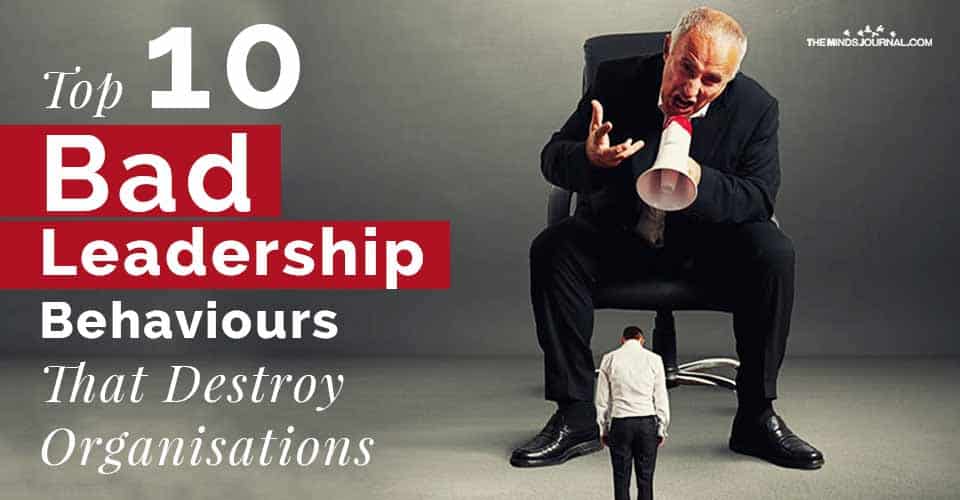
Top 10 Bad Leadership Behaviors That Destroy Organisations

Author : Ronald E. Riggio, Ph.D.

Have you ever had to work under a bad boss? If yes, then you know very well how frustrating, and nerve-wracking it can get.

We’ve all worked for one or more bad bosses. Some of us have had more than our fair share. Bad bosses are a particular problem for good, dedicated employees—those of us who want to make progress in our organizations. Why? Because bad bosses actually work against the best interests of the organization, its employees, and often, its customers and other stakeholders.

What does research on leadership tell us about the bad boss behaviors that are particularly likely to drive good employees crazy?

1. Being “All About Me.” 

This is the narcissistic leader who cares only about him/herself and only about achieving outcomes that benefit the leader. It’s really hard to work for a boss whose only aim is personal reward and advancement, with little concern given to you and your needs and goals.

Want to know more about how to handle a bad boss? Read How to Stay Positive around Negative People

2. Falling Asleep at the Switch. 

This is the leader who simply neglects or refuses to act when action is needed. There is a leadership style known as laissez-faire leadership—which is actually the absence of leadership.

A leader in name only, who doesn’t lead. A different form of bad leadership is called passive management-by-exception. This is the boss who waits until there is a problem before s/he does anything—and then it’s often punitive action (“Who did this?”).

3. Relying on the Wrong People. 

A leader who surrounds him/herself with sycophants and/or incompetents in the inner circle seems to multiply the “bad boss” effect. This means that appealing upward to this dysfunctional leadership team will get you nowhere, and they will drive you crazy.

4. Going Off the Rails. 

There are two ways that bad leaders can go off the rails: they can have difficulties in controlling their negative emotions and lash out at employees; or, they can pursue crazy ideas and strategies that cause the unit or organization to go off the rails and over a cliff.

5. Ignoring Feedback. 

Have you ever had a boss who acts badly or makes a mistake, but simply repeats the same mistake over and over again—despite getting valid feedback that correction is needed?

A boss who doesn’t learn and ignores feedback will definitely drive good workers crazy, as they think, “why is s/he in charge?”

Looking to know more about how you can handle negativity at your workplace? Read How To Deal With Passive-Aggressive People In Your Life

6. Not Being Able to Think Long-Term. 

A leader who is overly-focused on short-term results but gives little concern to the long-term consequences can work against the best interests of the group or organization.

One boss ran his team ragged trying to complete an unimportant but urgent task in order to please a client. As a result, everyone had to drop their long-term projects to help the boss, and everyone suffered.

7. Not Being Able to Communicate. 

For team success, it is crucial that bosses know how to communicate clearly and frequently to team members.

I once had a boss who would circle “mistakes” I had made on proposals, but would never tell me why they were mistakes. It drove me crazy until I was able to report to a different boss, who not only told me what I needed to do but carefully and clearly explained why.

8. Passing the Buck. 

One of the most important aspects of leadership is to take responsibility when things go wrong. But many bosses refuse to own up and instead blame others for failures—it’s maddening, particularly when the leader was the cause of the problem.

9. Not Following Through. 

A friend once told me about her boss, Dennis. Dennis was all talk. He told team members about his great ideas and plans, and he made them promises of pay raises, promotions, and other perks. Unfortunately, Dennis never followed through on any of his promises, and never enacted any of his great plans. He drove the team crazy until management wised up and fired Dennis.

10. Having No Substance. 

A while back, I attended a talk by an incoming university president who, in this talk, painted a picture of the transformation he foresaw—the lofty goals, plans, and programs he wanted to implement at the university. A few months later, I heard that he was fired. When I spoke to some of the faculty, they agreed “he was all talk… he really didn’t know what he was doing… no leadership there.”

Unfortunately, many individuals attain positions of leadership because they look good (like a leader), and they say the right things, but when it comes to substance, there’s no there there. That can really drive employees crazy!

What do good leaders look like?

  • They achieve results and don’t drive their employees/team members crazy in the process.
  • They empower and work with followers to get things done.
  • Through the empowerment process, they develop followers’ leadership capacity.
  • They leave the followers, the team, and the organization better off than when they began leading.

Written By Ronald E. Riggio

Originally Appeared In Psychology Today

Having to deal with a bad boss day in and day out can be really irritating and anger-inducing. Anyone who is bad at being leaders, and always focus on ordering people around, can never be a good boss. After all, being a boss doesn’t mean dominating people, it means to work along with your subordinates in harmony.

If you want to know more about how a bad boss can drive you crazy, then check this video out below:


Bad Leadership Behaviors Destroy Organisations Pin

Published On:

Last updated on:

Ronald E. Riggio, Ph.D.

Ronald E. Riggio, Ph.D., is the Henry R. Kravis Professor of Leadership and Organizational Psychology and former Director of the Kravis Leadership Institute at Claremont McKenna College. Professor Riggio is the author of over 100 books, book chapters, and research articles in the areas of leadership, assessment centers, organizational psychology and social psychology. His most recent books are Leadership Studies (Elgar, 2011), The Art of Followership and The Practice of Leadership (Jossey-Bass, 2008, 2007), Applications of Nonverbal Behavior (co-edited with Robert S. Feldman; Erlbaum, 2005), and Transformational Leadership (2nd ed.), coauthored with Bernard M. Bass (Erlbaum, 2006). Professor Riggio is an Associate Editor of The Leadership Quarterly, and is on the Editorial Boards of Leadership, Leadership Review, Group Dynamics, and the Journal of Nonverbal Behavior, and he was the originator of the Shoptalk column at the Los Angeles Times, a Q&A column dealing with workplace problems/issues.

Disclaimer: The informational content on The Minds Journal have been created and reviewed by qualified mental health professionals. They are intended solely for educational and self-awareness purposes and should not be used as a substitute for professional medical advice, diagnosis, or treatment. If you are experiencing emotional distress or have concerns about your mental health, please seek help from a licensed mental health professional or healthcare provider.

Leave a Comment

Today's Horoscope

Weekly Horoscope 5 April to 11 April 2026

Weekly Horoscope 5 April to 11 April 2026

Something shifts, something becomes clear, and something you ignored refuses to stay hidden. Read more about your zodiac sign and pay attention to what feels different.

Latest Quizzes

Can You Find The Easter Eggs? 10 Hidden Eggs: Look Carefully

No One Can Complete This Easter Egg Hunt Without Missing One—Can You? Take This Quiz Now!

There are 10 hidden eggs in this picture. You have 15 seconds. Can you complete this Easter Egg Hunt without missing one?

Latest Quotes

Real Signs Your Body Is Actually in Good Health: How to Know You’re Truly Well

Real Signs Your Body Is Actually in Good Health: How to Know You’re Truly Well

Real signs your body is healthy don’t always show up on lab reports. From good sleep and clear skin to regular digestion and a stable mood, your body is constantly sending quiet signals of wellness.

Readers Blog

Caption This Image and Selected Wisepicks – 5 April 2026

Caption This Image and Selected Wisepicks – 5 April 2026

Ready to unleash your inner wordsmith? ✨??☺️ Now’s your chance to show off your wit, charm, or sheer genius in just one line! Whether it’s laugh-out-loud funny or surprisingly deep, we want to hear it.Submit your funniest, wittiest, or most thought-provoking caption in the comments. We’ll pick 15+ winners to be featured on our website…

Latest Articles

Have you ever had to work under a bad boss? If yes, then you know very well how frustrating, and nerve-wracking it can get.

We’ve all worked for one or more bad bosses. Some of us have had more than our fair share. Bad bosses are a particular problem for good, dedicated employees—those of us who want to make progress in our organizations. Why? Because bad bosses actually work against the best interests of the organization, its employees, and often, its customers and other stakeholders.

What does research on leadership tell us about the bad boss behaviors that are particularly likely to drive good employees crazy?

1. Being “All About Me.” 

This is the narcissistic leader who cares only about him/herself and only about achieving outcomes that benefit the leader. It’s really hard to work for a boss whose only aim is personal reward and advancement, with little concern given to you and your needs and goals.

Want to know more about how to handle a bad boss? Read How to Stay Positive around Negative People

2. Falling Asleep at the Switch. 

This is the leader who simply neglects or refuses to act when action is needed. There is a leadership style known as laissez-faire leadership—which is actually the absence of leadership.

A leader in name only, who doesn’t lead. A different form of bad leadership is called passive management-by-exception. This is the boss who waits until there is a problem before s/he does anything—and then it’s often punitive action (“Who did this?”).

3. Relying on the Wrong People. 

A leader who surrounds him/herself with sycophants and/or incompetents in the inner circle seems to multiply the “bad boss” effect. This means that appealing upward to this dysfunctional leadership team will get you nowhere, and they will drive you crazy.

4. Going Off the Rails. 

There are two ways that bad leaders can go off the rails: they can have difficulties in controlling their negative emotions and lash out at employees; or, they can pursue crazy ideas and strategies that cause the unit or organization to go off the rails and over a cliff.

5. Ignoring Feedback. 

Have you ever had a boss who acts badly or makes a mistake, but simply repeats the same mistake over and over again—despite getting valid feedback that correction is needed?

A boss who doesn’t learn and ignores feedback will definitely drive good workers crazy, as they think, “why is s/he in charge?”

Looking to know more about how you can handle negativity at your workplace? Read How To Deal With Passive-Aggressive People In Your Life

6. Not Being Able to Think Long-Term. 

A leader who is overly-focused on short-term results but gives little concern to the long-term consequences can work against the best interests of the group or organization.

One boss ran his team ragged trying to complete an unimportant but urgent task in order to please a client. As a result, everyone had to drop their long-term projects to help the boss, and everyone suffered.

7. Not Being Able to Communicate. 

For team success, it is crucial that bosses know how to communicate clearly and frequently to team members.

I once had a boss who would circle “mistakes” I had made on proposals, but would never tell me why they were mistakes. It drove me crazy until I was able to report to a different boss, who not only told me what I needed to do but carefully and clearly explained why.

8. Passing the Buck. 

One of the most important aspects of leadership is to take responsibility when things go wrong. But many bosses refuse to own up and instead blame others for failures—it’s maddening, particularly when the leader was the cause of the problem.

9. Not Following Through. 

A friend once told me about her boss, Dennis. Dennis was all talk. He told team members about his great ideas and plans, and he made them promises of pay raises, promotions, and other perks. Unfortunately, Dennis never followed through on any of his promises, and never enacted any of his great plans. He drove the team crazy until management wised up and fired Dennis.

10. Having No Substance. 

A while back, I attended a talk by an incoming university president who, in this talk, painted a picture of the transformation he foresaw—the lofty goals, plans, and programs he wanted to implement at the university. A few months later, I heard that he was fired. When I spoke to some of the faculty, they agreed “he was all talk… he really didn’t know what he was doing… no leadership there.”

Unfortunately, many individuals attain positions of leadership because they look good (like a leader), and they say the right things, but when it comes to substance, there’s no there there. That can really drive employees crazy!

What do good leaders look like?

  • They achieve results and don’t drive their employees/team members crazy in the process.
  • They empower and work with followers to get things done.
  • Through the empowerment process, they develop followers’ leadership capacity.
  • They leave the followers, the team, and the organization better off than when they began leading.

Written By Ronald E. Riggio

Originally Appeared In Psychology Today

Having to deal with a bad boss day in and day out can be really irritating and anger-inducing. Anyone who is bad at being leaders, and always focus on ordering people around, can never be a good boss. After all, being a boss doesn’t mean dominating people, it means to work along with your subordinates in harmony.

If you want to know more about how a bad boss can drive you crazy, then check this video out below:


Bad Leadership Behaviors Destroy Organisations Pin

Published On:

Last updated on:

Ronald E. Riggio, Ph.D.

Ronald E. Riggio, Ph.D., is the Henry R. Kravis Professor of Leadership and Organizational Psychology and former Director of the Kravis Leadership Institute at Claremont McKenna College. Professor Riggio is the author of over 100 books, book chapters, and research articles in the areas of leadership, assessment centers, organizational psychology and social psychology. His most recent books are Leadership Studies (Elgar, 2011), The Art of Followership and The Practice of Leadership (Jossey-Bass, 2008, 2007), Applications of Nonverbal Behavior (co-edited with Robert S. Feldman; Erlbaum, 2005), and Transformational Leadership (2nd ed.), coauthored with Bernard M. Bass (Erlbaum, 2006). Professor Riggio is an Associate Editor of The Leadership Quarterly, and is on the Editorial Boards of Leadership, Leadership Review, Group Dynamics, and the Journal of Nonverbal Behavior, and he was the originator of the Shoptalk column at the Los Angeles Times, a Q&A column dealing with workplace problems/issues.

Leave a Comment

    Leave a Comment