5 Questions For Men In A Modern Relationship

Author : Konstantin Lukin

The face of relationships is changing in modern times, bringing to the surface some questions for men, that will help them understand relationships better.

Interpersonal relationships touch at the core of who we are, and this need to have our relationship “just right” can consume us.

So what defines the “perfect” relationship? Is it even achievable?

The definition and focus of a “good” relationship have significantly changed in the past half-century or so, and this has created some confusion as we adjust to a new definition of what a great relationship looks like in the 21st century.

Thus, I invite you to explore the following five domains that have evolved over the years, and how today’s relationships have a potential for a happier ending—if you ask the right questions.

1) Do you consider your significant other as a partner?

Today’s Man is adjusting to a new era, where his dad’s advice about relationships is no longer valid, if not downright damaging. Statements like, “I’ve never changed a diaper, and I’m proud of it,” is not an uncommon comment I heard growing up from my own dad.

Not too long ago, relationships (say in the 1950s) had a very strong power differential. Men made most of the money in the household, with less than 10% of women holding jobs above clerical positions. This is in sharp contrast to today, where things are shifting fast.

We, as men need to redefine how we see ourselves in relationships, so ask yourself:

  • Are you seeing yourself through your dad’s lens—meaning, do you have preconceived notions of how financial responsibilities, chores, etc. are shared?
  • How much of your current views are influenced by your past and old thinking style?
  • Is it in your best interest to change how you see yourself and relationships as a whole?
  • What views are currently serving you, and which would you consider revising?

Spend some time contemplating these questions; your relationship will be better for it.

2) Are you emotionally connecting?

This is something that was not on a man’s priority list back in the day. Some “marriage experts” suggested that when a woman gets married, she should take on a doting role, almost like a professional responsibility to attend to her man’s and family’s needs. This, as you can imagine, did not help with an emotional connection to a partner, as a woman was fulfilling a role out of obligation rather than a desire for closeness.

Current theories, in contrast, focus on emotionally focused conversations, where emotional expression and acceptance of partner’s needs are at the forefront of creating a strong, emotional bond. One treatment approach called EFT (Emotionally Focused Therapy) has been shown to be highly effective in helping couples stay in happier, long-lasting relationships.

The challenge I throw out to you, guys, is this – are you man enough to have a deep emotional conversation with your girlfriend or wife? And by that I mean, can you be vulnerable enough where she feels that you can open up and talk about your own areas of growth and challenges?

Related: 5 Signs A Man is Emotionally Attracted To You

How do you balance being a strong, empathetic, warm, and supportive boyfriend/husband, without compromising one’s manhood? We typically alternate between trying to be the alpha male—dominant and in control, and opening up to show the more hidden parts of oneself. If we can tap into how we feel, communicate, and connect with our partners, we will be a more realized Man, where great relationships abound.
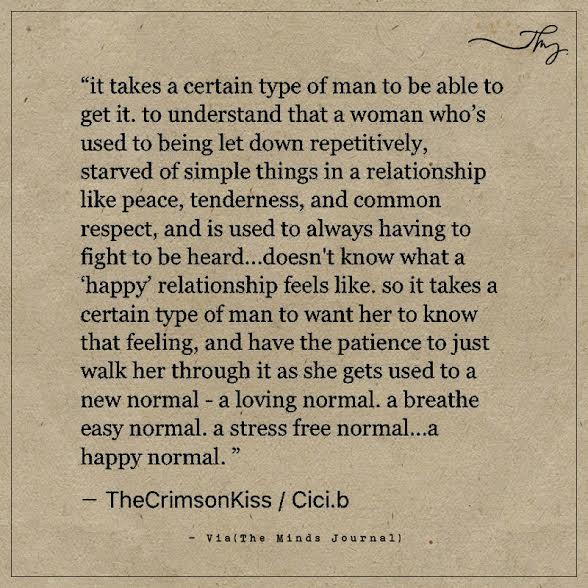
Questions for Men

3) Are you open to less rigid role definitions?

This one focuses more on potential behavioral change in relationships, meaning asking yourself how married are you to your defined role, e.g., as a provider, father, partner, lover?

When we try to fit ourselves into prescribed “boxes,” no one wins. The hope is that today’s relationships focus more on integration, so the question to ask maybe what works for you as a couple? What joint goals do you have, and how, given your individual strength and weaknesses, do you get there?

Is there a way, for example, a wife can fix a broken drawer and a husband wash the night’s dishes, and yet maintain their sense of femininity and masculinity and come together to respect each other’s contributions, however non-traditional they maybe? These are just some ideas to marinate on and hopefully adjust with time.

4) Are you threatened by your partner’s success?

How do you manage your own internal responses, i.e., emotions, when your wife has just told you that she has been promoted and is now at a higher position and pay grade than you?

Are you looking to grow from within? Or are you comparing yourself to her or others and making yourself feel worse in the process? Are you able to be supportive and encouraging regardless of her success? Or, are you taking out your frustrations and anger on her by denigrating her accomplishments just to make yourself feel better, shooting the relationship in the foot?

We need to rise above our own insecurities if we want a relationship where we are appreciated for our manhood, not our bravado.

Related: 25 Qualities Of A Good Man That Separate The Best From The Rest

5) Are you able to have conversations about intimacy?

This one is often difficult for men, for many reasons. We are rarely taught how to communicate (period, but especially) about our intimacy and sexual needs. If you look back at your life, how many times, and with whom, did you ever have an actual conversation about sex (except for bragging to your buddy about a one-night stand—that doesn’t count)? Probably never.

A sense of pride gets in the way.

Related: The Masculinity Myth: Why Men Need To Accept Their Femininity

Above and beyond just having sex, are you talking about each other’s needs when it comes to the bedroom? How do you broach this topic? Can you even envision asking for something that you’d like? Alternatively, are you open to hearing something from your partner that may question your “skill” or how you perceive yourself as a man in the bedroom?

On the surface, these are all simple questions, but asking them of your girlfriend or wife opens up the possibility of discovering that you are not “all that.” Then the question becomes—what do you do with that new information? I guess my point is, lean into these conversations—have them even though they may be uncomfortable—you will be a much stronger man and a better lover for it.

We, as men, need to grow and adapt to the current environment. Nothing about the change in the dynamics of relationships over the past 50 years gives me the impression of doom and gloom. If anything, I feel empowered to have a partner by my side, rather than a dependent.

The old adage “happy wife, happy life” is as true as ever. If we find ways to be content with our own manhood whilst promoting woman’s search for their own definition of what it means to be a modern woman (I have some news for you – they are also struggling with their own re-definition of motherhood and job satisfaction, which is well illustrated in Sheryl Sandberg’s book, Lean in), we will all be individually happier and co-create happier relationships.

I am optimistic about the state of marriage and relationships as a whole. Hopefully, if you consider the aforementioned, you will be on the right track for a more fulfilling partnership as well!

Stay Manly,

Dr. Lukin

Visit Dr. Konstantin Lukin’s website for more such articles.


Written By Konstantin Lukin

Originally Appeared In Psychology Today

The nature of romantic relationships is rapidly changing in this era, and what seemed acceptable 50 years back, are kind of unacceptable now. Growth is imperative when it comes to self-development, and having fulfilling romantic relationships. Gender roles are not rigid anymore like before. These questions which men should ask themselves can give them strong answers when it comes to understanding themselves, and their relationships better.

Questions Men In Modern Relationship Pin

Published On:

Last updated on:

Konstantin Lukin

Konstantin Lukin, Ph.D., is a licensed clinical psychologist who maintains a private practice in Ridgewood and Hoboken, NJ. He has extensive clinical and research experience spanning individuals of all ages, in both inpatient and outpatient settings. He specializes in men’s issues, couple’s counseling, and relationship problems. His therapeutic approach focuses on providing support and practical feedback to help patients effectively address personal challenges. He integrates complementary modalities and techniques to offer a personalized approach tailored to each patient. He has been trained in cognitive-behavioral, dialectical behavior, schema-focused, and emotionally focused therapy, and has also been involved with research projects throughout his career, including two National Institute of Mental Health-funded studies. He is a member of the Association for Behavioral and Cognitive Therapies, New Jersey Psychological Association, Northeast Counties Association of Psychologists, New York State Psychological Association, The International Centre for Excellence in Emotionally Focused Therapy, The New York Center for Emotionally Focused Therapy, the International OCD Foundation, and the Association for Contextual Behavioral Science (ACSB).

Disclaimer: The informational content on The Minds Journal have been created and reviewed by qualified mental health professionals. They are intended solely for educational and self-awareness purposes and should not be used as a substitute for professional medical advice, diagnosis, or treatment. If you are experiencing emotional distress or have concerns about your mental health, please seek help from a licensed mental health professional or healthcare provider.

Leave a Comment

Today's Horoscope

Daily Horoscope 25 March 2026: Prediction for Zodiac Signs

Daily Horoscope 25 March, 2026: Prediction For Each Zodiac Sign

Today, the message is simple: stop running on autopilot.

Latest Quizzes

Image Personality Test: Which Woman Reveals Your True Self?

Which Woman Are You? A Personality Test That Reveals Your True Inner Nature

This personality test reveals your true self based on the woman you choose. Simple, fun, and surprisingly accurate!

Latest Quotes

Manipulative Tactics in Relationships: Gaslighting, Love Bombing, and Emotional Control

Manipulative Tactics in Relationships: Gaslighting, Love Bombing, and Emotional Control

Manipulative tactics in relationships often start subtly—gaslighting, love bombing, guilt trips, or mixed signals. Once you recognize these emotional manipulation patterns, you can protect your mental health and step away from toxic dynamics.

Readers Blog

Caption This Image and Selected Wisepicks – 22 March 2026

Caption This Image and Selected Wisepicks – 22 March 2026

Ready to unleash your inner wordsmith? ✨??☺️ Now’s your chance to show off your wit, charm, or sheer genius in just one line! Whether it’s laugh-out-loud funny or surprisingly deep, we want to hear it.Submit your funniest, wittiest, or most thought-provoking caption in the comments. We’ll pick 15+ winners to be featured on our website…

Latest Articles

The face of relationships is changing in modern times, bringing to the surface some questions for men, that will help them understand relationships better.

Interpersonal relationships touch at the core of who we are, and this need to have our relationship “just right” can consume us.

So what defines the “perfect” relationship? Is it even achievable?

The definition and focus of a “good” relationship have significantly changed in the past half-century or so, and this has created some confusion as we adjust to a new definition of what a great relationship looks like in the 21st century.

Thus, I invite you to explore the following five domains that have evolved over the years, and how today’s relationships have a potential for a happier ending—if you ask the right questions.

1) Do you consider your significant other as a partner?

Today’s Man is adjusting to a new era, where his dad’s advice about relationships is no longer valid, if not downright damaging. Statements like, “I’ve never changed a diaper, and I’m proud of it,” is not an uncommon comment I heard growing up from my own dad.

Not too long ago, relationships (say in the 1950s) had a very strong power differential. Men made most of the money in the household, with less than 10% of women holding jobs above clerical positions. This is in sharp contrast to today, where things are shifting fast.

We, as men need to redefine how we see ourselves in relationships, so ask yourself:

  • Are you seeing yourself through your dad’s lens—meaning, do you have preconceived notions of how financial responsibilities, chores, etc. are shared?
  • How much of your current views are influenced by your past and old thinking style?
  • Is it in your best interest to change how you see yourself and relationships as a whole?
  • What views are currently serving you, and which would you consider revising?

Spend some time contemplating these questions; your relationship will be better for it.

2) Are you emotionally connecting?

This is something that was not on a man’s priority list back in the day. Some “marriage experts” suggested that when a woman gets married, she should take on a doting role, almost like a professional responsibility to attend to her man’s and family’s needs. This, as you can imagine, did not help with an emotional connection to a partner, as a woman was fulfilling a role out of obligation rather than a desire for closeness.

Current theories, in contrast, focus on emotionally focused conversations, where emotional expression and acceptance of partner’s needs are at the forefront of creating a strong, emotional bond. One treatment approach called EFT (Emotionally Focused Therapy) has been shown to be highly effective in helping couples stay in happier, long-lasting relationships.

The challenge I throw out to you, guys, is this – are you man enough to have a deep emotional conversation with your girlfriend or wife? And by that I mean, can you be vulnerable enough where she feels that you can open up and talk about your own areas of growth and challenges?

Related: 5 Signs A Man is Emotionally Attracted To You

How do you balance being a strong, empathetic, warm, and supportive boyfriend/husband, without compromising one’s manhood? We typically alternate between trying to be the alpha male—dominant and in control, and opening up to show the more hidden parts of oneself. If we can tap into how we feel, communicate, and connect with our partners, we will be a more realized Man, where great relationships abound.

Questions for Men

3) Are you open to less rigid role definitions?

This one focuses more on potential behavioral change in relationships, meaning asking yourself how married are you to your defined role, e.g., as a provider, father, partner, lover?

When we try to fit ourselves into prescribed “boxes,” no one wins. The hope is that today’s relationships focus more on integration, so the question to ask maybe what works for you as a couple? What joint goals do you have, and how, given your individual strength and weaknesses, do you get there?

Is there a way, for example, a wife can fix a broken drawer and a husband wash the night’s dishes, and yet maintain their sense of femininity and masculinity and come together to respect each other’s contributions, however non-traditional they maybe? These are just some ideas to marinate on and hopefully adjust with time.

4) Are you threatened by your partner’s success?

How do you manage your own internal responses, i.e., emotions, when your wife has just told you that she has been promoted and is now at a higher position and pay grade than you?

Are you looking to grow from within? Or are you comparing yourself to her or others and making yourself feel worse in the process? Are you able to be supportive and encouraging regardless of her success? Or, are you taking out your frustrations and anger on her by denigrating her accomplishments just to make yourself feel better, shooting the relationship in the foot?

We need to rise above our own insecurities if we want a relationship where we are appreciated for our manhood, not our bravado.

Related: 25 Qualities Of A Good Man That Separate The Best From The Rest

5) Are you able to have conversations about intimacy?

This one is often difficult for men, for many reasons. We are rarely taught how to communicate (period, but especially) about our intimacy and sexual needs. If you look back at your life, how many times, and with whom, did you ever have an actual conversation about sex (except for bragging to your buddy about a one-night stand—that doesn’t count)? Probably never.

A sense of pride gets in the way.

Related: The Masculinity Myth: Why Men Need To Accept Their Femininity

Above and beyond just having sex, are you talking about each other’s needs when it comes to the bedroom? How do you broach this topic? Can you even envision asking for something that you’d like? Alternatively, are you open to hearing something from your partner that may question your “skill” or how you perceive yourself as a man in the bedroom?

On the surface, these are all simple questions, but asking them of your girlfriend or wife opens up the possibility of discovering that you are not “all that.” Then the question becomes—what do you do with that new information? I guess my point is, lean into these conversations—have them even though they may be uncomfortable—you will be a much stronger man and a better lover for it.

We, as men, need to grow and adapt to the current environment. Nothing about the change in the dynamics of relationships over the past 50 years gives me the impression of doom and gloom. If anything, I feel empowered to have a partner by my side, rather than a dependent.

The old adage “happy wife, happy life” is as true as ever. If we find ways to be content with our own manhood whilst promoting woman’s search for their own definition of what it means to be a modern woman (I have some news for you – they are also struggling with their own re-definition of motherhood and job satisfaction, which is well illustrated in Sheryl Sandberg’s book, Lean in), we will all be individually happier and co-create happier relationships.

I am optimistic about the state of marriage and relationships as a whole. Hopefully, if you consider the aforementioned, you will be on the right track for a more fulfilling partnership as well!

Stay Manly,

Dr. Lukin

Visit Dr. Konstantin Lukin’s website for more such articles.


Written By Konstantin Lukin

Originally Appeared In Psychology Today

The nature of romantic relationships is rapidly changing in this era, and what seemed acceptable 50 years back, are kind of unacceptable now. Growth is imperative when it comes to self-development, and having fulfilling romantic relationships. Gender roles are not rigid anymore like before. These questions which men should ask themselves can give them strong answers when it comes to understanding themselves, and their relationships better.

Questions Men In Modern Relationship Pin

Published On:

Last updated on:

Konstantin Lukin

Konstantin Lukin, Ph.D., is a licensed clinical psychologist who maintains a private practice in Ridgewood and Hoboken, NJ. He has extensive clinical and research experience spanning individuals of all ages, in both inpatient and outpatient settings. He specializes in men’s issues, couple’s counseling, and relationship problems. His therapeutic approach focuses on providing support and practical feedback to help patients effectively address personal challenges. He integrates complementary modalities and techniques to offer a personalized approach tailored to each patient. He has been trained in cognitive-behavioral, dialectical behavior, schema-focused, and emotionally focused therapy, and has also been involved with research projects throughout his career, including two National Institute of Mental Health-funded studies. He is a member of the Association for Behavioral and Cognitive Therapies, New Jersey Psychological Association, Northeast Counties Association of Psychologists, New York State Psychological Association, The International Centre for Excellence in Emotionally Focused Therapy, The New York Center for Emotionally Focused Therapy, the International OCD Foundation, and the Association for Contextual Behavioral Science (ACSB).

Leave a Comment

    Leave a Comment