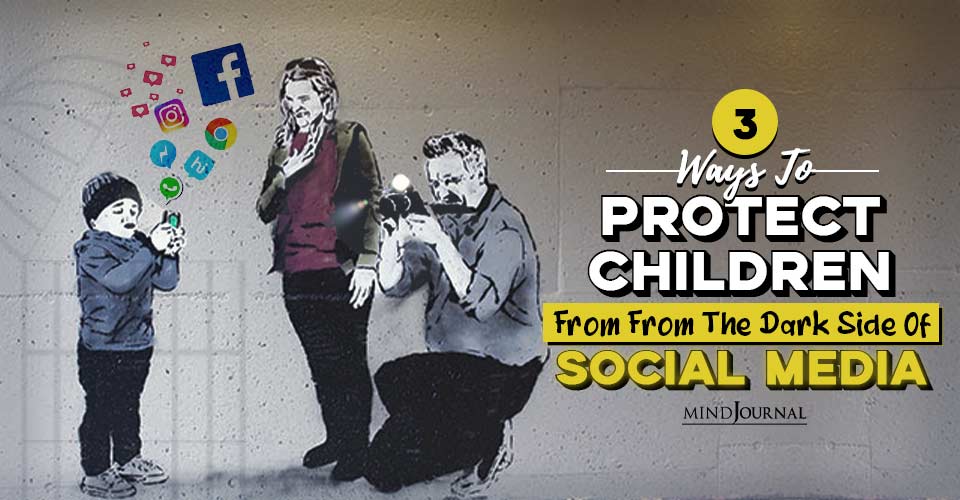
3 Ways To Protect Children From The Dark Side Of Social Media

Author : Dr. Erin Leonard, Ph.D.

Protecting your children from the dark side of social media has become more important than ever, rather it’s a necessity now. Shielding your children from the negative effects of social media and making sure that they don’t go through anything traumatizing is the need of the hour now for most parents.

Key Points

Children are generally more susceptible to social media's negative impact than adults.
Understanding an adolescent's developmental plight can help a parent implement strategies to assist their child.
Recognizing and validating a child's empathic acts may provide proof that he or she is a good and worthwhile person.

Social media is not going away, so protecting a child from its adverse effects is necessary. An awareness of a child’s developmental vulnerabilities and how they clash with the dark side of social media can help keep children safe.

Around the age of 11 or 12, a child’s involvement with friends intensifies. He or she spends more time interacting with peers and less time with family. Although this is normal and healthy, it exposes the child to more of the outside world. The child may also hold her friends’ opinions in high regard and strive to garner their approval.

The influence of friends and the need to be accepted on social media may make an adolescent vulnerable to a specific type of friend.

Historically, this kind of friend has been kind but exhibits a strong streak of narcissism in the adolescent years. Deceptive because she is well behaved in the presence of teachers, coaches, and parents, she saves her unscrupulous and cruel behaviors behind closed doors.

This teen tends to exile a friend with whom she is jealous and utilizes social media to do it. She intentionally excludes one friend from an event and posts dozens of pictures of the gathering on social media. The friend who is singled out and excluded is usually crushed. Unfortunately, the other friends in the group typically comply with the bully’s antics because if they balk, they will be the next to be excluded from the group.

The adolescent is abandoned by her friend group and if she speaks up is likely framed as “dramatic” and a “problem.” Losing a friend group in adolescence is a fate that often feels worse than death to an adolescent.

Related: 12 Ways to Empower Your Child Against Bullying

First, to combat this scenario, a parent can encourage the child to have multiple close friends in various friend groups. For example, a trusted friend on her track team, in her youth group, on her block, and at church. Maintaining close friendships in many areas of her life ensures she is protected because other friend groups will absorb her if she is excluded from one.

A parent who is proactive about encouraging a child to cultivate close relationships in different areas of her life may be extending a lifeline to that child in the teen years when social media is sometimes used as a weapon to hurt, bully, and exclude.

the dark side of social media

In addition to the development of strong peer relationships in the adolescent years, increased independence is also developmentally appropriate. Yet, this developmental stage creates mild vulnerability in a child on social media.

New autonomy spurs an adolescent to think about who she is in relationship to the world. Because she is attempting to discern who she is, she naturally compares herself to others to help her sort it out. Although these comparisons rarely help because there is always someone prettier, smarter, richer, and more popular on social media, it is a common and understandable tendency in the teen years.

A second way to help an adolescent struggling with social media, who may be constantly comparing herself to others, is to educate her on the superficiality of social media. It is a one-dimensional medium, packed with smoke and mirrors which allow people to present themselves as “perfect.”

Assist a child in understanding that the people who constantly need accolades and attention may be compensating for deep and profound unhappiness. Social media only represents a picture of the surface, but rarely goes much deeper.

Another developmental phenomenon in the teen years, which may create an “Achilles heel” with social media, involves the child’s identity. New independence in the teen years requires a young person to make a multitude of decisions a day about who she is and who she wants to be in the world, from how she wants to dress, to whom she wants as friends, to what music she likes.

Related: Does Social Media Increase Teen Depression? This Is What Research Says

This developmental phase is often exciting but also overwhelming and taxing. It is often referred to as identity formation. Because a child’s sense of self is “under construction,” it may be vulnerable to the negative effects of social media.

A third way a parent can help a child in this developmental plight is to be proactive. Due to the superficial nature of social media, it may be necessary to help a child consolidate her self-esteem early. Instead of affirming the child’s achievements and physical appearance, a parent may remember to validate her deeper capacities.

Thoughtfulness, selflessness, humility, effort, empathy, kindness, and conscientiousness are qualities that exemplify strong character. A parent’s focus on these qualities may help the child value who she is instead of what she does.

A child who feels as if she is only as good as her next achievement may have a shaky sense of self. Her self-worth may depend on outside validation and the “win,” causing her world to crash if she is not perfect. A parent who reflects and validates a child’s empathy as she walks through life is a parent who offers the childproof of who she is.

Simply telling a child she is smart and pretty in a mirror may not work. Catching a child in an actual act of kindness, empathy, and selflessness as she travels through life means a parent is paying attention and offers evidence to the child that she is a good and worthwhile person.

The child may be more apt to believe a parent who routinely recognizes the beauty of her heart. This strong sense of self may buffer her from the negative impact of social media.

Social media is not going away and many kids use it to stay connected with each other in positive ways, but the negative side effects can impact a child’s mental health. A recap of the three parental interventions detailed above may help.

Related: The 3 Negative Effects Of Social Media On Our Life

First, ensure she maintains multiple close friendships in various areas of her life. Second, educate her on social media’s superficial nature. Third, strengthen her character by reflecting her deeper capacities as she moves through life. Helping a child shoulder the burden of social media may protect her and keep her safe.


Written By Erin Leonard 
Originally Appeared On Psychology Today 

References:

https://scholar.google.com/scholar?q=journal+articles+on+adolescents+and+importance+of+peer+relationships&hl=en&as_sdt=0&as_vis=1&oi=scholart#d=gs_qabs&u=%23p%3DCV8weU3_clYJ
https://scholar.google.com/scholar?q=journal+articles+on+adolescents+and+identity+formation&hl=en&as_sdt=0&as_vis=1&oi=scholart#d=gs_qabs&u=%23p%3DthwqIDg9968J
https://scholar.google.com/scholar?q=journal+articles+on+adolescents+and+identity+formation&hl=en&as_sdt=0&as_vis=1&oi=scholart#d=gs_qabs&u=%23p%3DYLaJuTchqdQJ
https://scholar.google.com/scholar?q=journal+articles+on+adolescents+and+identity+formation&hl=en&as_sdt=0&as_vis=1&oi=scholart#d=gs_qabs&u=%23p%3DW5_K1Tah5eUJ
https://scholar.google.com/scholar?q=journal.articles+on+impact+of+social+media&hl=en&as_sdt=0&as_vis=1&oi=scholart#d=gs_qabs&u=%23p%3DnSSbhmIkdxQJ
https://scholar.google.com/scholar?q=journal.articles+on+adolescents+and+bullying&hl=en&as_sdt=0&as_vis=1&oi=scholart#d=gs_qabs&u=%23p%3DKz6G54Ff9_IJ
https://scholar.google.com/scholar?q=journal.articles+on+adolescents+and+bullying&hl=en&as_sdt=0&as_vis=1&oi=scholart#d=gs_qabs&u=%23p%3D_qYzgdA2o18J
dark side of social media pin

Published On:

Last updated on:

Dr. Erin Leonard, Ph.D.

Dr. Erin Leonard, Ph.D. is an award-winning researcher, author, and psychotherapist. For more than 20 years, she has helped her clients recover their well-being and improve their mental health. With years of training and a clear understanding of what goes into providing a compassionate approach to psychotherapy, Dr. Leonard provides unique counseling and therapeutic services in the Michiana area. Her extensive training and wealth of experience ensure her clients experience improvement quickly Dr. Leonard specializes in individual, couples, and family therapy. However, her practice is a safe and open space for anyone with the need to be heard, understood, and treated.

Disclaimer: The informational content on The Minds Journal have been created and reviewed by qualified mental health professionals. They are intended solely for educational and self-awareness purposes and should not be used as a substitute for professional medical advice, diagnosis, or treatment. If you are experiencing emotional distress or have concerns about your mental health, please seek help from a licensed mental health professional or healthcare provider.

Leave a Comment

Today's Horoscope

Weekly Horoscope PART one

Weekly Horoscope 15 March to 21 March 2026

Read your zodiac sign’s prediction to understand the energy surrounding you and how to make the most of the days ahead!

Latest Quizzes

Interesting Finger Personality Test: 4 Finger Lines

Finger Personality Test: Join Your Fingers And Reveal A Hidden Personality Secret!

Look closely at your finger lines. Which pattern do you see? This personality test might surprise you!

Latest Quotes

How Men Show Love Through Actions (Male Psychology in Relationships)

How Men Show Love Through Actions (Male Psychology in Relationships)

Male psychology in relationships shows that men express love through presence, protection, and peace more than poetry. Decode his actions so you can see how deeply he actually cares.

Readers Blog

Caption This Image and Selected Wisepicks – 8 March 2026

Caption This Image and Selected Wisepicks – 8 March 2026

Provide a creative, relevant caption for the picture below and get selected and featured with your name and caption.  Selected Wisepicks We have selected 11 comments as Wisepicks from our Facebook, Facebook Group and Instagram as on 15 March 2026 Lou Angelique Heruela Listen to your inner child,not the angry voices in your mind. Bloom…

Latest Articles

Protecting your children from the dark side of social media has become more important than ever, rather it’s a necessity now. Shielding your children from the negative effects of social media and making sure that they don’t go through anything traumatizing is the need of the hour now for most parents.

Key Points

Children are generally more susceptible to social media's negative impact than adults.
Understanding an adolescent's developmental plight can help a parent implement strategies to assist their child.
Recognizing and validating a child's empathic acts may provide proof that he or she is a good and worthwhile person.

Social media is not going away, so protecting a child from its adverse effects is necessary. An awareness of a child’s developmental vulnerabilities and how they clash with the dark side of social media can help keep children safe.

Around the age of 11 or 12, a child’s involvement with friends intensifies. He or she spends more time interacting with peers and less time with family. Although this is normal and healthy, it exposes the child to more of the outside world. The child may also hold her friends’ opinions in high regard and strive to garner their approval.

The influence of friends and the need to be accepted on social media may make an adolescent vulnerable to a specific type of friend.

Historically, this kind of friend has been kind but exhibits a strong streak of narcissism in the adolescent years. Deceptive because she is well behaved in the presence of teachers, coaches, and parents, she saves her unscrupulous and cruel behaviors behind closed doors.

This teen tends to exile a friend with whom she is jealous and utilizes social media to do it. She intentionally excludes one friend from an event and posts dozens of pictures of the gathering on social media. The friend who is singled out and excluded is usually crushed. Unfortunately, the other friends in the group typically comply with the bully’s antics because if they balk, they will be the next to be excluded from the group.

The adolescent is abandoned by her friend group and if she speaks up is likely framed as “dramatic” and a “problem.” Losing a friend group in adolescence is a fate that often feels worse than death to an adolescent.

Related: 12 Ways to Empower Your Child Against Bullying

First, to combat this scenario, a parent can encourage the child to have multiple close friends in various friend groups. For example, a trusted friend on her track team, in her youth group, on her block, and at church. Maintaining close friendships in many areas of her life ensures she is protected because other friend groups will absorb her if she is excluded from one.

A parent who is proactive about encouraging a child to cultivate close relationships in different areas of her life may be extending a lifeline to that child in the teen years when social media is sometimes used as a weapon to hurt, bully, and exclude.

the dark side of social media

In addition to the development of strong peer relationships in the adolescent years, increased independence is also developmentally appropriate. Yet, this developmental stage creates mild vulnerability in a child on social media.

New autonomy spurs an adolescent to think about who she is in relationship to the world. Because she is attempting to discern who she is, she naturally compares herself to others to help her sort it out. Although these comparisons rarely help because there is always someone prettier, smarter, richer, and more popular on social media, it is a common and understandable tendency in the teen years.

A second way to help an adolescent struggling with social media, who may be constantly comparing herself to others, is to educate her on the superficiality of social media. It is a one-dimensional medium, packed with smoke and mirrors which allow people to present themselves as “perfect.”

Assist a child in understanding that the people who constantly need accolades and attention may be compensating for deep and profound unhappiness. Social media only represents a picture of the surface, but rarely goes much deeper.

Another developmental phenomenon in the teen years, which may create an “Achilles heel” with social media, involves the child’s identity. New independence in the teen years requires a young person to make a multitude of decisions a day about who she is and who she wants to be in the world, from how she wants to dress, to whom she wants as friends, to what music she likes.

Related: Does Social Media Increase Teen Depression? This Is What Research Says

This developmental phase is often exciting but also overwhelming and taxing. It is often referred to as identity formation. Because a child’s sense of self is “under construction,” it may be vulnerable to the negative effects of social media.

A third way a parent can help a child in this developmental plight is to be proactive. Due to the superficial nature of social media, it may be necessary to help a child consolidate her self-esteem early. Instead of affirming the child’s achievements and physical appearance, a parent may remember to validate her deeper capacities.

Thoughtfulness, selflessness, humility, effort, empathy, kindness, and conscientiousness are qualities that exemplify strong character. A parent’s focus on these qualities may help the child value who she is instead of what she does.

A child who feels as if she is only as good as her next achievement may have a shaky sense of self. Her self-worth may depend on outside validation and the “win,” causing her world to crash if she is not perfect. A parent who reflects and validates a child’s empathy as she walks through life is a parent who offers the childproof of who she is.

Simply telling a child she is smart and pretty in a mirror may not work. Catching a child in an actual act of kindness, empathy, and selflessness as she travels through life means a parent is paying attention and offers evidence to the child that she is a good and worthwhile person.

The child may be more apt to believe a parent who routinely recognizes the beauty of her heart. This strong sense of self may buffer her from the negative impact of social media.

Social media is not going away and many kids use it to stay connected with each other in positive ways, but the negative side effects can impact a child’s mental health. A recap of the three parental interventions detailed above may help.

Related: The 3 Negative Effects Of Social Media On Our Life

First, ensure she maintains multiple close friendships in various areas of her life. Second, educate her on social media’s superficial nature. Third, strengthen her character by reflecting her deeper capacities as she moves through life. Helping a child shoulder the burden of social media may protect her and keep her safe.


Written By Erin Leonard 
Originally Appeared On Psychology Today 

References:

https://scholar.google.com/scholar?q=journal+articles+on+adolescents+and+importance+of+peer+relationships&hl=en&as_sdt=0&as_vis=1&oi=scholart#d=gs_qabs&u=%23p%3DCV8weU3_clYJ
https://scholar.google.com/scholar?q=journal+articles+on+adolescents+and+identity+formation&hl=en&as_sdt=0&as_vis=1&oi=scholart#d=gs_qabs&u=%23p%3DthwqIDg9968J
https://scholar.google.com/scholar?q=journal+articles+on+adolescents+and+identity+formation&hl=en&as_sdt=0&as_vis=1&oi=scholart#d=gs_qabs&u=%23p%3DYLaJuTchqdQJ
https://scholar.google.com/scholar?q=journal+articles+on+adolescents+and+identity+formation&hl=en&as_sdt=0&as_vis=1&oi=scholart#d=gs_qabs&u=%23p%3DW5_K1Tah5eUJ
https://scholar.google.com/scholar?q=journal.articles+on+impact+of+social+media&hl=en&as_sdt=0&as_vis=1&oi=scholart#d=gs_qabs&u=%23p%3DnSSbhmIkdxQJ
https://scholar.google.com/scholar?q=journal.articles+on+adolescents+and+bullying&hl=en&as_sdt=0&as_vis=1&oi=scholart#d=gs_qabs&u=%23p%3DKz6G54Ff9_IJ
https://scholar.google.com/scholar?q=journal.articles+on+adolescents+and+bullying&hl=en&as_sdt=0&as_vis=1&oi=scholart#d=gs_qabs&u=%23p%3D_qYzgdA2o18J
dark side of social media pin

Published On:

Last updated on:

Dr. Erin Leonard, Ph.D.

Dr. Erin Leonard, Ph.D. is an award-winning researcher, author, and psychotherapist. For more than 20 years, she has helped her clients recover their well-being and improve their mental health. With years of training and a clear understanding of what goes into providing a compassionate approach to psychotherapy, Dr. Leonard provides unique counseling and therapeutic services in the Michiana area. Her extensive training and wealth of experience ensure her clients experience improvement quickly Dr. Leonard specializes in individual, couples, and family therapy. However, her practice is a safe and open space for anyone with the need to be heard, understood, and treated.

Leave a Comment

    Leave a Comment