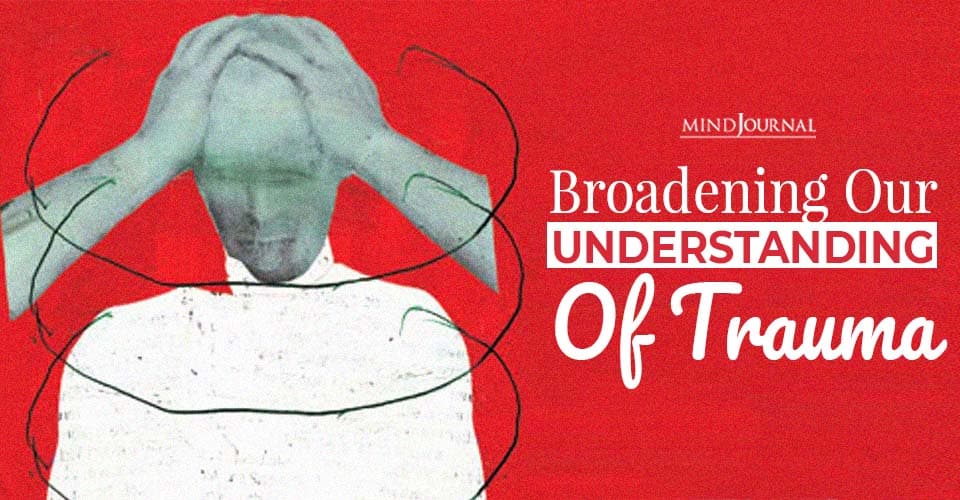
Broadening Our Understanding of Trauma: Why Context Matters

Author : Tahmi Perzichilli, MS, LPCC, LADC

The influence of trauma in mental and chemical health treatment is getting more and more attention. Trauma has many faces. How can we, as therapists, broaden our understanding of trauma and its many symptoms to better serve the people seeking out help?

When we hear the word โ€œtrauma,โ€ we tend to think of events that lead to death or injury. These events might include sexual violence, accidents, war crimes, and/or natural disasters. This is an accurate description of the trauma. It also fulfills the criteria for a diagnosis of post-traumatic stress (PTSD).

But the transmission of the effects of trauma may be far broader and more complicated. Thus, it is important that the intricacies of trauma-related symptoms within interpersonal or systemic contexts continue to gain recognition. When we, as therapists and other helping professionals, increase our awareness of trauma and its varied symptoms, we can better serve people seeking our help.

How is trauma defined in the DSM?

The fifth and newest edition of the Diagnostic and Statistical Manual of Mental Disorders broadened the definition of trauma to include direct or indirect recurring exposure to traumatic events. The broadened definition refers to two types of trauma.

  • Complex trauma,ย which is the result of repetitive, prolonged trauma that occurs in interpersonal relationships with an uneven power dynamic. This type of trauma might includeย neglectย orย abuseย from a caregiver, for example.
  • Vicariousย orย secondary traumaย may be defined as indirect exposure to trauma firsthand or through narratives of the event. In other words,ย this typeย of trauma is often experienced by helping professionals such as therapists.

Read Structural Dissociation: How Complex Trauma Causes A Split In Our Being

Symptom criteria in the DSM-5 for a PTSD diagnosis includes four categories beyond trauma exposure.

  1. Intrusive symptoms,ย such asย flashbacksย or distressingย memories
  2. Avoidance symptoms,ย includingย avoidance of internal or external reminders
  3. Negative alterations in mood or cognition.ย In other words, a person might have aย persistent negative emotional state or negative beliefs about the self or the world.
  4. Hyperarousal symptoms,ย such asย anger, reckless behaviour, or difficulty concentrating

If some symptoms are present and interfere with typical function, but not all symptom criteria is met, a diagnosis of Other or Unspecified Trauma- and Stressor-Related Disorder may be given.

How can a broader diagnostic definition help in understanding trauma?

Exploration of trauma helps broaden the diagnostic definition. Recent findings in neuroscience may also be relevant to the understanding of the contextual factors in interpersonal traumas. Research has found that social exclusion and rejection are mediated by the same aspects as our physical pain system.

Human physiology does not differentiate between social and physical pain. Trauma-related symptoms may result when someone feels threatened or experiences physical harm or injury, either directly or indirectly. But experiences of social exclusion or rejection are likely to result in the same symptoms.

Transgenerational or Intergenerational Trauma

First identified in the 1960s, this type of trauma describes the symptoms experienced by descendants of Holocaust survivors. It occurs when trauma symptoms are present within generations of the same family, beyond the generation of the person who experienced the trauma. This particular trauma may also be present in the context of immigration-related traumas.

Research suggests symptoms may be transmitted to later generations when a parentโ€™s unresolved grief, depression, anxiety, and/or other symptoms interfere with the ability to establish a healthy or secure attachment with their children and consistently meet the emotional needs of their children.

Read The Reason Emotional Trauma Doesnโ€™t Heal and How to Overcome It

Historical Trauma

This type of trauma also involves a subjective reexperiencing and recollection of traumatic events by an individual or a community over multiple generations. The term has origins in the 1980s and is based on the studied traumas of the colonization, relocation, and assimilation of the Native Americans.

The experience of historical trauma is absorbed into the cultural memory of the group, flowing from generation to generation. This is similar to the way non-traumatic aspects of the culture regenerate.

Traumatic stress may be altered in each generation as members continue to witness the effects of trauma on previous generations. As a result, each successive generation may begin to exhibit unique symptoms of trauma.

Racial Trauma

In 2001, the U.S. Surgeon General identified racial trauma as the attributing factor to ethnic and racial disparities. This type of trauma considers the symptoms that may result when a person experiences racism. Some forms of race-based trauma include:

Trauma-related symptoms may result when someone feels threatened or experiences physical harm or injury, either directly or indirectly. But experiences of social exclusion or rejection are likely to result in the same symptoms.

  • Experiencing and/or witnessing racial harassment
  • Ethnoviolence
  • Microaggressions
  • Institutional racism
  • The constant threat of racial or ethnicย discrimination

Research indicates that the more subtle forms of racism lead to constant vigilance, or a kind of โ€œcultural paranoia,โ€ which may serve as a defense mechanism. Experiences of racism may be subtle, but the culmination of these types of race-based trauma often result in traumatization.

Read Can We Inherit Trauma Genetically?

Systemic Trauma

In spite of the above knowledge of the many contexts of traumatic experiences, many socially relevant forms of trauma are not always considered traumatic, even by mental health care providers. This shows the relevance of systemic, or institutional, trauma.

Also known as institutional trauma or betrayal, this type of trauma is defined as the institutional action and inaction that can worsen the impact of traumatic experience. Systemic trauma regards the contextual features that give rise to, maintain, and impact trauma-related responses. There are parallels between the interpersonal and institutional trauma. These include factors of trust and dependency, as well as a lack of sustained awareness across contexts.
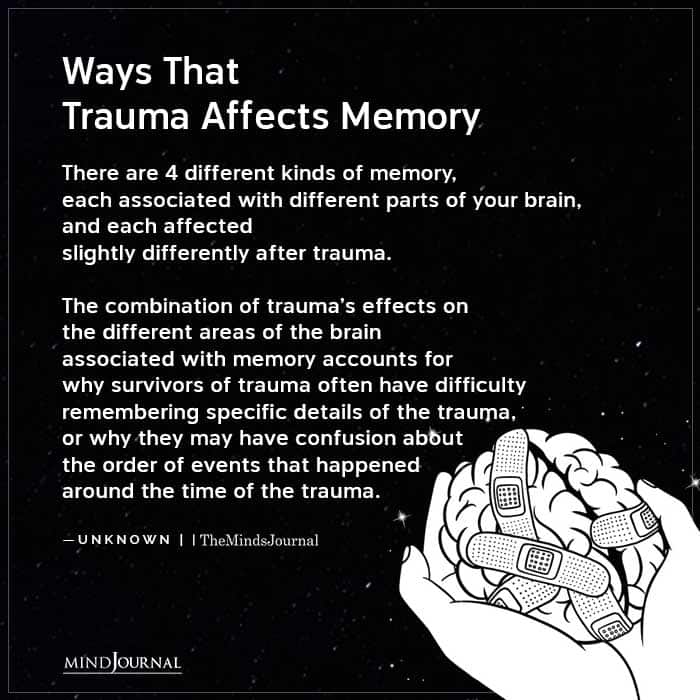
trauma affects memory

How can we impove trauma treatment?

As trauma professionals, it is necessary to acknowledge the above and incorporate systemic approaches in order to better assess, diagnose, and treat trauma. For instance, I ask you to consider an African-American whose current lived experience includes transgenerational trauma, historical trauma, racial trauma, and systemic trauma. Their trauma-related symptoms, such as anger or distrust, may then be interpreted by othersโ€”including those in powerโ€”as character flaws. This only heightens the trauma response, on every level.

It can be challenging to expand our paradigms of trauma. A broadened conceptual framework is necessary, both scientifically and ethically. This perspective extends the conceptualizations of trauma to consider the influence of environments beyond the person themselves.

These might include the following:


  • Schools and universities
  • Churches and other religious institutions
  • The military
  • Workplace settings
  • Hospitals, jails, and prisons
  • Agencies and systems such as police, foster care, immigration, federal assistance, disaster management, and the media
  • Conflicts involving war, torture, terrorism, and refugees
  • Dynamics of racism,ย sexism, discrimination,ย bullying, andย homophobia
  • Issues pertaining to conceptualizations, measurement, methodology, teaching, and intervention.

When we have a good understanding of trauma and consider all these factors, we can provide more specialized treatment to people seeking trauma treatment. Above all, we must remember that context matters.


References:

  1. American Psychiatric Association. (2013).ย Diagnostic and statistical manual of mental disordersย (5th ed.). Arlington, VA: American Psychiatric Publishing.
  2. Carter, R. T. (2006, December 1). Race-based traumatic stress.ย Psychiatric Times, 23(14).ย Retrieved from http://www.psychiatrictimes.com/cultural-psychiatry/race-based-traumatic-stress
  3. Goldsmith, R. E., Martin, C. G., & Smith, C. P. (2014, March 11). Systemic trauma.ย Journal of Trauma & Dissociation, 15(2),ย 117-132.
  4. MacDonald, G., & Leary, M. R. (2005). Why does social exclusion hurt? The relationship between social and physical pain.ย Psychological Bulletin, 131(2), 202-223.
  5. Phipps, R. M., & Degges-White, S. (2014, July 1). A new look at transgenerational trauma transmission: Second-generation Latino immigrant youth.ย Journal of Multicultural Counseling & Development, 42(3),ย 174-187.
  6. Smith, C. P., & Freyd, J. J. (2014). Institutional betrayal.ย American Psychologist, 69(6), 575-587.
  7. Williams, M. T., & Leins, C. (2016). Race-based trauma: The challenge and promise of MDMA-Assisted psychotherapy.ย Multidisciplinary Association for Psychedelic Studies (MAPS) Bulletin, 26,ย 32-37.

Written by: Tahmi Perzichilli
Originally appeared on: Good Therapy
Republished with permission. 
Published On:

Last updated on:

Tahmi Perzichilli, MS, LPCC, LADC

Pulling from both personal and professional experience, I strive to create an environment that enhances and encourages personal growth through providing support and practical feedback. My approach is holistic, person-centered, strength-based, and trauma-informed. With compassion and understanding, I work with each individual to help build upon unique strengths and to achieve the goals that one is committed to accomplishing..

Disclaimer: The informational content on The Minds Journal have been created and reviewed by qualified mental health professionals. They are intended solely for educational and self-awareness purposes and should not be used as a substitute for professional medical advice, diagnosis, or treatment. If you are experiencing emotional distress or have concerns about your mental health, please seek help from a licensed mental health professional or healthcare provider.

Leave a Comment

Today's Horoscope

Your Daily Horoscope For 4 April, 2026: Free Predictions

Daily Horoscope 4 April, 2026: Prediction For Each Zodiac Sign

Look at your daily prediction and see what the stars have in store for your love life and your future!

Latest Quizzes

How Many Circles Do You See? A Simple Test of Thinking Style

How Many Circles Do You See? Your Answer Might Reveal Narcissistic Traits!ย 

Take a closer look at this simple image and discover what your circle count reveals about your thinking style, perception, and attention in this fun and engaging visual test.

Latest Quotes

Real Signs Your Body Is Actually in Good Health: How to Know Youโ€™re Truly Well

Real Signs Your Body Is Actually in Good Health: How to Know Youโ€™re Truly Well

Real signs your body is healthy donโ€™t always show up on lab reports. From good sleep and clear skin to regular digestion and a stable mood, your body is constantly sending quiet signals of wellness.

Readers Blog

Caption This Image and Selected Wisepicks โ€“ 5 April 2026

Caption This Image and Selected Wisepicks โ€“ 5 April 2026

Ready to unleash your inner wordsmith? โœจ??โ˜บ๏ธ Nowโ€™s your chance to show off your wit, charm, or sheer genius in just one line! Whether itโ€™s laugh-out-loud funny or surprisingly deep, we want to hear it.Submit your funniest, wittiest, or most thought-provoking caption in the comments. Weโ€™ll pick 15+ winners to be featured on our website…

Latest Articles

The influence of trauma in mental and chemical health treatment is getting more and more attention. Trauma has many faces. How can we, as therapists, broaden our understanding of trauma and its many symptoms to better serve the people seeking out help?

When we hear the word โ€œtrauma,โ€ we tend to think of events that lead to death or injury. These events might include sexual violence, accidents, war crimes, and/or natural disasters. This is an accurate description of the trauma. It also fulfills the criteria for a diagnosis of post-traumatic stress (PTSD).

But the transmission of the effects of trauma may be far broader and more complicated. Thus, it is important that the intricacies of trauma-related symptoms within interpersonal or systemic contexts continue to gain recognition. When we, as therapists and other helping professionals, increase our awareness of trauma and its varied symptoms, we can better serve people seeking our help.

How is trauma defined in the DSM?

The fifth and newest edition of the Diagnostic and Statistical Manual of Mental Disorders broadened the definition of trauma to include direct or indirect recurring exposure to traumatic events. The broadened definition refers to two types of trauma.

  • Complex trauma,ย which is the result of repetitive, prolonged trauma that occurs in interpersonal relationships with an uneven power dynamic. This type of trauma might includeย neglectย orย abuseย from a caregiver, for example.
  • Vicariousย orย secondary traumaย may be defined as indirect exposure to trauma firsthand or through narratives of the event. In other words,ย this typeย of trauma is often experienced by helping professionals such as therapists.

Read Structural Dissociation: How Complex Trauma Causes A Split In Our Being

Symptom criteria in the DSM-5 for a PTSD diagnosis includes four categories beyond trauma exposure.

  1. Intrusive symptoms,ย such asย flashbacksย or distressingย memories
  2. Avoidance symptoms,ย includingย avoidance of internal or external reminders
  3. Negative alterations in mood or cognition.ย In other words, a person might have aย persistent negative emotional state or negative beliefs about the self or the world.
  4. Hyperarousal symptoms,ย such asย anger, reckless behaviour, or difficulty concentrating

If some symptoms are present and interfere with typical function, but not all symptom criteria is met, a diagnosis of Other or Unspecified Trauma- and Stressor-Related Disorder may be given.

How can a broader diagnostic definition help in understanding trauma?

Exploration of trauma helps broaden the diagnostic definition. Recent findings in neuroscience may also be relevant to the understanding of the contextual factors in interpersonal traumas. Research has found that social exclusion and rejection are mediated by the same aspects as our physical pain system.

Human physiology does not differentiate between social and physical pain. Trauma-related symptoms may result when someone feels threatened or experiences physical harm or injury, either directly or indirectly. But experiences of social exclusion or rejection are likely to result in the same symptoms.

Transgenerational or Intergenerational Trauma

First identified in the 1960s, this type of trauma describes the symptoms experienced by descendants of Holocaust survivors. It occurs when trauma symptoms are present within generations of the same family, beyond the generation of the person who experienced the trauma. This particular trauma may also be present in the context of immigration-related traumas.

Research suggests symptoms may be transmitted to later generations when a parentโ€™s unresolved grief, depression, anxiety, and/or other symptoms interfere with the ability to establish a healthy or secure attachment with their children and consistently meet the emotional needs of their children.

Read The Reason Emotional Trauma Doesnโ€™t Heal and How to Overcome It

Historical Trauma

This type of trauma also involves a subjective reexperiencing and recollection of traumatic events by an individual or a community over multiple generations. The term has origins in the 1980s and is based on the studied traumas of the colonization, relocation, and assimilation of the Native Americans.

The experience of historical trauma is absorbed into the cultural memory of the group, flowing from generation to generation. This is similar to the way non-traumatic aspects of the culture regenerate.

Traumatic stress may be altered in each generation as members continue to witness the effects of trauma on previous generations. As a result, each successive generation may begin to exhibit unique symptoms of trauma.

Racial Trauma

In 2001, the U.S. Surgeon General identified racial trauma as the attributing factor to ethnic and racial disparities. This type of trauma considers the symptoms that may result when a person experiences racism. Some forms of race-based trauma include:

Trauma-related symptoms may result when someone feels threatened or experiences physical harm or injury, either directly or indirectly. But experiences of social exclusion or rejection are likely to result in the same symptoms.

  • Experiencing and/or witnessing racial harassment
  • Ethnoviolence
  • Microaggressions
  • Institutional racism
  • The constant threat of racial or ethnicย discrimination

Research indicates that the more subtle forms of racism lead to constant vigilance, or a kind of โ€œcultural paranoia,โ€ which may serve as a defense mechanism. Experiences of racism may be subtle, but the culmination of these types of race-based trauma often result in traumatization.

Read Can We Inherit Trauma Genetically?

Systemic Trauma

In spite of the above knowledge of the many contexts of traumatic experiences, many socially relevant forms of trauma are not always considered traumatic, even by mental health care providers. This shows the relevance of systemic, or institutional, trauma.

Also known as institutional trauma or betrayal, this type of trauma is defined as the institutional action and inaction that can worsen the impact of traumatic experience. Systemic trauma regards the contextual features that give rise to, maintain, and impact trauma-related responses. There are parallels between the interpersonal and institutional trauma. These include factors of trust and dependency, as well as a lack of sustained awareness across contexts.

trauma affects memory

How can we impove trauma treatment?

As trauma professionals, it is necessary to acknowledge the above and incorporate systemic approaches in order to better assess, diagnose, and treat trauma. For instance, I ask you to consider an African-American whose current lived experience includes transgenerational trauma, historical trauma, racial trauma, and systemic trauma. Their trauma-related symptoms, such as anger or distrust, may then be interpreted by othersโ€”including those in powerโ€”as character flaws. This only heightens the trauma response, on every level.

It can be challenging to expand our paradigms of trauma. A broadened conceptual framework is necessary, both scientifically and ethically. This perspective extends the conceptualizations of trauma to consider the influence of environments beyond the person themselves.

These might include the following:


  • Schools and universities
  • Churches and other religious institutions
  • The military
  • Workplace settings
  • Hospitals, jails, and prisons
  • Agencies and systems such as police, foster care, immigration, federal assistance, disaster management, and the media
  • Conflicts involving war, torture, terrorism, and refugees
  • Dynamics of racism,ย sexism, discrimination,ย bullying, andย homophobia
  • Issues pertaining to conceptualizations, measurement, methodology, teaching, and intervention.

When we have a good understanding of trauma and consider all these factors, we can provide more specialized treatment to people seeking trauma treatment. Above all, we must remember that context matters.


References:

  1. American Psychiatric Association. (2013).ย Diagnostic and statistical manual of mental disordersย (5th ed.). Arlington, VA: American Psychiatric Publishing.
  2. Carter, R. T. (2006, December 1). Race-based traumatic stress.ย Psychiatric Times, 23(14).ย Retrieved from http://www.psychiatrictimes.com/cultural-psychiatry/race-based-traumatic-stress
  3. Goldsmith, R. E., Martin, C. G., & Smith, C. P. (2014, March 11). Systemic trauma.ย Journal of Trauma & Dissociation, 15(2),ย 117-132.
  4. MacDonald, G., & Leary, M. R. (2005). Why does social exclusion hurt? The relationship between social and physical pain.ย Psychological Bulletin, 131(2), 202-223.
  5. Phipps, R. M., & Degges-White, S. (2014, July 1). A new look at transgenerational trauma transmission: Second-generation Latino immigrant youth.ย Journal of Multicultural Counseling & Development, 42(3),ย 174-187.
  6. Smith, C. P., & Freyd, J. J. (2014). Institutional betrayal.ย American Psychologist, 69(6), 575-587.
  7. Williams, M. T., & Leins, C. (2016). Race-based trauma: The challenge and promise of MDMA-Assisted psychotherapy.ย Multidisciplinary Association for Psychedelic Studies (MAPS) Bulletin, 26,ย 32-37.

Written by: Tahmi Perzichilli
Originally appeared on: Good Therapy
Republished with permission. 

Published On:

Last updated on:

Tahmi Perzichilli, MS, LPCC, LADC

Pulling from both personal and professional experience, I strive to create an environment that enhances and encourages personal growth through providing support and practical feedback. My approach is holistic, person-centered, strength-based, and trauma-informed. With compassion and understanding, I work with each individual to help build upon unique strengths and to achieve the goals that one is committed to accomplishing..

Leave a Comment

    Leave a Comment