Invisible Wounds: 10 Ways Unresolved Attachment Trauma Manifests in Adults

Author : Kaytlyn Gillis LCSW-BACS

Your childhood trauma wounds can haunt you for the rest of your life. Unresolved attachment trauma in adults is more common than you think, however, knowing the signs of attachment trauma in adults can help you understand yourself more and take the necessary steps to heal.

Key Points

  • Childhood trauma often refers to traumas experienced in the family of origin during the formative years of our development.
  • Although many traumas result from abuse or neglect, not all are.
  • Some childhood traumas, such as emotional neglect, were not done purposefully. Some parents might not even have known.

Childhood trauma, while a broad term, usually relates to trauma experienced in the formative years while someone lives with their family of origin.

Not all trauma is the result of abuse or neglect, although these are the things most commonly reported by survivors as being the things that stick with them into adulthood and impact relationships and self-esteem.

Many clinicians call these attachment trauma wounds, as they occur as a result of the actionsโ€“or inactionsโ€“of the childโ€™s caregivers during the developmental years, which are the years when attachments are formed.

An attachment wound relates to the trauma from having an abusive, absent, or unavailable parental figure.

Some childhood traumas, such as emotional neglect, were not done purposefullyโ€“especially if the parents were coming from a place of understanding where this type of โ€œemotionally hands-offโ€ parenting was encouraged.

Related: How Adverse Childhood Experiences Affect Emotional Intelligence

Whether it was intentional or not, this wound creates a sense of shame and low self-worth in a child, who often grows into an adult who blames themself for the actions (or inactions) of their parents.

Attachment wounds relate to unresolved feelings from our caregivers and can manifest through mental health concerns, unhealthy behaviors, and poor coping skills, such as substance use or overeating.

Here are some signs that you might have unresolved trauma wounds. It is important to note that not all of these are necessarily related to trauma experiences, especially if they can be explained by other things such as neurodivergence.

However, if you find that you can relate to many of them, it might be a result of trauma wounds.

Unresolved attachment trauma and it's impact on a human being

10 Possible Signs Of Unresolved Attachment Trauma

1. People-pleasing behaviors.

Children who had to fight hard to get the attention of their caregivers learned that making them happy would therefore make their life easier.

They learned from an early age how to engage in people pleasing to avoid the emotional pain of having someone dislike or be upset with them.

2. Perfectionism.

This is especially common in children who are survivors of emotional neglect. In my practice, I find that this happens for one of two reasons: the first is children who learned that doing things perfectlyโ€“such as dance recitals or sports gamesโ€“is the best way to get the limited attention that mom or dad had.

The second most common reason I see this is due to children who had to take care of themselves who learned that making a mistake is unacceptable since they never learned how to cope with the feelings that come from not doing something perfectly.

Related: Inner Child Work: 5 Ways To Heal Deep-Rooted Trauma

3. Constantly comparing yourself to others.

Sometimes this is due to low self-esteem or self-worth. If you were compared against others in childhood, such as other siblings or peers, you might have learned that you did not measure up somehow.

4. Avoiding relationships or getting close to people.

This is often due to fear of getting close to others, which comes from fear of getting hurt. If you were hurt or abandoned in childhood, it is natural to want to avoid thatโ€“even if this decision is not a conscious decision.

5. Jumping from relationship to relationship.

Just like those who avoid relationships to avoid emotional pain, those who jump from one relationship to another are often trying to fill the void that was left by their attachment wounds.

It is almost as if you can somehow prove to yourself that you are truly loveable and worthy by being in a relationship.
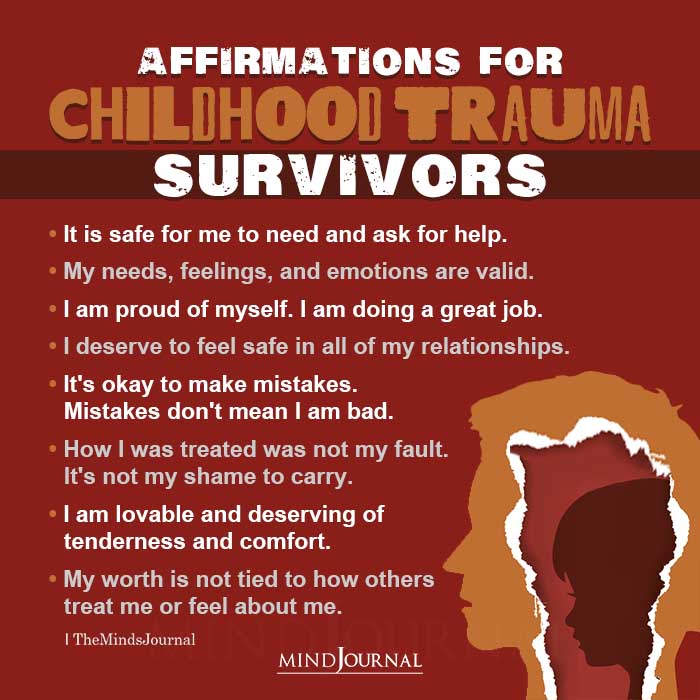
Healing your deep-seated unresolved attachment trauma

6. Too rigid or too loose boundaries.

Having too loose of boundaries, such as letting people walk all over you, is a sign that you learned that it is acceptable to be treated this way. Likewise, those who have too rigid boundaries might be trying to protect themselves.

Related: How Childhood Wounds End Up Haunting You, Even In Your Adulthood

7. Trying to fix others.

If you grew up with a caregiver who struggled with mental illness or substance use, you might carry this need to help and heal others into your adult relationships.

Your inner child is saying, โ€œif I couldnโ€™t have fixed mom/dad, then maybe I can fix my partner.โ€

8. Disordered eating.

There is a strong connection between childhood traumas and disordered eating. Many of my clients with Binge Eating Disorder have traumatic pasts, and eating helps to soothe intrusive thoughts and inner pains.

Likewise, restriction of food and calories is often linked with low self-worth and childhood trauma. In a recent study, โ€œwhen confronting stress, some children went for a favorite snack, while others lost their appetite.โ€ (Gibson-Judkins 2019).

9. Self-medicating with substances /substance misuse.

We know that there is a link between substance misuse or addiction and trauma. People who experience emotional or physical pain are often looking for ways to numb these feelings, sometimes leading to substance misuse.

Healing your deep-seated unresolved attachment trauma

10. Feelings of depression, anxiety, or anger that do not go away.

Occasionally feeling these things is normal and could be situationalโ€“especially if you are dealing with a lot of stress at work or around the holiday season, for example.

However, if you feel that they are not going away, they could be from unresolved inner trauma wounds. Seeking further support can help deal with these feelings.

Related: 10 Ways To Overcome Childhood Trauma: Grow Beyond Your Childhood Trauma And Reclaim Your Life

If you find that you check off a lot of the above, and are looking for further support, here are some ways to heal:

First, acknowledge your truth. Validating your experiences and your history is the first step to healing.

Journaling and self-reflection help many deals with their inner thoughts. Try to focus less on grammar and perfection and more on just getting the thoughts out. Sometimes I will tell clients to write with a crayon, so they focus less on how it looks.

Looking for a trauma-informed therapist can help you work through unresolved pains and traumas if you feel unable to move past them.

References:

Gibson-Judkins, C. (2019). The Link Between Childhood Trauma and Eating Disorders. https://www.egglestonyouthcenter.org/blog/the-link-between-childhood-trโ€ฆ.

Written By Kaytee Gillis
Originally Appeared On Psychology Today

Published On:

Last updated on:

Kaytlyn Gillis LCSW-BACS

Kaytee Gillis, LCSW-BACS, is a psychotherapist, advocate, and author with a passion for working with survivors of family trauma. She received her BA in psychology from Clark University, and her Masterโ€™s from Tulane. Her work focuses on assisting survivors of family and intimate partner abuse and assisting survivors with navigating the legal system to receive protection. Her recent book, Invisible Bruises: How a Better Understanding of the Patterns of Domestic Violence Can Help Survivors Navigate the Legal System, sheds light on the ways that the legal system can perpetuate the cycle of domestic violence by failing to recognize patterns that would otherwise hold perpetrators accountable and protect survivors. Gillis provides training on recognizing patterns of domestic violence, treating the aftermath of abuse, and helping survivors move forward.

Disclaimer: The informational content on The Minds Journal have been created and reviewed by qualified mental health professionals. They are intended solely for educational and self-awareness purposes and should not be used as a substitute for professional medical advice, diagnosis, or treatment. If you are experiencing emotional distress or have concerns about your mental health, please seek help from a licensed mental health professional or healthcare provider.

Response

  1. Rominta

    I had so many tragedies in my life then the best step to get healings from all the wounds and the pains to accept them and surrender them to the ALMIGHTY GOD and to feel His UNCONDITIONAL LOVE who Embrace myself and then I talk to myself,” yes,honey,you are so paint and I love you too much”
    Till know I like to say that words when I feel so sad,my body is so week and enjoy myself after that while taking my favorite food or meal,thank for your sharing on your this journal,
    GBU always

Leave a Comment

Today's Horoscope

Weekly Horoscope PART one

Weekly Horoscope 15 March to 21 March 2026

Read your zodiac signโ€™s prediction to understand the energy surrounding you and how to make the most of the days ahead!

Latest Quizzes

Interesting Finger Personality Test: 4 Finger Lines

Finger Personality Test: Join Your Fingers And Reveal A Hidden Personality Secret!

Look closely at your finger lines. Which pattern do you see? This personality test might surprise you!

Latest Quotes

How Men Show Love Through Actions (Male Psychology in Relationships)

How Men Show Love Through Actions (Male Psychology in Relationships)

Male psychology in relationships shows that men express love through presence, protection, and peace more than poetry. Decode his actions so you can see how deeply he actually cares.

Readers Blog

Caption This Image and Selected Wisepicks โ€“ 8 March 2026

Caption This Image and Selected Wisepicks โ€“ 8 March 2026

Provide a creative, relevant caption for the picture below and get selected and featured with your name and caption.  Selected Wisepicks We have selected 11 comments as Wisepicks from our Facebook, Facebook Group and Instagram as on 15 March 2026 Lou Angelique Heruela Listen to your inner child,not the angry voices in your mind. Bloom…

Latest Articles

Your childhood trauma wounds can haunt you for the rest of your life. Unresolved attachment trauma in adults is more common than you think, however, knowing the signs of attachment trauma in adults can help you understand yourself more and take the necessary steps to heal.

Key Points

  • Childhood trauma often refers to traumas experienced in the family of origin during the formative years of our development.
  • Although many traumas result from abuse or neglect, not all are.
  • Some childhood traumas, such as emotional neglect, were not done purposefully. Some parents might not even have known.

Childhood trauma, while a broad term, usually relates to trauma experienced in the formative years while someone lives with their family of origin.

Not all trauma is the result of abuse or neglect, although these are the things most commonly reported by survivors as being the things that stick with them into adulthood and impact relationships and self-esteem.

Many clinicians call these attachment trauma wounds, as they occur as a result of the actionsโ€“or inactionsโ€“of the childโ€™s caregivers during the developmental years, which are the years when attachments are formed.

An attachment wound relates to the trauma from having an abusive, absent, or unavailable parental figure.

Some childhood traumas, such as emotional neglect, were not done purposefullyโ€“especially if the parents were coming from a place of understanding where this type of โ€œemotionally hands-offโ€ parenting was encouraged.

Related: How Adverse Childhood Experiences Affect Emotional Intelligence

Whether it was intentional or not, this wound creates a sense of shame and low self-worth in a child, who often grows into an adult who blames themself for the actions (or inactions) of their parents.

Attachment wounds relate to unresolved feelings from our caregivers and can manifest through mental health concerns, unhealthy behaviors, and poor coping skills, such as substance use or overeating.

Here are some signs that you might have unresolved trauma wounds. It is important to note that not all of these are necessarily related to trauma experiences, especially if they can be explained by other things such as neurodivergence.

However, if you find that you can relate to many of them, it might be a result of trauma wounds.

Unresolved attachment trauma and it's impact on a human being

10 Possible Signs Of Unresolved Attachment Trauma

1. People-pleasing behaviors.

Children who had to fight hard to get the attention of their caregivers learned that making them happy would therefore make their life easier.

They learned from an early age how to engage in people pleasing to avoid the emotional pain of having someone dislike or be upset with them.

2. Perfectionism.

This is especially common in children who are survivors of emotional neglect. In my practice, I find that this happens for one of two reasons: the first is children who learned that doing things perfectlyโ€“such as dance recitals or sports gamesโ€“is the best way to get the limited attention that mom or dad had.

The second most common reason I see this is due to children who had to take care of themselves who learned that making a mistake is unacceptable since they never learned how to cope with the feelings that come from not doing something perfectly.

Related: Inner Child Work: 5 Ways To Heal Deep-Rooted Trauma

3. Constantly comparing yourself to others.

Sometimes this is due to low self-esteem or self-worth. If you were compared against others in childhood, such as other siblings or peers, you might have learned that you did not measure up somehow.

4. Avoiding relationships or getting close to people.

This is often due to fear of getting close to others, which comes from fear of getting hurt. If you were hurt or abandoned in childhood, it is natural to want to avoid thatโ€“even if this decision is not a conscious decision.

5. Jumping from relationship to relationship.

Just like those who avoid relationships to avoid emotional pain, those who jump from one relationship to another are often trying to fill the void that was left by their attachment wounds.

It is almost as if you can somehow prove to yourself that you are truly loveable and worthy by being in a relationship.

Healing your deep-seated unresolved attachment trauma

6. Too rigid or too loose boundaries.

Having too loose of boundaries, such as letting people walk all over you, is a sign that you learned that it is acceptable to be treated this way. Likewise, those who have too rigid boundaries might be trying to protect themselves.

Related: How Childhood Wounds End Up Haunting You, Even In Your Adulthood

7. Trying to fix others.

If you grew up with a caregiver who struggled with mental illness or substance use, you might carry this need to help and heal others into your adult relationships.

Your inner child is saying, โ€œif I couldnโ€™t have fixed mom/dad, then maybe I can fix my partner.โ€

8. Disordered eating.

There is a strong connection between childhood traumas and disordered eating. Many of my clients with Binge Eating Disorder have traumatic pasts, and eating helps to soothe intrusive thoughts and inner pains.

Likewise, restriction of food and calories is often linked with low self-worth and childhood trauma. In a recent study, โ€œwhen confronting stress, some children went for a favorite snack, while others lost their appetite.โ€ (Gibson-Judkins 2019).

9. Self-medicating with substances /substance misuse.

We know that there is a link between substance misuse or addiction and trauma. People who experience emotional or physical pain are often looking for ways to numb these feelings, sometimes leading to substance misuse.

Healing your deep-seated unresolved attachment trauma

10. Feelings of depression, anxiety, or anger that do not go away.

Occasionally feeling these things is normal and could be situationalโ€“especially if you are dealing with a lot of stress at work or around the holiday season, for example.

However, if you feel that they are not going away, they could be from unresolved inner trauma wounds. Seeking further support can help deal with these feelings.

Related: 10 Ways To Overcome Childhood Trauma: Grow Beyond Your Childhood Trauma And Reclaim Your Life

If you find that you check off a lot of the above, and are looking for further support, here are some ways to heal:

First, acknowledge your truth. Validating your experiences and your history is the first step to healing.

Journaling and self-reflection help many deals with their inner thoughts. Try to focus less on grammar and perfection and more on just getting the thoughts out. Sometimes I will tell clients to write with a crayon, so they focus less on how it looks.

Looking for a trauma-informed therapist can help you work through unresolved pains and traumas if you feel unable to move past them.

References:

Gibson-Judkins, C. (2019). The Link Between Childhood Trauma and Eating Disorders. https://www.egglestonyouthcenter.org/blog/the-link-between-childhood-trโ€ฆ.

Written By Kaytee Gillis
Originally Appeared On Psychology Today

Published On:

Last updated on:

Kaytlyn Gillis LCSW-BACS

Kaytee Gillis, LCSW-BACS, is a psychotherapist, advocate, and author with a passion for working with survivors of family trauma. She received her BA in psychology from Clark University, and her Masterโ€™s from Tulane. Her work focuses on assisting survivors of family and intimate partner abuse and assisting survivors with navigating the legal system to receive protection. Her recent book, Invisible Bruises: How a Better Understanding of the Patterns of Domestic Violence Can Help Survivors Navigate the Legal System, sheds light on the ways that the legal system can perpetuate the cycle of domestic violence by failing to recognize patterns that would otherwise hold perpetrators accountable and protect survivors. Gillis provides training on recognizing patterns of domestic violence, treating the aftermath of abuse, and helping survivors move forward.

Response

  1. Rominta

    I had so many tragedies in my life then the best step to get healings from all the wounds and the pains to accept them and surrender them to the ALMIGHTY GOD and to feel His UNCONDITIONAL LOVE who Embrace myself and then I talk to myself,” yes,honey,you are so paint and I love you too much”
    Till know I like to say that words when I feel so sad,my body is so week and enjoy myself after that while taking my favorite food or meal,thank for your sharing on your this journal,
    GBU always

Leave a Comment

    1 thought on “Invisible Wounds: 10 Ways Unresolved Attachment Trauma Manifests in Adults”

    1. I had so many tragedies in my life then the best step to get healings from all the wounds and the pains to accept them and surrender them to the ALMIGHTY GOD and to feel His UNCONDITIONAL LOVE who Embrace myself and then I talk to myself,” yes,honey,you are so paint and I love you too much”
      Till know I like to say that words when I feel so sad,my body is so week and enjoy myself after that while taking my favorite food or meal,thank for your sharing on your this journal,
      GBU always

      Reply

    Leave a Comment