Passive Aggression: The Emotional Weapon Nobody Talks About

Author : Monica Vermani C. Psych.

Passive Aggression: The Emotional Weapon Nobody Talks About

We’ve all dealt with passive aggressive people – those who smile on the surface but express anger through silence, sarcasm, or subtle digs.

Recognizing the signs of passive aggressive behavior isn’t always easy, because passive aggression hides behind politeness and avoidance. Understanding it is the first step to protecting your peace and communicating with clarity.

A cutting remark. The silent treatment. A despondent, conflict-avoidant friend or co-worker who refuses to talk about the cause of their unhappiness: Chances are, we’ve all been on the receiving and giving end of passive-aggressive comments, remarks, or behaviors in some form at some point in our lives.

From back-handed compliments that undermine as they appear to uplift, to sarcastic remarks, exclusion from social events or activities, being let down by unfulfilled promises, or faint praise, the list of passive aggressive behaviors and tactics is long, confounding, and often painful.

Although the term itself may be well-known, most of us are unaware of the various ways it can manifest and play out in our social lives, workplaces, and close relationships. 

Aggression, through overt acts of physical violence, verbal and non-verbal hostility, and other intimidating and controlling behaviors, is pretty easy to identify.

Related: How To Respond To Passive Aggressive Behavior?

Passive aggression, on the other hand, is covert, multi-faceted, and often cloaked in behaviors that leave us feeling demoralized, confused, and let down.

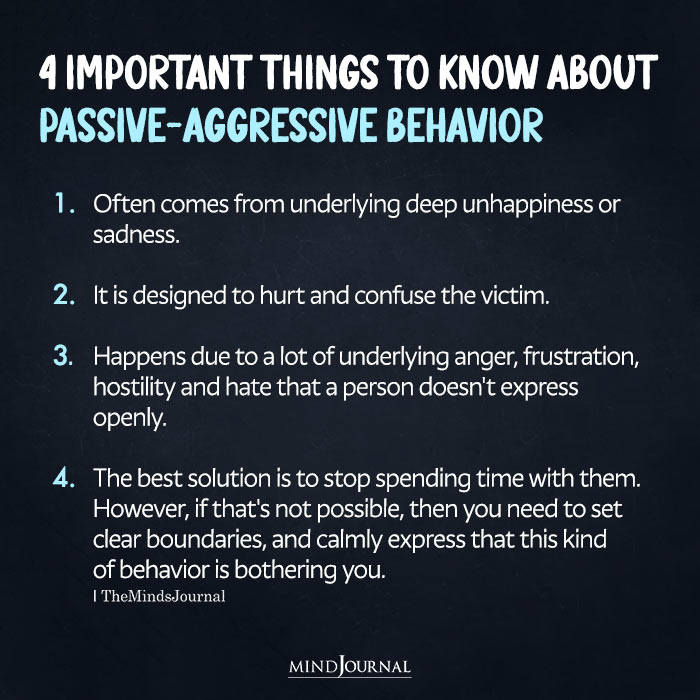
Passive aggression is a subtle, cloaked, or covert means of expressing anger. Anger is, for many people, a complex, fear-inducing, and difficult emotion to understand, express, and navigate.

Passive aggression is rooted in anger and plays out in virtually every area of life, in social situations, friendships, workplaces, and intimate-partner relationships.

Often, people who exhibit patterns of passive aggressive behavior are influenced by their early childhood role models, including parents, family members, and caretakers, whose passive aggressive behaviors formed blueprints of how relationships work and how anger is expressed, suppressed, or dealt with.

Often, people who feel trapped in situations in which there is an imbalance of power feel unheard or undervalued in social, family, intimate-partner relationships, or workplace settings, and resort to the perceived safety of passive aggressive behaviors to express their anger, frustration, or discontentment.
Passive aggression

Recognizing passive aggression in action

When passive aggressive behaviors are present in relationship dynamics, authenticity suffers, as do transparency, honest exchanges, and efforts at conflict resolution.

In social relationships, through intentional, malicious, and manipulative withholding behaviors like exclusion, the silent treatment, procrastination, and gossip, passive aggression can harm friendships and social group dynamics.

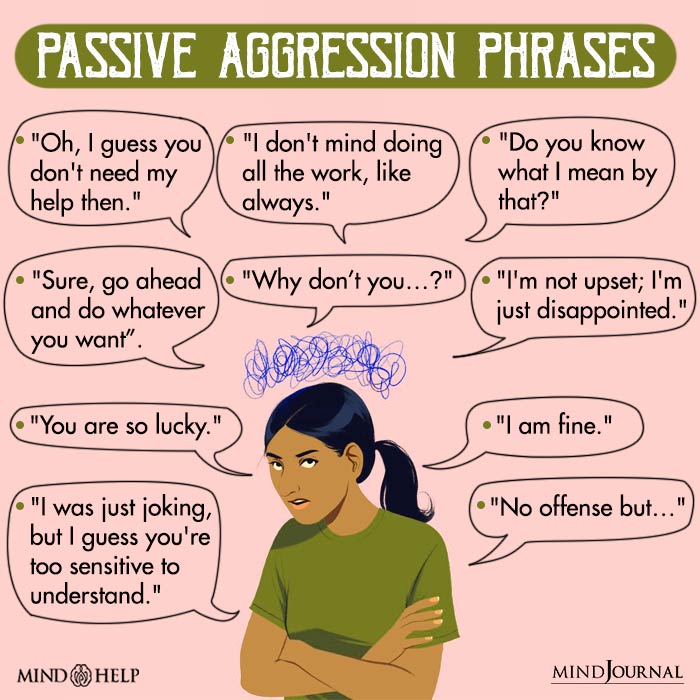
Sarcastic remarks, withholding enthusiasm and effort, appearing unhappy or sullen, appearing disinterested, and subtly signalling a lack of concern are but a few of the many ways passive aggression can creep in and do damage to individuals and groups.

(These behaviors can also be present in people dealing with severe anxiety and fear of judgment. In feared or dreaded situations that trigger the flight/flight/flee response, individuals may also appear aloof, uncaring, and lacking in enthusiasm.)

In the workplace, passive aggression can creep in and manifest in many ways, resulting in lowered employee morale, engagement, and team cohesion, which can lead to missed deadlines and decreased productivity.

A 2022 Gallup report identified low employee engagement as an $8.8 trillion global problem. Passive-aggressive co-workers often respond belatedly, or not at all, to emails.

They may miss deadlines or repeatedly let down colleagues who depend on them to complete tasks and fulfill responsibilities.

Hurt and harm in intimate-partner relationships

Harmful behaviors, including withholding, controlling, guilt-tripping, and undermining, can plant seeds of distrust and disconnection in intimate-partner relationships.

What’s more, a lack of honesty, transparency, and inability to work through problems in a compassionate and vulnerable manner erodes trust and leads to a breakdown of communication.

Passive aggression and mental health

Passive aggression can also turn inward. As harmful as passive aggressive behaviors are to others, they also cause tremendous hurt and harm to individuals mired in such behaviors.

Recent studies have determined a relationship between depression and self-directed passive aggression, concluding that “self-directed passive-aggressive behavior partially mediates the association between distorted self-monitoring and dysfunctional self-evaluation.”
Passive aggression

Compelled to seek connection

We are social animals. As such, we are compelled to seek connections with others to build strong, authentic, and lasting bonds with relatives, peers, co-workers, and community members.

When these relationships are genuine, transparent, and healthy, we thrive, learn, and grow.

Developing an understanding of how passive aggression shows up and plays out is the first step to effectively dealing with its harmful impacts.

Modelling a more genuine, authentic, and transparent approach to communicating can foster healthier and more honest interactions and mitigate the negative impact of passive aggressive behaviors in your relationships.

Related: Covert Verbal Abuse: Passive Aggressive Behavior That Aims to Control You

6 steps to handling passive-aggressive people

  • Develop an understanding of what passive aggression is and how to spot red-flag comments and patterns of behavior in others.
  • Identify and acknowledge how problematic patterns of passive aggressive behaviors of others impact your emotional well-being, self-worth, life tasks, and relationships.
  • Respond to passive-aggressive comments, behaviors, and impacts authentically, rather than reacting in kind or in anger, with accusations or labeling of behaviors as ‘passive-aggressive.’ (Remember: Some of these behaviors may be rooted in anxiety rather than passive aggression.)
  • Set the stage for more authentic conversations and exchanges by clearly and calmly expressing your intentions, expectations, and feelings. An authentic and honest exchange models a more transparent, honest, and productive means of communication.
  • Accept that you cannot control or change the behaviors of others.
  • Seek the help of a mental health professional if you are struggling to overcome passive-aggressive behavior, or a couple’s counselor if you and your partner are stuck in patterns of passive-aggressive relationship dynamics.

Written by Monica Vermani C. Psych.
Originally Appeared on Psychology Today
passive aggressive behaviors

Published On:

Last updated on:

Monica Vermani C. Psych.

Dr. Monica Vermani, C. Psych., is a clinical psychologist specializing in treating trauma, stress, mood, and anxiety disorders, and the founder of Start Living Corporate Wellness. She is also a well-known public speaker, author, corporate wellness expert, and mental health advocate. A regular commentator to online and print media outlets, and TV, radio, and podcasts, including Forbes Magazine, CNN Healthline, Psychology Today, InStyle Magazine, Parade, Martha Stewart, Oprah Daily, and many others, Dr. Vermani’s latest book, A Deeper Wellness, Conquering Stress, Mood, Anxiety, and Traumas, is available worldwide, in print, eBook, and audiobook on Amazon or at www.drmonicavermani.com Think About It!, Dr. Vermani’s recent Ted X UofT talk about dealing with negative thoughts and self-limiting beliefs will be released in the near future.

Disclaimer: The informational content on The Minds Journal have been created and reviewed by qualified mental health professionals. They are intended solely for educational and self-awareness purposes and should not be used as a substitute for professional medical advice, diagnosis, or treatment. If you are experiencing emotional distress or have concerns about your mental health, please seek help from a licensed mental health professional or healthcare provider.

Leave a Comment

Today's Horoscope

Weekly Horoscope PART one

Weekly Horoscope 15 March to 21 March 2026

Read your zodiac sign’s prediction to understand the energy surrounding you and how to make the most of the days ahead!

Latest Quizzes

Interesting Finger Personality Test: 4 Finger Lines

Finger Personality Test: Join Your Fingers And Reveal A Hidden Personality Secret!

Look closely at your finger lines. Which pattern do you see? This personality test might surprise you!

Latest Quotes

How Men Show Love Through Actions (Male Psychology in Relationships)

How Men Show Love Through Actions (Male Psychology in Relationships)

Male psychology in relationships shows that men express love through presence, protection, and peace more than poetry. Decode his actions so you can see how deeply he actually cares.

Readers Blog

Caption This Image and Selected Wisepicks – 15 March 2026

Caption This Image and Selected Wisepicks – 15 March 2026

Ready to unleash your inner wordsmith? ✨??☺️ Now’s your chance to show off your wit, charm, or sheer genius in just one line! Whether it’s laugh-out-loud funny or surprisingly deep, we want to hear it.Submit your funniest, wittiest, or most thought-provoking caption in the comments. We’ll pick 15+ winners to be featured on our website…

Latest Articles

Passive Aggression: The Emotional Weapon Nobody Talks About

We’ve all dealt with passive aggressive people – those who smile on the surface but express anger through silence, sarcasm, or subtle digs.

Recognizing the signs of passive aggressive behavior isn’t always easy, because passive aggression hides behind politeness and avoidance. Understanding it is the first step to protecting your peace and communicating with clarity.

A cutting remark. The silent treatment. A despondent, conflict-avoidant friend or co-worker who refuses to talk about the cause of their unhappiness: Chances are, we’ve all been on the receiving and giving end of passive-aggressive comments, remarks, or behaviors in some form at some point in our lives.

From back-handed compliments that undermine as they appear to uplift, to sarcastic remarks, exclusion from social events or activities, being let down by unfulfilled promises, or faint praise, the list of passive aggressive behaviors and tactics is long, confounding, and often painful.

Although the term itself may be well-known, most of us are unaware of the various ways it can manifest and play out in our social lives, workplaces, and close relationships. 

Aggression, through overt acts of physical violence, verbal and non-verbal hostility, and other intimidating and controlling behaviors, is pretty easy to identify.

Related: How To Respond To Passive Aggressive Behavior?

Passive aggression, on the other hand, is covert, multi-faceted, and often cloaked in behaviors that leave us feeling demoralized, confused, and let down.

Passive aggression is a subtle, cloaked, or covert means of expressing anger. Anger is, for many people, a complex, fear-inducing, and difficult emotion to understand, express, and navigate.

Passive aggression is rooted in anger and plays out in virtually every area of life, in social situations, friendships, workplaces, and intimate-partner relationships.

Often, people who exhibit patterns of passive aggressive behavior are influenced by their early childhood role models, including parents, family members, and caretakers, whose passive aggressive behaviors formed blueprints of how relationships work and how anger is expressed, suppressed, or dealt with.

Often, people who feel trapped in situations in which there is an imbalance of power feel unheard or undervalued in social, family, intimate-partner relationships, or workplace settings, and resort to the perceived safety of passive aggressive behaviors to express their anger, frustration, or discontentment.

Passive aggression

Recognizing passive aggression in action

When passive aggressive behaviors are present in relationship dynamics, authenticity suffers, as do transparency, honest exchanges, and efforts at conflict resolution.

In social relationships, through intentional, malicious, and manipulative withholding behaviors like exclusion, the silent treatment, procrastination, and gossip, passive aggression can harm friendships and social group dynamics.

Sarcastic remarks, withholding enthusiasm and effort, appearing unhappy or sullen, appearing disinterested, and subtly signalling a lack of concern are but a few of the many ways passive aggression can creep in and do damage to individuals and groups.

(These behaviors can also be present in people dealing with severe anxiety and fear of judgment. In feared or dreaded situations that trigger the flight/flight/flee response, individuals may also appear aloof, uncaring, and lacking in enthusiasm.)

In the workplace, passive aggression can creep in and manifest in many ways, resulting in lowered employee morale, engagement, and team cohesion, which can lead to missed deadlines and decreased productivity.

A 2022 Gallup report identified low employee engagement as an $8.8 trillion global problem. Passive-aggressive co-workers often respond belatedly, or not at all, to emails.

They may miss deadlines or repeatedly let down colleagues who depend on them to complete tasks and fulfill responsibilities.

Hurt and harm in intimate-partner relationships

Harmful behaviors, including withholding, controlling, guilt-tripping, and undermining, can plant seeds of distrust and disconnection in intimate-partner relationships.

What’s more, a lack of honesty, transparency, and inability to work through problems in a compassionate and vulnerable manner erodes trust and leads to a breakdown of communication.

Passive aggression and mental health

Passive aggression can also turn inward. As harmful as passive aggressive behaviors are to others, they also cause tremendous hurt and harm to individuals mired in such behaviors.

Recent studies have determined a relationship between depression and self-directed passive aggression, concluding that “self-directed passive-aggressive behavior partially mediates the association between distorted self-monitoring and dysfunctional self-evaluation.”

Passive aggression

Compelled to seek connection

We are social animals. As such, we are compelled to seek connections with others to build strong, authentic, and lasting bonds with relatives, peers, co-workers, and community members.

When these relationships are genuine, transparent, and healthy, we thrive, learn, and grow.

Developing an understanding of how passive aggression shows up and plays out is the first step to effectively dealing with its harmful impacts.

Modelling a more genuine, authentic, and transparent approach to communicating can foster healthier and more honest interactions and mitigate the negative impact of passive aggressive behaviors in your relationships.

Related: Covert Verbal Abuse: Passive Aggressive Behavior That Aims to Control You

6 steps to handling passive-aggressive people

  • Develop an understanding of what passive aggression is and how to spot red-flag comments and patterns of behavior in others.
  • Identify and acknowledge how problematic patterns of passive aggressive behaviors of others impact your emotional well-being, self-worth, life tasks, and relationships.
  • Respond to passive-aggressive comments, behaviors, and impacts authentically, rather than reacting in kind or in anger, with accusations or labeling of behaviors as ‘passive-aggressive.’ (Remember: Some of these behaviors may be rooted in anxiety rather than passive aggression.)
  • Set the stage for more authentic conversations and exchanges by clearly and calmly expressing your intentions, expectations, and feelings. An authentic and honest exchange models a more transparent, honest, and productive means of communication.
  • Accept that you cannot control or change the behaviors of others.
  • Seek the help of a mental health professional if you are struggling to overcome passive-aggressive behavior, or a couple’s counselor if you and your partner are stuck in patterns of passive-aggressive relationship dynamics.

Written by Monica Vermani C. Psych.
Originally Appeared on Psychology Today
passive aggressive behaviors

Published On:

Last updated on:

Monica Vermani C. Psych.

Dr. Monica Vermani, C. Psych., is a clinical psychologist specializing in treating trauma, stress, mood, and anxiety disorders, and the founder of Start Living Corporate Wellness. She is also a well-known public speaker, author, corporate wellness expert, and mental health advocate. A regular commentator to online and print media outlets, and TV, radio, and podcasts, including Forbes Magazine, CNN Healthline, Psychology Today, InStyle Magazine, Parade, Martha Stewart, Oprah Daily, and many others, Dr. Vermani’s latest book, A Deeper Wellness, Conquering Stress, Mood, Anxiety, and Traumas, is available worldwide, in print, eBook, and audiobook on Amazon or at www.drmonicavermani.com Think About It!, Dr. Vermani’s recent Ted X UofT talk about dealing with negative thoughts and self-limiting beliefs will be released in the near future.

Leave a Comment

    Leave a Comment