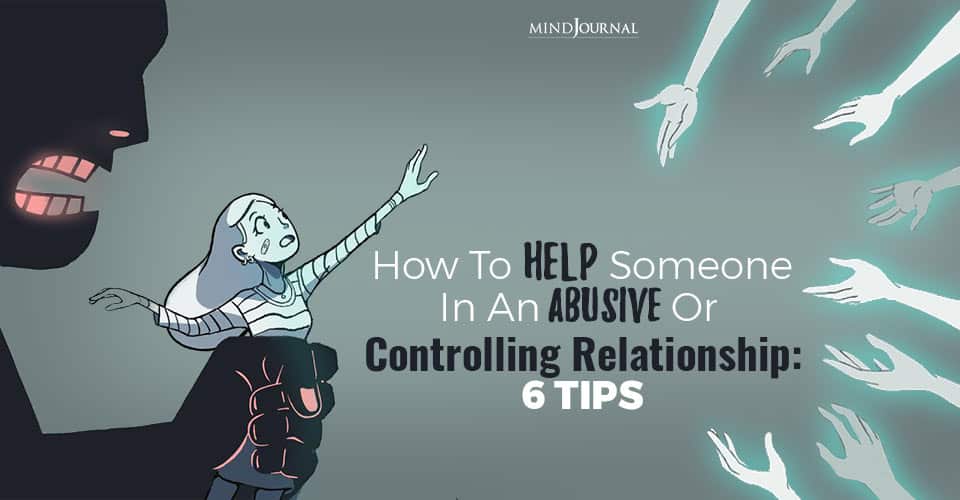
How To Help Someone In An Abusive Or Controlling Relationship: 6 Tips

Author : Lisa Aronson Fontes Ph.D.

When you feel that someone is in an abusive and controlling relationship and you want to help them in any way you can, by all means, do so. But you need to know exactly how you can help them effectively, without any harm coming to them.


You may have noticed that your friend is acting differently, and you suspect they are being controlled and maybe even abused by their intimate partner. Learn how you can help.

Coercive Control And Domestic Violence

Controlling Relationship

Coercive control is an umbrella name for the strategy that many abusers use to control their partners—not just the violence. Tactics include isolating, gaslighting, degrading, and economic, physical, and sexual abuse. Each abusive tactic has particularly harmful effects. Altogether, the impact can be devastating.


The next section presents ways you can counteract the effects of these tactics to help someone you care about. 

The goal: Empower your friend to make their own decisions and regain control over their life

Here Are 6 Ways You Can Help Someone In An Abusive Or Controlling Relationship

1. Counteract Isolation. 

Maybe you have noticed that your friend does not show up for activities they once liked—and it feels odd. Abusers isolate their partners in a variety of ways including blocking their plans, acting jealous, spreading rumors, and creating tension with their partners’ friends, family, and coworkers. Often, victims end up limiting their own contacts outside the relationship—it just isn’t worth the hassle.


You can counteract isolation by staying in touch or getting back in touch with the person you are worried about, even though the abuser might make this difficult. Through some combination of email, texts, phone calls, gifts, and visits, see if you can maintain contact. Keep the conversations light and do not raise your concerns about abuse too early.

Also, remember that their mail, phone calls, email, and social media may be monitored by the abuser, with or without their knowledge; do not put them at risk by saying anything that could alarm the abuser. Focus on having a good time together.

Encourage your friend to participate in activities outside the home. Almost anything that breaks their isolation is valuable, including going on a walk each day, religious services, even shopping. If you live nearby, schedule regular times to get together. If you live far away, see if you can schedule phone calls.

Know that the abuser may monitor or revoke “permission” to engage in these activities at any point; so the less threatening the pursuit seems to the abuser, the more likely the person being victimized will be able to participate.

Related: Are You In An Abusive Relationship And Don’t Even Know It? 4 Identifying Signs

2. Counteract Gaslighting. 

Gaslighting is a way to make a person feel crazy or seem crazy to others by manipulating the environment and denying reality. Techniques including hiding things, denying that events happened, or blaming victims for things they did not do.


To make them unstable, abusers also spread rumors about their victims, push them to consume drugs or alcohol, file false charges with the police or child protective services, and deprive them of food or sleep.

You can counteract gaslighting by affirming your friend’s perspective. It may also be helpful to recount memories you share—these stories will remind the person who they were prior to the abuse. Resist the temptation to lecture; instead, try to listen more. 

3. Counteract Degradation. 

Abusers frequently degrade their partners by insulting, criticizing, and humiliating them. Abusers make demands about the most intimate aspects of a victim’s life including sex, eating, bathing, dressing, and even using the toilet. Over time, these degrading tactics cut into a person’s self-esteem.

You can counteract this degradation by showing genuine support and appreciation. Start by using phrases including, “One thing I have always liked about you…,” “I admire how you…,” and “I love it when we…” As long as these comments are sincere, they can help people who are being abused feel better about themselves.

Avoid criticizing or blaming them and remain nonjudgmental about their choices—including and especially choices that concern the abuser. They know their lives and their risks better than anyone else does. Your job is to help them appreciate themselves again; the choices they make are still their own.

4. Counteract Economic Abuse. 

One of the hallmarks of coercive control is depriving a victim of resources such as money and transportation. Some abusers do not let their partners work outside the home, while others obligate their partners to turn over their paycheck. Abusers may use the money to threaten, reward, or punish, or make victims “earn their keep” by obligating them to do things against their will.

Abusers will often steal from their partners and ruin their credit, making it more difficult for victims to break free.


You can counteract economic control by asking what your friend needs. Likely possibilities include money, food, childcare, pet care, transportation, information, a job, and a place to live or store their belongings. While you probably cannot provide all this yourself, perhaps you can hook up your friend or family member with community-based resources. Make only those promises that you can keep.

Related: 10 Things That Happen In An Emotionally Abusive Relationship

5. Counteract the Entrapping Effects of “Acts of Love.” 

Abusers often act highly romantic and loving when it seems like a useful tactic to keep the victim in the relationship. Your friend might want to tell you about the good parts of their relationship.

Listen to these and honor them—do not discount them. Comments such as, “It sounds like your relationship is amazing at times,” will help the person know they are understood.

If it seems okay, you can encourage the person to keep track of the days the relationship seems great, okay, or terrible. You can gently share your worries if the time seems right. “You looked afraid when I saw you with James this morning…” “You seem timider and quieter than you did years ago…” “You have described to me some great times and some scary and dangerous times in your relationship. I’m wondering what this will look like in a year or ten years…” “Do you have reasons to think your relationship is getting better or worse?”


From the outside, it may be clear to you that romance and acts of love are just other manipulative tools. However, a person who is thirsty for love and affection may give in to their allure.

6. Counteract Physical Violence. 

In coercive control relationships, typically most of the violence is relatively mild but frequent—slapping, pushing, grabbing, shaking, and rougher-than-desired sex. The victim is unlikely to report these acts to the police. When abusers become more physically violent, they typically blame the victim for the abuse—saying that she provoked the violence by doing or failing to do something.

If you see signs of fear or violence, comment on them gently. For instance, “That looks like a bruise on your arm,” or “It looks like someone kicked that wall.” If your friend describes threatening or violent incidents, empathize with phrases such as, “that sounds terrifying,” or “that sounds so painful.” Remind the victim that there is no acceptable reason to frighten or hit another person, no matter what they did or said.

Ask about signs of lethality such as using or threatening to use a weapon, extreme jealousy or control, sexual assault, or strangulation. If these are present, tell your friend that these are indications that the abuse may become fatal and that you do not want them to end up dead.

Finally, discuss safety planning. Do not insist on discussing physical violence if your friend does not want to discuss it with you. Focus on your connection and ways to counteract isolation.

Related: Emotionally Overwhelmed or Feeling Trapped In An Abusive Relationship? Here’s What You Can Do


A Great Deal More

Stalking, threats, sexual coercion, manipulation through the children, harassment through the legal system, and the ways culture and gender intersect—these are all relevant to coercive control and domestic abuse but lie beyond the scope of this piece.

Being controlled by a partner is confusing, lonely, and extremely damaging in the short and long term. Supporting your friend can help so much.


Written by Lisa Aronson Fontes
Originally Appeared In Psychology Today

When you want to help someone who is in an abusive and controlling relationship, always remember that standing by them and supporting them can go a long way in making them feel better. Sometimes, it is the mental and emotional support that gives them the courage to get out of a toxic situation like that.

Help Abusive Controlling Relationship pin
Help Someonen PIN


Published On:

Last updated on:

Lisa Aronson Fontes Ph.D.

Lisa Aronson Fontes, Ph.D., is a Senior Lecturer at the University of Massachusetts Amherst, and author of numerous publications including the books: Invisible Chains: Overcoming Coercive Control in Your Intimate Relationship, Interviewing Clients Across Cultures, and Child Abuse & Culture: Working with Diverse Families. She has dedicated two decades to making mental health, criminal justice, and social service systems more responsive to culturally diverse people. Fluent in Spanish and Portuguese, Dr. Fontes is a popular trainer, consultant, and speaker for audiences around the world.

Disclaimer: The informational content on The Minds Journal have been created and reviewed by qualified mental health professionals. They are intended solely for educational and self-awareness purposes and should not be used as a substitute for professional medical advice, diagnosis, or treatment. If you are experiencing emotional distress or have concerns about your mental health, please seek help from a licensed mental health professional or healthcare provider.

Leave a Comment

Today's Horoscope

Your Daily Horoscope For 4 April, 2026: Free Predictions

Daily Horoscope 4 April, 2026: Prediction For Each Zodiac Sign

Look at your daily prediction and see what the stars have in store for your love life and your future!

Latest Quizzes

How Many Circles Do You See? A Simple Test of Thinking Style

How Many Circles Do You See? Your Answer Might Reveal Narcissistic Traits! 

Take a closer look at this simple image and discover what your circle count reveals about your thinking style, perception, and attention in this fun and engaging visual test.

Latest Quotes

Real Signs Your Body Is Actually in Good Health: How to Know You’re Truly Well

Real Signs Your Body Is Actually in Good Health: How to Know You’re Truly Well

Real signs your body is healthy don’t always show up on lab reports. From good sleep and clear skin to regular digestion and a stable mood, your body is constantly sending quiet signals of wellness.

Readers Blog

Caption This Image and Selected Wisepicks – 5 April 2026

Caption This Image and Selected Wisepicks – 5 April 2026

Ready to unleash your inner wordsmith? ✨??☺️ Now’s your chance to show off your wit, charm, or sheer genius in just one line! Whether it’s laugh-out-loud funny or surprisingly deep, we want to hear it.Submit your funniest, wittiest, or most thought-provoking caption in the comments. We’ll pick 15+ winners to be featured on our website…

Latest Articles

When you feel that someone is in an abusive and controlling relationship and you want to help them in any way you can, by all means, do so. But you need to know exactly how you can help them effectively, without any harm coming to them.


You may have noticed that your friend is acting differently, and you suspect they are being controlled and maybe even abused by their intimate partner. Learn how you can help.

Coercive Control And Domestic Violence

Controlling Relationship

Coercive control is an umbrella name for the strategy that many abusers use to control their partners—not just the violence. Tactics include isolating, gaslighting, degrading, and economic, physical, and sexual abuse. Each abusive tactic has particularly harmful effects. Altogether, the impact can be devastating.


The next section presents ways you can counteract the effects of these tactics to help someone you care about. 

The goal: Empower your friend to make their own decisions and regain control over their life

Here Are 6 Ways You Can Help Someone In An Abusive Or Controlling Relationship

1. Counteract Isolation. 

Maybe you have noticed that your friend does not show up for activities they once liked—and it feels odd. Abusers isolate their partners in a variety of ways including blocking their plans, acting jealous, spreading rumors, and creating tension with their partners’ friends, family, and coworkers. Often, victims end up limiting their own contacts outside the relationship—it just isn’t worth the hassle.


You can counteract isolation by staying in touch or getting back in touch with the person you are worried about, even though the abuser might make this difficult. Through some combination of email, texts, phone calls, gifts, and visits, see if you can maintain contact. Keep the conversations light and do not raise your concerns about abuse too early.

Also, remember that their mail, phone calls, email, and social media may be monitored by the abuser, with or without their knowledge; do not put them at risk by saying anything that could alarm the abuser. Focus on having a good time together.

Encourage your friend to participate in activities outside the home. Almost anything that breaks their isolation is valuable, including going on a walk each day, religious services, even shopping. If you live nearby, schedule regular times to get together. If you live far away, see if you can schedule phone calls.

Know that the abuser may monitor or revoke “permission” to engage in these activities at any point; so the less threatening the pursuit seems to the abuser, the more likely the person being victimized will be able to participate.

Related: Are You In An Abusive Relationship And Don’t Even Know It? 4 Identifying Signs

2. Counteract Gaslighting. 

Gaslighting is a way to make a person feel crazy or seem crazy to others by manipulating the environment and denying reality. Techniques including hiding things, denying that events happened, or blaming victims for things they did not do.


To make them unstable, abusers also spread rumors about their victims, push them to consume drugs or alcohol, file false charges with the police or child protective services, and deprive them of food or sleep.

You can counteract gaslighting by affirming your friend’s perspective. It may also be helpful to recount memories you share—these stories will remind the person who they were prior to the abuse. Resist the temptation to lecture; instead, try to listen more. 

3. Counteract Degradation. 

Abusers frequently degrade their partners by insulting, criticizing, and humiliating them. Abusers make demands about the most intimate aspects of a victim’s life including sex, eating, bathing, dressing, and even using the toilet. Over time, these degrading tactics cut into a person’s self-esteem.

You can counteract this degradation by showing genuine support and appreciation. Start by using phrases including, “One thing I have always liked about you…,” “I admire how you…,” and “I love it when we…” As long as these comments are sincere, they can help people who are being abused feel better about themselves.

Avoid criticizing or blaming them and remain nonjudgmental about their choices—including and especially choices that concern the abuser. They know their lives and their risks better than anyone else does. Your job is to help them appreciate themselves again; the choices they make are still their own.

4. Counteract Economic Abuse. 

One of the hallmarks of coercive control is depriving a victim of resources such as money and transportation. Some abusers do not let their partners work outside the home, while others obligate their partners to turn over their paycheck. Abusers may use the money to threaten, reward, or punish, or make victims “earn their keep” by obligating them to do things against their will.

Abusers will often steal from their partners and ruin their credit, making it more difficult for victims to break free.


You can counteract economic control by asking what your friend needs. Likely possibilities include money, food, childcare, pet care, transportation, information, a job, and a place to live or store their belongings. While you probably cannot provide all this yourself, perhaps you can hook up your friend or family member with community-based resources. Make only those promises that you can keep.

Related: 10 Things That Happen In An Emotionally Abusive Relationship

5. Counteract the Entrapping Effects of “Acts of Love.” 

Abusers often act highly romantic and loving when it seems like a useful tactic to keep the victim in the relationship. Your friend might want to tell you about the good parts of their relationship.

Listen to these and honor them—do not discount them. Comments such as, “It sounds like your relationship is amazing at times,” will help the person know they are understood.

If it seems okay, you can encourage the person to keep track of the days the relationship seems great, okay, or terrible. You can gently share your worries if the time seems right. “You looked afraid when I saw you with James this morning…” “You seem timider and quieter than you did years ago…” “You have described to me some great times and some scary and dangerous times in your relationship. I’m wondering what this will look like in a year or ten years…” “Do you have reasons to think your relationship is getting better or worse?”


From the outside, it may be clear to you that romance and acts of love are just other manipulative tools. However, a person who is thirsty for love and affection may give in to their allure.

6. Counteract Physical Violence. 

In coercive control relationships, typically most of the violence is relatively mild but frequent—slapping, pushing, grabbing, shaking, and rougher-than-desired sex. The victim is unlikely to report these acts to the police. When abusers become more physically violent, they typically blame the victim for the abuse—saying that she provoked the violence by doing or failing to do something.

If you see signs of fear or violence, comment on them gently. For instance, “That looks like a bruise on your arm,” or “It looks like someone kicked that wall.” If your friend describes threatening or violent incidents, empathize with phrases such as, “that sounds terrifying,” or “that sounds so painful.” Remind the victim that there is no acceptable reason to frighten or hit another person, no matter what they did or said.

Ask about signs of lethality such as using or threatening to use a weapon, extreme jealousy or control, sexual assault, or strangulation. If these are present, tell your friend that these are indications that the abuse may become fatal and that you do not want them to end up dead.

Finally, discuss safety planning. Do not insist on discussing physical violence if your friend does not want to discuss it with you. Focus on your connection and ways to counteract isolation.

Related: Emotionally Overwhelmed or Feeling Trapped In An Abusive Relationship? Here’s What You Can Do


A Great Deal More

Stalking, threats, sexual coercion, manipulation through the children, harassment through the legal system, and the ways culture and gender intersect—these are all relevant to coercive control and domestic abuse but lie beyond the scope of this piece.

Being controlled by a partner is confusing, lonely, and extremely damaging in the short and long term. Supporting your friend can help so much.


Written by Lisa Aronson Fontes
Originally Appeared In Psychology Today

When you want to help someone who is in an abusive and controlling relationship, always remember that standing by them and supporting them can go a long way in making them feel better. Sometimes, it is the mental and emotional support that gives them the courage to get out of a toxic situation like that.

Help Abusive Controlling Relationship pin
Help Someonen PIN


Published On:

Last updated on:

Lisa Aronson Fontes Ph.D.

Lisa Aronson Fontes, Ph.D., is a Senior Lecturer at the University of Massachusetts Amherst, and author of numerous publications including the books: Invisible Chains: Overcoming Coercive Control in Your Intimate Relationship, Interviewing Clients Across Cultures, and Child Abuse & Culture: Working with Diverse Families. She has dedicated two decades to making mental health, criminal justice, and social service systems more responsive to culturally diverse people. Fluent in Spanish and Portuguese, Dr. Fontes is a popular trainer, consultant, and speaker for audiences around the world.

Leave a Comment

    Leave a Comment