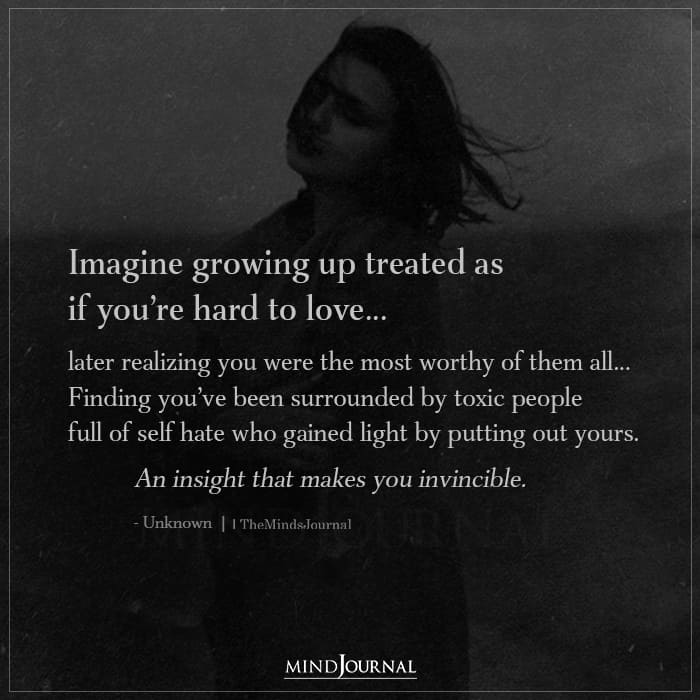
The Truth About Self Hatred And How We Can Overcome It

Author : Anna Katharina Schaffner Ph.D.

Understanding the truth about self hatred is probably the only way to overcome it. It is only when you understand the reality of it, is when you will finally be able to shift from self hatred to self compassion. 

Key Points:

  • It is too devastating for children to acknowledge that their parents might not be competent or may be cruel.
  • Self hatred is a childhood survival strategy, but it no longer serves us in our adult life.
  • It is possible to move from self hatred to self compassion.

The truth about self hatred, and its more subtle cousins low self-worth, low self-esteem, and low confidence, is well-known but seldom talked about. It’s an uncomfortable topic.

Altricial vs. Precocial Species

In their early years, and indeed throughout most of their childhood, human children completely depend on their caregivers. In biological terms, we are what is called an “altricial species.”

Altricial birds or mammals give birth to helpless offspring. Their newly hatched or born young tend to emerge into this world with their eyes closed. They are usually immobile, lack fur or down, and can’t gather food on their own.

Humans are perhaps the most altricial species there is: We remain dependent on those who are in charge of our well-being to fulfill our physical and emotional needs for much longer than other mammals.

So-called “precocial” animals, by contrast, give birth to young whose eyes are open, who have hair or down and large brains, and who are almost immediately mobile. They can flee from or defend themselves against predators relatively quickly after birth.

Why does that matter in psychological terms? It matters because, consciously or unconsciously, we are aware of our abject dependency as naked and helpless infants.

Consequently, the thought that there might be something wrong with our parents—that they might not have our best interests at heart, that they might be lacking in their capacity to care for us, that they might be unloving or even behave actively aggressive and destructive toward us—is existentially threatening.

In fact, it is so terrifying that we defend against it with all our might. Our psychological apparatus does all it can to keep us from knowing and feeling this truth.

Related: 10 Signs Of Self Hatred And How To Overcome

Blaming Ourselves

At the heart of our defense strategy against such knowledge is the construction of narratives about ourselves and others that are more bearable. Paradoxically, then, if we feel unloved; are constantly criticized, mocked, or rejected; or are the victims of sexual abuse, we prefer to blame ourselves rather than our parents.

The conscious acknowledgment of our parents’ incompetency or cruelty is simply too devastating. Psychologically, it feels much safer for us to turn the criticism inward rather than outward and to blame ourselves for the misfortunes we suffer.

In their wise and wonderful book Quotes to Live By (2022), the philosopher collective of the School of Life puts it this way:

A categorical fact of psychological life is the disinclination of any child to think that there is something wrong with its parents, even when there very much is; it will go to almost any lengths to prevent the idea emerging that its parents may be mentally unwell or fundamentally brutish… It prefers to hate itself rather than get angry with those who have let it down.

The truth about self hatred

The authors also put their finger on what that means in more concrete terms: As children, we replace righteous anger with shame. For anger simply feels too dangerous an option:

“Small children naturally turn injury done to them into a dislike of themselves. They ask not so much, ‘Why does my parent fail to care for me?’ as ‘How might I have failed this admirable person?’ They hate themselves rather than doubting those who should be protecting them; shame replaces anger. It feels, on balance, like the safer option.”

Whilst the strategy to blame and dislike ourselves might be a sad but sensible survival mechanism in childhood, it does, of course, turn into a truly debilitating handicap in adulthood.

When we are grown up, at last able to fend for and take care of ourselves and to select partners and friends who are loving and kind, our self hatred no longer serves us. But, by then, it has become habitual. It is the devil we know.

We continue to explain our ancient shame about not having been loved enough with the narrative that we are not loveable, that there is something wrong with us at our core, and that we are, fundamentally, bad people.

In addition, when we suffer from self-hating thoughts, we often tend to layer another layer of pain on the original pain—a process that, in acceptance and commitment therapy, is called “dirty pain.”

We hate ourselves for hating ourselves. We feel ashamed for feeling shame. We simply cannot understand why we have such a distorted and unhealthy relationship with ourselves, and why we cannot be confident and happy like other people.

When we finally seek therapy to work on these dysfunctional patterns of thinking and feeling, many of us touch base with that repressed anger. We may feel very bitter about our parents and the ways in which they have failed us for a while. Sometimes, we may remain stuck in the anger phase for a very long time.

The Truth About Self Hatred And How We Can Overcome It

From Anger to Sadness

And yet anger, too, is merely a developmental stage in the healing process. While it is deeply necessary to dwell in the land of rage for a while, it is not desirable to become a permanent denizen. Anger is energizing, and a driver, and it can be tempting to hold onto it.

But only when we are finally ready to let it go do we arrive at the core emotion: sadness. Allowing ourselves to feel our own sadness about what has happened to us can be powerfully healing. Sadness is honest, real, and clean pain.

Once we are able to allow ourselves to be sad, we are beginning to feel again. For self hatred, and that is another important point, is largely a cognitive phenomenon—thoughts, evaluations, and judgments. These are also, in addition to being a dysfunctional habit, a defense against feeling—and especially against feeling our sadness.

Related: The 5 Ingredients of Shame

Acceptance and Self-Compassion

Yet, beyond sadness, finally, lies what we truly strive for, the reward for our cognitive and emotional understanding of what has happened to us: acceptance and self-compassion.

We may, then, describe the stages of self hatred and how to overcome it as follows:

  • Emotional and/or physical injury inflicted by our caregivers in childhood
  • The conversion of rightful anger into shame as a measure of self-protection
  • The normalization of narratives of unworthiness and unlovability
  • The discovery of the origins of our negative core beliefs and self-stories (often in therapy)
  • A period of anger
  • A period of sadness
  • True understanding, acceptance, and self-compassion.
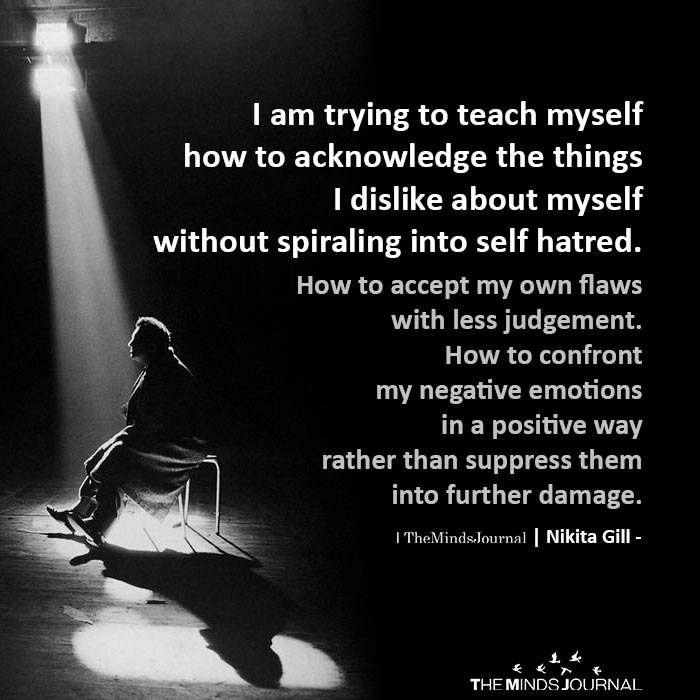
How to overcome self hatred

This is only the theory, of course. In practice, our developmental and healing processes are never that neat and linear. And nor can we demarcate the various stages quite so tidily. They are all interrelated and may often overlap with one another.

We may also vacillate wildly between the different phases, making great progress one day and feeling like we are back to square one the next. We may dance or zigzag back and forth between those stages.

Nobody, moreover, is able to feel acceptance and practice self-compassion all the time—we all have bad days or maybe thrown off our path temporarily by life’s many curve balls.

But what I want to say is this: Wherever you may be on this journey from self hatred to self-compassion, know that change is possible. As difficult and painful as the process may be, the rewards are more than worth the effort.

Imagine what your life would feel like if you were able to let go of your hateful self-talk most of the time and replace it with a compassionate and wise inner voice.

Related: Are You Emotionally Abusing Yourself? 8 Ways To Stop

Imagine the peace that would reign in your inner empire, and what you would be able to do without your self-destructive inner noise. How differently you could show up in your life. Hold on to that vision, and simply continue to take one step at a time.

If you are interested in being coached by Anna, please get in touch with her via [email protected] or book a free 30-minute exploration call with her here (https://calendly.com/the-exhaustion-coach/free-coaching-exploration-call). You can find out more about her and her coaching philosophy here (www.the-exhaustion-coach.com).


Written By Anna Katharina Schaffner Ph.D.
Originally Appeared On Psychology Today
the truth about self hatred

Published On:

Last updated on:

Anna Katharina Schaffner Ph.D.

Anna Katharina Schaffner, Ph.D. is a professional burnout and executive coach and a writer. She used to be a professor of Cultural History at the University of Kent. She specialises in helping people overcome burnout and overwhelm and to rediscover their passion and purpose. Her unique blend of expertise as both a writer and a coach reflects a lifelong dedication to the art of self-improvement. She is the author of Exhaustion: A History (Columbia University Press, 2016) and The Art of Self-Improvement: Ten Timeless Truths (Yale University Press, 2021). Her latest book is Exhausted: An A-Z for the Weary (Profile, 2024). Anna is deeply passionate about helping her coaching clients transition from a state of exhaustion to a state of vitality in which they can direct their energy to what really matters in their life. In her coaching practice, she combines state-of-the-art and science-based coaching techniques, including co-active coaching and ACT (Acceptance and Commitment Therapy), with tried-and-tested ancient wisdom. Her focus is on the importance of deepening self-knowledge and working on values, purpose, and character strengths. She also integrates ancient Stoic techniques and the art of letting go into her practice. You can book a free coaching exploration call with her here. Anna’s journalism has appeared in the Times Literary Supplement, the Guardian, Psychology Today, PositivePsychology, Aeon, PSYCHE, The Los Angeles Review of Books, and other places. Her research has been discussed on BBC Radio 4, in Vogue, National Geographic, The Atlantic, Philosophie Magazine and in other media. You can find some of her writing here. You can find Anna on LinkedIn and on Instagram.

Disclaimer: The informational content on The Minds Journal have been created and reviewed by qualified mental health professionals. They are intended solely for educational and self-awareness purposes and should not be used as a substitute for professional medical advice, diagnosis, or treatment. If you are experiencing emotional distress or have concerns about your mental health, please seek help from a licensed mental health professional or healthcare provider.

Leave a Comment

Today's Horoscope

Weekly Horoscope PART one

Weekly Horoscope 15 March to 21 March 2026

Read your zodiac sign’s prediction to understand the energy surrounding you and how to make the most of the days ahead!

Latest Quizzes

Interesting Finger Personality Test: 4 Finger Lines

Finger Personality Test: Join Your Fingers And Reveal A Hidden Personality Secret!

Look closely at your finger lines. Which pattern do you see? This personality test might surprise you!

Latest Quotes

How Men Show Love Through Actions (Male Psychology in Relationships)

How Men Show Love Through Actions (Male Psychology in Relationships)

Male psychology in relationships shows that men express love through presence, protection, and peace more than poetry. Decode his actions so you can see how deeply he actually cares.

Readers Blog

Caption This Image and Selected Wisepicks – 8 March 2026

Caption This Image and Selected Wisepicks – 8 March 2026

Provide a creative, relevant caption for the picture below and get selected and featured with your name and caption.  Selected Wisepicks We have selected 11 comments as Wisepicks from our Facebook, Facebook Group and Instagram as on 15 March 2026 Lou Angelique Heruela Listen to your inner child,not the angry voices in your mind. Bloom…

Latest Articles

Understanding the truth about self hatred is probably the only way to overcome it. It is only when you understand the reality of it, is when you will finally be able to shift from self hatred to self compassion. 

Key Points:

  • It is too devastating for children to acknowledge that their parents might not be competent or may be cruel.
  • Self hatred is a childhood survival strategy, but it no longer serves us in our adult life.
  • It is possible to move from self hatred to self compassion.

The truth about self hatred, and its more subtle cousins low self-worth, low self-esteem, and low confidence, is well-known but seldom talked about. It’s an uncomfortable topic.

Altricial vs. Precocial Species

In their early years, and indeed throughout most of their childhood, human children completely depend on their caregivers. In biological terms, we are what is called an “altricial species.”

Altricial birds or mammals give birth to helpless offspring. Their newly hatched or born young tend to emerge into this world with their eyes closed. They are usually immobile, lack fur or down, and can’t gather food on their own.

Humans are perhaps the most altricial species there is: We remain dependent on those who are in charge of our well-being to fulfill our physical and emotional needs for much longer than other mammals.

So-called “precocial” animals, by contrast, give birth to young whose eyes are open, who have hair or down and large brains, and who are almost immediately mobile. They can flee from or defend themselves against predators relatively quickly after birth.

Why does that matter in psychological terms? It matters because, consciously or unconsciously, we are aware of our abject dependency as naked and helpless infants.

Consequently, the thought that there might be something wrong with our parents—that they might not have our best interests at heart, that they might be lacking in their capacity to care for us, that they might be unloving or even behave actively aggressive and destructive toward us—is existentially threatening.

In fact, it is so terrifying that we defend against it with all our might. Our psychological apparatus does all it can to keep us from knowing and feeling this truth.

Related: 10 Signs Of Self Hatred And How To Overcome

Blaming Ourselves

At the heart of our defense strategy against such knowledge is the construction of narratives about ourselves and others that are more bearable. Paradoxically, then, if we feel unloved; are constantly criticized, mocked, or rejected; or are the victims of sexual abuse, we prefer to blame ourselves rather than our parents.

The conscious acknowledgment of our parents’ incompetency or cruelty is simply too devastating. Psychologically, it feels much safer for us to turn the criticism inward rather than outward and to blame ourselves for the misfortunes we suffer.

In their wise and wonderful book Quotes to Live By (2022), the philosopher collective of the School of Life puts it this way:

A categorical fact of psychological life is the disinclination of any child to think that there is something wrong with its parents, even when there very much is; it will go to almost any lengths to prevent the idea emerging that its parents may be mentally unwell or fundamentally brutish… It prefers to hate itself rather than get angry with those who have let it down.

The truth about self hatred

The authors also put their finger on what that means in more concrete terms: As children, we replace righteous anger with shame. For anger simply feels too dangerous an option:

“Small children naturally turn injury done to them into a dislike of themselves. They ask not so much, ‘Why does my parent fail to care for me?’ as ‘How might I have failed this admirable person?’ They hate themselves rather than doubting those who should be protecting them; shame replaces anger. It feels, on balance, like the safer option.”

Whilst the strategy to blame and dislike ourselves might be a sad but sensible survival mechanism in childhood, it does, of course, turn into a truly debilitating handicap in adulthood.

When we are grown up, at last able to fend for and take care of ourselves and to select partners and friends who are loving and kind, our self hatred no longer serves us. But, by then, it has become habitual. It is the devil we know.

We continue to explain our ancient shame about not having been loved enough with the narrative that we are not loveable, that there is something wrong with us at our core, and that we are, fundamentally, bad people.

In addition, when we suffer from self-hating thoughts, we often tend to layer another layer of pain on the original pain—a process that, in acceptance and commitment therapy, is called “dirty pain.”

We hate ourselves for hating ourselves. We feel ashamed for feeling shame. We simply cannot understand why we have such a distorted and unhealthy relationship with ourselves, and why we cannot be confident and happy like other people.

When we finally seek therapy to work on these dysfunctional patterns of thinking and feeling, many of us touch base with that repressed anger. We may feel very bitter about our parents and the ways in which they have failed us for a while. Sometimes, we may remain stuck in the anger phase for a very long time.

The Truth About Self Hatred And How We Can Overcome It

From Anger to Sadness

And yet anger, too, is merely a developmental stage in the healing process. While it is deeply necessary to dwell in the land of rage for a while, it is not desirable to become a permanent denizen. Anger is energizing, and a driver, and it can be tempting to hold onto it.

But only when we are finally ready to let it go do we arrive at the core emotion: sadness. Allowing ourselves to feel our own sadness about what has happened to us can be powerfully healing. Sadness is honest, real, and clean pain.

Once we are able to allow ourselves to be sad, we are beginning to feel again. For self hatred, and that is another important point, is largely a cognitive phenomenon—thoughts, evaluations, and judgments. These are also, in addition to being a dysfunctional habit, a defense against feeling—and especially against feeling our sadness.

Related: The 5 Ingredients of Shame

Acceptance and Self-Compassion

Yet, beyond sadness, finally, lies what we truly strive for, the reward for our cognitive and emotional understanding of what has happened to us: acceptance and self-compassion.

We may, then, describe the stages of self hatred and how to overcome it as follows:

  • Emotional and/or physical injury inflicted by our caregivers in childhood
  • The conversion of rightful anger into shame as a measure of self-protection
  • The normalization of narratives of unworthiness and unlovability
  • The discovery of the origins of our negative core beliefs and self-stories (often in therapy)
  • A period of anger
  • A period of sadness
  • True understanding, acceptance, and self-compassion.
How to overcome self hatred

This is only the theory, of course. In practice, our developmental and healing processes are never that neat and linear. And nor can we demarcate the various stages quite so tidily. They are all interrelated and may often overlap with one another.

We may also vacillate wildly between the different phases, making great progress one day and feeling like we are back to square one the next. We may dance or zigzag back and forth between those stages.

Nobody, moreover, is able to feel acceptance and practice self-compassion all the time—we all have bad days or maybe thrown off our path temporarily by life’s many curve balls.

But what I want to say is this: Wherever you may be on this journey from self hatred to self-compassion, know that change is possible. As difficult and painful as the process may be, the rewards are more than worth the effort.

Imagine what your life would feel like if you were able to let go of your hateful self-talk most of the time and replace it with a compassionate and wise inner voice.

Related: Are You Emotionally Abusing Yourself? 8 Ways To Stop

Imagine the peace that would reign in your inner empire, and what you would be able to do without your self-destructive inner noise. How differently you could show up in your life. Hold on to that vision, and simply continue to take one step at a time.

If you are interested in being coached by Anna, please get in touch with her via [email protected] or book a free 30-minute exploration call with her here (https://calendly.com/the-exhaustion-coach/free-coaching-exploration-call). You can find out more about her and her coaching philosophy here (www.the-exhaustion-coach.com).


Written By Anna Katharina Schaffner Ph.D.
Originally Appeared On Psychology Today
the truth about self hatred

Published On:

Last updated on:

Anna Katharina Schaffner Ph.D.

Anna Katharina Schaffner, Ph.D. is a professional burnout and executive coach and a writer. She used to be a professor of Cultural History at the University of Kent. She specialises in helping people overcome burnout and overwhelm and to rediscover their passion and purpose. Her unique blend of expertise as both a writer and a coach reflects a lifelong dedication to the art of self-improvement. She is the author of Exhaustion: A History (Columbia University Press, 2016) and The Art of Self-Improvement: Ten Timeless Truths (Yale University Press, 2021). Her latest book is Exhausted: An A-Z for the Weary (Profile, 2024). Anna is deeply passionate about helping her coaching clients transition from a state of exhaustion to a state of vitality in which they can direct their energy to what really matters in their life. In her coaching practice, she combines state-of-the-art and science-based coaching techniques, including co-active coaching and ACT (Acceptance and Commitment Therapy), with tried-and-tested ancient wisdom. Her focus is on the importance of deepening self-knowledge and working on values, purpose, and character strengths. She also integrates ancient Stoic techniques and the art of letting go into her practice. You can book a free coaching exploration call with her here. Anna’s journalism has appeared in the Times Literary Supplement, the Guardian, Psychology Today, PositivePsychology, Aeon, PSYCHE, The Los Angeles Review of Books, and other places. Her research has been discussed on BBC Radio 4, in Vogue, National Geographic, The Atlantic, Philosophie Magazine and in other media. You can find some of her writing here. You can find Anna on LinkedIn and on Instagram.

Leave a Comment

    Leave a Comment