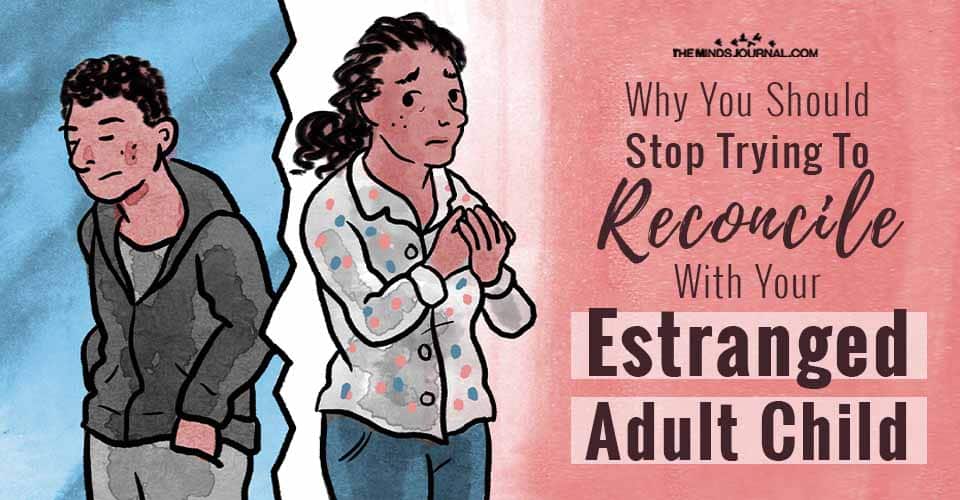
Why You Should Stop Trying To Reconcile With Your Estranged Adult Child

Author : Joshua Coleman

Are you one of those parents, who is trying very hard to reconcile with their estranged adult child, but whatever you do, it just doesn’t seem to work?

One of the most common questions I receive from parents in my practice is whether they should keep trying to reach out or just give up.

In general, I think that parents should try to reach out to an adult child for a significant period of time with letters of amends, empathy, and attempting to address their complaints before they stop trying.

However, sometimes giving up is best for everyone. But when?

Here some good reasons when you should stop:

  • You are being threatened with restraining orders.
  • Your adult child says that they need time apart but will be back in contact.
  • Whenever you do reach out, they’re consistently hostile and threatening.
  • All your letters or gifts to them or to your grandchildren are sent back “return to sender.”

While those conditions may seem obvious, many parents feel like they’re being neglectful or abandoning their child if they stop reaching out.

This may be especially challenging for mothers who are often governed by the following convictions:

  • Put yourself last, especially where your children are concerned, including grown children.
  • Give till it hurts.
  • Worrying about your child is part of being a good mother.

The constant cultural transmission is that if you don’t feel all of those things then you’re somehow behaving selfishly, irresponsibly, and unlovingly. That you’re being unmotherly.

Yet, sometimes the most loving, parental action is to allow the distance that your child says they need. You don’t have to commit to it forever. But if things are so inflamed that you’re getting threatened with restraining orders or your gifts are being sent back, then they’re too inflamed for progress to be made by reaching out. 

And even if those conditions aren’t met, but you’re being ignored year-after-year, then discontinuing to reach out is probably best. I typically recommend at least a year. 

Want to know more about the estranged parent-child dynamic? Read 10 Reasons Why Your Grown Kids Don’t Like You

Here’s why discontinuing to try is not only better for your mental health, it’s  sometimes better for a potential reconciliation:

  1. Your estranged adult child may feel like you’re respecting their wishes more.
  2. They may respect you more for not continuing to set yourself to be rejected by them.
  3. It may invite more self-reflection on their part: “Hmm, my mother hasn’t reached out in seven months. Wonder what’s going on?”
  4. It may cause them to miss you. That old saying, “How can I miss you if you never go away?” is sometimes true in families.
  5. It gives the relationship time and space to allow things to become less inflamed.

It’s not easy to stop trying. But sometimes it’s best for everyone.

Joshua Coleman is the author of numerous articles and chapters and has written three books: 

  • When Parents Hurt: Compassionate Strategies When You and Your Grown Child Don’t Get Along (HarperCollins, 2007)
  • The Lazy Husband: How to Get Men to Do More Parenting and Housework (St. Martin’s Press, 2006)
  • The Marriage Makeover: Finding Happiness in Imperfect Harmony (St. Martin’s Press, 2004)

His new book: RULES OF ESTRANGEMENT will be released in Nov 2020


Written by Joshua Coleman

Originally Appeared In Psychology Today

It’s only natural as a parent to want to make amends with their estranged children. But sometimes, you might need to take a step back and give them some time to get over all the issues. Giving space to your estranged adult child is sometimes the best thing you can do for them and also improve the chances of a reconciliation.

If you want to know more about why you should stop trying with your estranged adult child, then check this video out below:

Stop Trying Reconcile Estranged Adult Child pin

Published On:

Last updated on:

Joshua Coleman

Dr. Joshua Coleman is a psychologist, speaker, and writer in the San Francisco Bay Area. He is frequently contacted by the media for opinions and commentary about changes in the American family. He has been a frequent guest on the Today Show, NPR, The BBC, NYU Psychiatry Radio, and has also been featured on Sesame Street, 20/20, Good Morning America, America Online Coaches, PBS, and numerous news programs for FOX, ABC, CNN, and NBC television. He has written for the New York Times and his work with parental estrangement has also been featured there. He has also written for the San Francisco Chronicle, Variety Magazine, CNN, Greater Good Magazine, and The Huffington Post. He is the co-editor, along with historian Stephanie Coontz of seven online volumes of Unconventional Wisdom: News You Can Use, a compendium of noteworthy research on the contemporary family, gender, sexuality, poverty, and work-family issues.

Disclaimer: The informational content on The Minds Journal have been created and reviewed by qualified mental health professionals. They are intended solely for educational and self-awareness purposes and should not be used as a substitute for professional medical advice, diagnosis, or treatment. If you are experiencing emotional distress or have concerns about your mental health, please seek help from a licensed mental health professional or healthcare provider.

Leave a Comment

Today's Horoscope

Weekly Horoscope PART one

Weekly Horoscope 15 March to 21 March 2026

Read your zodiac sign’s prediction to understand the energy surrounding you and how to make the most of the days ahead!

Latest Quizzes

Interesting Finger Personality Test: 4 Finger Lines

Finger Personality Test: Join Your Fingers And Reveal A Hidden Personality Secret!

Look closely at your finger lines. Which pattern do you see? This personality test might surprise you!

Latest Quotes

How Men Show Love Through Actions (Male Psychology in Relationships)

How Men Show Love Through Actions (Male Psychology in Relationships)

Male psychology in relationships shows that men express love through presence, protection, and peace more than poetry. Decode his actions so you can see how deeply he actually cares.

Readers Blog

Caption This Image and Selected Wisepicks – 15 March 2026

Caption This Image and Selected Wisepicks – 15 March 2026

Ready to unleash your inner wordsmith? ✨??☺️ Now’s your chance to show off your wit, charm, or sheer genius in just one line! Whether it’s laugh-out-loud funny or surprisingly deep, we want to hear it.Submit your funniest, wittiest, or most thought-provoking caption in the comments. We’ll pick 15+ winners to be featured on our website…

Latest Articles

Are you one of those parents, who is trying very hard to reconcile with their estranged adult child, but whatever you do, it just doesn’t seem to work?

One of the most common questions I receive from parents in my practice is whether they should keep trying to reach out or just give up.

In general, I think that parents should try to reach out to an adult child for a significant period of time with letters of amends, empathy, and attempting to address their complaints before they stop trying.

However, sometimes giving up is best for everyone. But when?

Here some good reasons when you should stop:

  • You are being threatened with restraining orders.
  • Your adult child says that they need time apart but will be back in contact.
  • Whenever you do reach out, they’re consistently hostile and threatening.
  • All your letters or gifts to them or to your grandchildren are sent back “return to sender.”

While those conditions may seem obvious, many parents feel like they’re being neglectful or abandoning their child if they stop reaching out.

This may be especially challenging for mothers who are often governed by the following convictions:

  • Put yourself last, especially where your children are concerned, including grown children.
  • Give till it hurts.
  • Worrying about your child is part of being a good mother.

The constant cultural transmission is that if you don’t feel all of those things then you’re somehow behaving selfishly, irresponsibly, and unlovingly. That you’re being unmotherly.

Yet, sometimes the most loving, parental action is to allow the distance that your child says they need. You don’t have to commit to it forever. But if things are so inflamed that you’re getting threatened with restraining orders or your gifts are being sent back, then they’re too inflamed for progress to be made by reaching out. 

And even if those conditions aren’t met, but you’re being ignored year-after-year, then discontinuing to reach out is probably best. I typically recommend at least a year. 

Want to know more about the estranged parent-child dynamic? Read 10 Reasons Why Your Grown Kids Don’t Like You

Here’s why discontinuing to try is not only better for your mental health, it’s  sometimes better for a potential reconciliation:

  1. Your estranged adult child may feel like you’re respecting their wishes more.
  2. They may respect you more for not continuing to set yourself to be rejected by them.
  3. It may invite more self-reflection on their part: “Hmm, my mother hasn’t reached out in seven months. Wonder what’s going on?”
  4. It may cause them to miss you. That old saying, “How can I miss you if you never go away?” is sometimes true in families.
  5. It gives the relationship time and space to allow things to become less inflamed.

It’s not easy to stop trying. But sometimes it’s best for everyone.

Joshua Coleman is the author of numerous articles and chapters and has written three books: 

  • When Parents Hurt: Compassionate Strategies When You and Your Grown Child Don’t Get Along (HarperCollins, 2007)
  • The Lazy Husband: How to Get Men to Do More Parenting and Housework (St. Martin’s Press, 2006)
  • The Marriage Makeover: Finding Happiness in Imperfect Harmony (St. Martin’s Press, 2004)

His new book: RULES OF ESTRANGEMENT will be released in Nov 2020


Written by Joshua Coleman

Originally Appeared In Psychology Today

It’s only natural as a parent to want to make amends with their estranged children. But sometimes, you might need to take a step back and give them some time to get over all the issues. Giving space to your estranged adult child is sometimes the best thing you can do for them and also improve the chances of a reconciliation.

If you want to know more about why you should stop trying with your estranged adult child, then check this video out below:

Stop Trying Reconcile Estranged Adult Child pin

Published On:

Last updated on:

Joshua Coleman

Dr. Joshua Coleman is a psychologist, speaker, and writer in the San Francisco Bay Area. He is frequently contacted by the media for opinions and commentary about changes in the American family. He has been a frequent guest on the Today Show, NPR, The BBC, NYU Psychiatry Radio, and has also been featured on Sesame Street, 20/20, Good Morning America, America Online Coaches, PBS, and numerous news programs for FOX, ABC, CNN, and NBC television. He has written for the New York Times and his work with parental estrangement has also been featured there. He has also written for the San Francisco Chronicle, Variety Magazine, CNN, Greater Good Magazine, and The Huffington Post. He is the co-editor, along with historian Stephanie Coontz of seven online volumes of Unconventional Wisdom: News You Can Use, a compendium of noteworthy research on the contemporary family, gender, sexuality, poverty, and work-family issues.

Leave a Comment

    Leave a Comment