

It’s 2:13 AM… you’re staring at the ceiling, calculating exactly how many hours of sleep you’ll get if you sleep right now. But your brain has other plans; it’s replaying a conversation from 3 years ago or worrying about a meeting a week from now. This might be sleep anxiety.
And if you find yourself stuck in a 2 AM ‘Brain Loop’ every night, your body is sending you a major warning signal, so check out some of the remedies for sleep anxiety treatment below.
It’s a cycle you can actually break. After months of trial and error, I found a 4-step process to delete sleep anxiety for good. Here’s the blueprint on how to deal with sleep anxiety. But before we get into details, learn more about the sleep anxiety symptoms.
Read More Here: Silent Panic Attacks Are More Common Than You Think, Here Are 9 Signs To Watch Out For!
What Is Sleep Anxiety?
Unlike insomnia, where you just can’t sleep, sleep anxiety is a psychological loop where the act of trying to sleep actually triggers your “fight or flight” response. You become hyper-alert, and your brain begins to associate your bed with stress instead of rest.
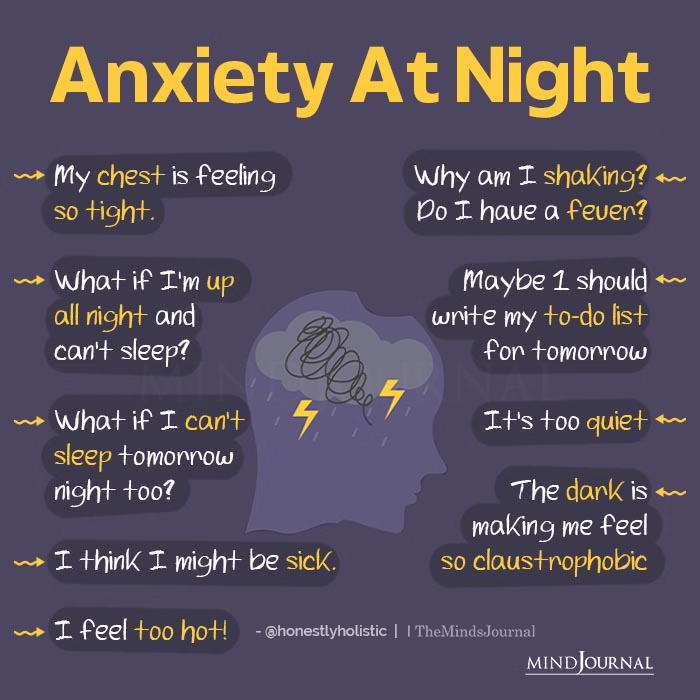
If you find yourself getting stuck in the 2 AM “Brain Loop,” look for these specific red flags:
5 Signs of Sleep Anxiety
1. You start feeling anxious or “heavy” as soon as the sun goes down because you’re already worried about the night.
2. Your mind won’t stop replaying old conversations or worrying about tomorrow as soon as the room gets quiet.
3. You’re constantly calculating how many hours of sleep you have left if you fall asleep right now.
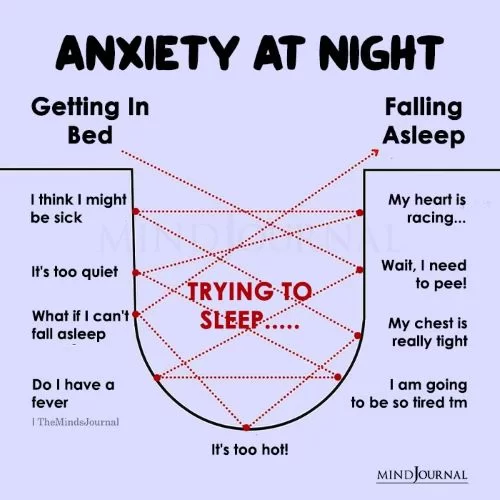
4. You feel exhausted on the couch, but the second your head hits the pillow, you’re wide awake.
5. Your body feels “wired,” or your heart beats faster, the moment you try to close your eyes.
Read More Here: 20 Anxiety Dreams That Might Be Waking You Up — And What They Actually Mean
The 4-Step Fix: Sleep Anxiety Treatment
1. Try The 15-Minute Rule
If you haven’t fallen asleep after 15 minutes, get out of bed. Staying there while anxious trains your brain to stay awake in that environment. One of the best remedies for sleep anxiety is to move to a different room and do something quiet or boring in dim light. Only return to bed when you feel physically sleepy. This breaks the mental link between your bed and your anxiety.
2. Use Reverse Psychology On Yourself
Stop trying to sleep. When you try to sleep, you create “performance anxiety.” Instead, lie in the dark and challenge yourself to stay awake as long as possible. By removing the pressure to fall asleep, you lower your heart rate and usually drift off without realizing it.
3. The 4-7-8 Breath
This is a mechanical override for your nervous system. Inhale through your nose for 4 seconds, hold your breath for 7 seconds, and exhale forcefully through your mouth for 8 seconds. The long exhale stimulates the vagus nerve, which tells your body to switch from “fight or flight” mode to “rest and digest” mode. It is a manual off-switch for a racing heart.
4. Pink Noise
White noise can sometimes be too harsh for a sensitive nervous system. Switch to pink noise, which sounds like steady rain or the rustling of tree leaves. It uses deeper frequencies that have been shown to sync with brain waves, helping you to slow down your mental activity. It also creates a sound shield that prevents small house noises from startling you back into an alert state.
Bottomline
Sleep anxiety is a conditioned reaction that your brain has learned; it is not a lifetime punishment. By using these four steps, you are essentially retraining your nervous system to feel safe again. Choose one technique to try tonight and stick with it.
Which of these signs hit home for you? Save this post so you have these steps ready the next time the 2 AM brain loop starts.
Frequently Asked Questions (FAQs)
What is sleep anxiety?
Sleep anxiety is a psychological condition where the act of trying to sleep actually triggers your “fight or flight” response.
How to deal with sleep anxiety?
One of the best remedies for sleep anxiety is to move to a different room and do something quiet or boring in dim light, for example, reading a book.
Does lack of sleep cause anxiety?
Yes, lack of sleep can trigger anxiety or worsen existing issues, leading to increased stress.
What color noise is best for sleep and anxiety?
Pink noise sounds like steady rain or the rustling of tree leaves and uses deeper frequencies that have been shown to sync with brain waves, helping you to slow down your mental activity.


Leave a Comment