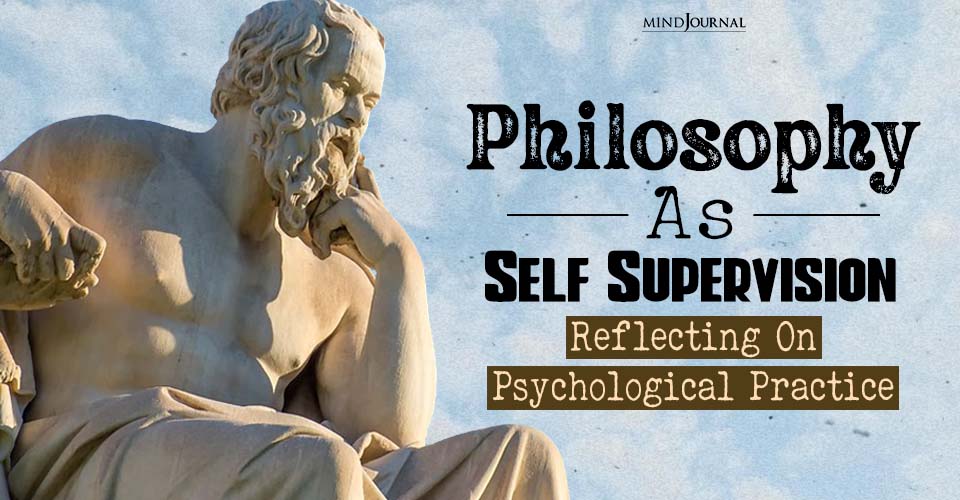
Philosophy as Self-Supervision: Reflecting on Psychological Practice

Author : Finn Janning PhD, Writer & Philosopher

Philosophy As Self Supervision Important Key Points

How often do you pause and reflect on your own practice? Self supervision isn’t just a tool, it’s a philosophical approach for insight and growth. So let’s explore more!

How philosophical inquiry enhances self-awareness, reflection, and growth.

Key points

  • Philosophical reflection can be a tool for self-supervision.
  • Wonder and uncertainty can shape professional growth.
  • Philosophical inquiry can be integrated into everyday practice.

Read More Here: Philosophy 101: 10 Philosophical Concepts To Help You Navigate Life’s Complexities

Philosophy offers a way to approach psychological practice with deeper self-reflection and critical awareness. Engaging with philosophical inquiry allows psychologists to cultivate a reflective stance toward their work, moving beyond technical expertise to explore their practice’s underlying assumptions, uncertainties, and ethical dimensions.

One of philosophy’s most fundamental impulses is wonder. In Theaetetus (155d), Plato describes thaumazein—the experience of wonder—as the beginning of philosophy, a feeling that arises when confronted with something we do not fully understand.

This sense of wonder, this curiosity, is what drives us to philosophize—a natural longing to comprehend the world and ourselves. As he notes in Rhetoric (1372a): “To learn something and to marvel at it is often a source of pleasure. For wonder entails a desire to learn and to know.”

In psychological practice, this sense of wonder is closely tied to the experience of uncertainty and self-questioning. In Philosophical Investigations, Ludwig Wittgenstein describes the experience of grappling with a problem as a kind of disorientation: “A philosophical problem has the form: I do not know my way about.”

Rather than seeing such moments as obstacles, philosophy invites us to treat them as essential opportunities for growth. Self-questioning does not mean one’s practice is flawed; it is an invitation to ask open-ended questions: What works? What does not? And why?

Hannah Arendt captures this self-inquisitive dimension of philosophy when she in a lecture writes that the “very word con-science, at any rate, points in this direction insofar as it means ‘to know with and by myself,’ a kind of knowledge that is actualized in every thinking process”.

This form of knowledge—activated through careful and critical self-examination—becomes central to understanding and developing one’s therapeutic approach in a way that can be shared, refined, and discussed with colleagues.

Thus, philosophy is not merely an abstract discipline; it is a practical tool for cultivating the reflective capacities that enable psychologists to engage with their work more thoughtfully and ethically.

Philosophy As A Tool for Self Supervision

Philosophy provides a lens through which psychologists can systematically reflect on their practice. Rather than treating knowledge as something external—validated by research alone—philosophy encourages an introspective and practice-based approach.

It prompts psychologists to explore their implicit assumptions, cognitive biases, and emotional responses in therapeutic settings. Some guiding questions that emerge from a philosophical perspective include:

  • Why does a particular therapeutic approach fail in this specific context?
  • How can I interpret a client’s reactions in a new way?
  • What does my own uncertainty reveal about my methods?
  • How do I navigate moments of therapeutic impasse?
  • Why do I struggle with maintaining attention in certain sessions?
  • How do my values and personal experiences influence my interventions?
  • Where do my impulses in a session come from, and do they facilitate or hinder the process?

Philosophy does not provide fixed answers to these questions, but it offers a disciplined way of thinking that allows psychologists to engage with them more rigorously and with greater openness. In this way, philosophical inquiry becomes a means of ongoing self supervision—an approach that fosters personal and professional development.

Philosophy as an Ethical and Reflective Practice

Philosophy helps cultivate a mindset essential for psychological practice: one that balances expertise with curiosity, self-confidence with self-doubt, and structure with flexibility. This philosophical stance serves three key purposes:

  • Deepening professional self-awareness by fostering ongoing reflection on one’s practice.
  • Generating new insights that emerge from lived experiences and critical questioning.
  • Philosophy contributes to a reflective professional culture that values self-inquiry as much as external research, fostering a sense of community among psychologists.

Philosophy, in this sense, is not an abstract luxury but a necessity. It strengthens psychologists’ ability to navigate the complexities of human experience—not just in their clients but within themselves. In this sense, philosophy is not an abstract luxury but a necessity for the field of psychology.

Read More Here: Mindfulness And The Spirit of Buddhist Meditation

Written by Finn Janning, PhD, Writer & Philosopher
Originally appeared on Psychology Today
philosophical reflection

Published On:

Last updated on:

Disclaimer: The informational content on The Minds Journal have been created and reviewed by qualified mental health professionals. They are intended solely for educational and self-awareness purposes and should not be used as a substitute for professional medical advice, diagnosis, or treatment. If you are experiencing emotional distress or have concerns about your mental health, please seek help from a licensed mental health professional or healthcare provider.

Leave a Comment

Today's Horoscope

Your Daily Horoscope For 4 April, 2026: Free Predictions

Daily Horoscope 4 April, 2026: Prediction For Each Zodiac Sign

Look at your daily prediction and see what the stars have in store for your love life and your future!

Latest Quizzes

How Many Circles Do You See? A Simple Test of Thinking Style

How Many Circles Do You See? Your Answer Might Reveal Narcissistic Traits! 

Take a closer look at this simple image and discover what your circle count reveals about your thinking style, perception, and attention in this fun and engaging visual test.

Latest Quotes

Real Signs Your Body Is Actually in Good Health: How to Know You’re Truly Well

Real Signs Your Body Is Actually in Good Health: How to Know You’re Truly Well

Real signs your body is healthy don’t always show up on lab reports. From good sleep and clear skin to regular digestion and a stable mood, your body is constantly sending quiet signals of wellness.

Readers Blog

Caption This Image and Selected Wisepicks – 5 April 2026

Caption This Image and Selected Wisepicks – 5 April 2026

Ready to unleash your inner wordsmith? ✨??☺️ Now’s your chance to show off your wit, charm, or sheer genius in just one line! Whether it’s laugh-out-loud funny or surprisingly deep, we want to hear it.Submit your funniest, wittiest, or most thought-provoking caption in the comments. We’ll pick 15+ winners to be featured on our website…

Latest Articles

Philosophy As Self Supervision Important Key Points

How often do you pause and reflect on your own practice? Self supervision isn’t just a tool, it’s a philosophical approach for insight and growth. So let’s explore more!

How philosophical inquiry enhances self-awareness, reflection, and growth.

Key points

  • Philosophical reflection can be a tool for self-supervision.
  • Wonder and uncertainty can shape professional growth.
  • Philosophical inquiry can be integrated into everyday practice.

Read More Here: Philosophy 101: 10 Philosophical Concepts To Help You Navigate Life’s Complexities

Philosophy offers a way to approach psychological practice with deeper self-reflection and critical awareness. Engaging with philosophical inquiry allows psychologists to cultivate a reflective stance toward their work, moving beyond technical expertise to explore their practice’s underlying assumptions, uncertainties, and ethical dimensions.

One of philosophy’s most fundamental impulses is wonder. In Theaetetus (155d), Plato describes thaumazein—the experience of wonder—as the beginning of philosophy, a feeling that arises when confronted with something we do not fully understand.

This sense of wonder, this curiosity, is what drives us to philosophize—a natural longing to comprehend the world and ourselves. As he notes in Rhetoric (1372a): “To learn something and to marvel at it is often a source of pleasure. For wonder entails a desire to learn and to know.”

In psychological practice, this sense of wonder is closely tied to the experience of uncertainty and self-questioning. In Philosophical Investigations, Ludwig Wittgenstein describes the experience of grappling with a problem as a kind of disorientation: “A philosophical problem has the form: I do not know my way about.”

Rather than seeing such moments as obstacles, philosophy invites us to treat them as essential opportunities for growth. Self-questioning does not mean one’s practice is flawed; it is an invitation to ask open-ended questions: What works? What does not? And why?

Hannah Arendt captures this self-inquisitive dimension of philosophy when she in a lecture writes that the “very word con-science, at any rate, points in this direction insofar as it means ‘to know with and by myself,’ a kind of knowledge that is actualized in every thinking process”.

This form of knowledge—activated through careful and critical self-examination—becomes central to understanding and developing one’s therapeutic approach in a way that can be shared, refined, and discussed with colleagues.

Thus, philosophy is not merely an abstract discipline; it is a practical tool for cultivating the reflective capacities that enable psychologists to engage with their work more thoughtfully and ethically.

Philosophy As A Tool for Self Supervision

Philosophy provides a lens through which psychologists can systematically reflect on their practice. Rather than treating knowledge as something external—validated by research alone—philosophy encourages an introspective and practice-based approach.

It prompts psychologists to explore their implicit assumptions, cognitive biases, and emotional responses in therapeutic settings. Some guiding questions that emerge from a philosophical perspective include:

  • Why does a particular therapeutic approach fail in this specific context?
  • How can I interpret a client’s reactions in a new way?
  • What does my own uncertainty reveal about my methods?
  • How do I navigate moments of therapeutic impasse?
  • Why do I struggle with maintaining attention in certain sessions?
  • How do my values and personal experiences influence my interventions?
  • Where do my impulses in a session come from, and do they facilitate or hinder the process?

Philosophy does not provide fixed answers to these questions, but it offers a disciplined way of thinking that allows psychologists to engage with them more rigorously and with greater openness. In this way, philosophical inquiry becomes a means of ongoing self supervision—an approach that fosters personal and professional development.

Philosophy as an Ethical and Reflective Practice

Philosophy helps cultivate a mindset essential for psychological practice: one that balances expertise with curiosity, self-confidence with self-doubt, and structure with flexibility. This philosophical stance serves three key purposes:

  • Deepening professional self-awareness by fostering ongoing reflection on one’s practice.
  • Generating new insights that emerge from lived experiences and critical questioning.
  • Philosophy contributes to a reflective professional culture that values self-inquiry as much as external research, fostering a sense of community among psychologists.

Philosophy, in this sense, is not an abstract luxury but a necessity. It strengthens psychologists’ ability to navigate the complexities of human experience—not just in their clients but within themselves. In this sense, philosophy is not an abstract luxury but a necessity for the field of psychology.

Read More Here: Mindfulness And The Spirit of Buddhist Meditation

Written by Finn Janning, PhD, Writer & Philosopher
Originally appeared on Psychology Today
philosophical reflection

Published On:

Last updated on:

Finn Janning PhD, Writer & Philosopher

Leave a Comment

    Leave a Comment