When Its Hard To Validate Each Other In A Relationship, Try This

Author : Alicia Muñoz, LPC

Validation is a skill, but it’s also an art. It can be practiced and developed as we evolve in our relationships. Most of us need to feel like our partner “gets” us–like they can see things through our eyes and understand our point of view. Especially when couples get into a power struggle, or there’s a misunderstanding, validation can support the repair process.

Many of us have underlying fears about what will happen if we validate our partner. We’re afraid it means we’re sacrificing our truth, or that the balance of power in the relationship will tip and leave us at a disadvantage.

Related: 7 Reasons Why Mutual Understanding Is More Important Than Love In A Relationship

When A Couple Gets Stuck

Take Maria and Jacqueline, for example. They’ve just had a blow-out fight about Maria forgetting, yet again, to send a text saying she’ll be arriving home late from work, which would have helped Jacqueline plan her evening with their kids and put them to sleep on time.

In this situation, Maria may have a hard time “validating” Jacqueline’s frustration because she fears this will give her more ammunition to use against her in judgments and criticisms. Jacqueline, on the other hand, won’t validate Maria (although she knows she’s under a lot of pressure at work) because she fears doing so is tantamount to an endorsement of her irresponsibility and forgetfulness.
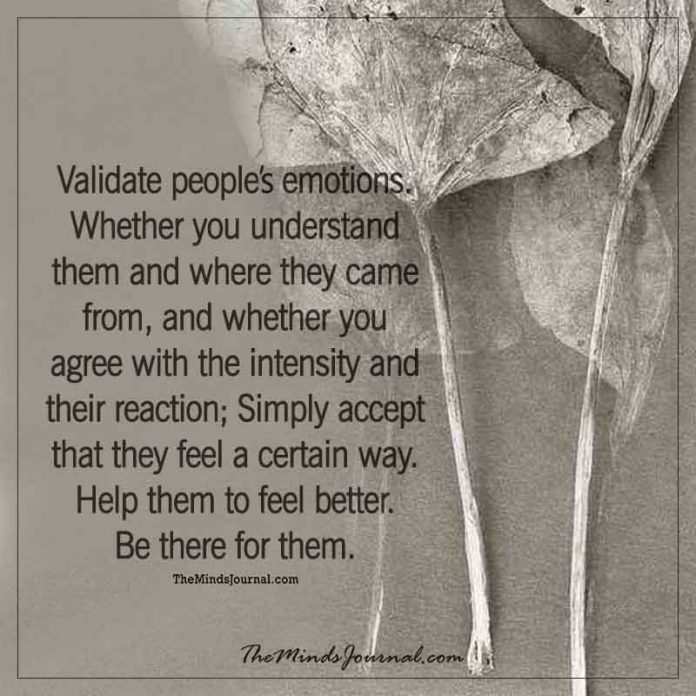
giving your partner validation

Pre-requisites For Successful Validation

When you validate your partner and affirm their point of view, does it feel like it gets used against you? Like your validation is turned into proof that they’re right and you’re wrong?

Here are a few important pre-requisites for practicing validation successfully with a partner.

1) Develop confidence in your own right to YOUR reality. This will help you affirm your partner’s reality more effectively. Otherwise, validation can lead you to feel like you’re losing your psychological footing.

2) Cultivate an emotional and psychological “balance of power” in your relationship. If your sense of personal power feels relatively equal to your partner’s, and you feel differentiated from them (e.g. you can be who you are and still stay connected to them, and visa versa) then it’s easier to validate them when there’s a difference of opinion or perspective.

3) Respect one another’s emotional, psychological, and physical boundaries. Fuzzy or frequently disregarded boundaries in a relationship decrease the safety that supports validation. You may both be worried that any validation will be co-opted as a way to dominate each other.

Related: 4 Ways To Restore Respect In A Relationship

Distinct AND Interdependent

If your attempts at validating your partner don’t go well, think about these validation pre-requisites. Maybe it’s time to focus on building your confidence in yourself and your right to your own reality distinct from your partner.

Or maybe it’s time to look at the power dynamic in your relationship and talk to your partner about it honestly, or with a professional’s guidance–exploring how a lack of psychological safety may be interfering with your ability to show up authentically and validate one another while also feeling secure in your bond.

Developing and strengthening your sense of self as both distinct from others, and interdependent with others, supports validation.

Follow Alicia Muñoz on Instagram for more informative and interesting posts, @aliciamunozcouples.


Written By Alicia Muñoz
Originally Appeared On Alicia Muñoz
hard to validate each other in a relationship validation pin

Published On:

Last updated on:

Alicia Muñoz, LPC

Alicia Muñoz is a licensed professional counselor and a certified couples therapist with training in Imago Therapy, CBT, Focusing, Accelerated Experiential Dynamic Psychotherapy (AEDP), and Intensive Short Term Dynamic Psychotherapy (ISTDP). She has worked in a wide array of clinical settings over the past fourteen years, including private clinics, New York City’s Bellevue Hospital, and private practice. Her work aims at inspiring and motivating her clients to understand their relationship challenges, connect to their body’s innate wisdom, practice new self-soothing and communication skills, slow down, and bring a sense of curiosity and mindfulness to unresolved conflicts with their partners.

Disclaimer: The informational content on The Minds Journal have been created and reviewed by qualified mental health professionals. They are intended solely for educational and self-awareness purposes and should not be used as a substitute for professional medical advice, diagnosis, or treatment. If you are experiencing emotional distress or have concerns about your mental health, please seek help from a licensed mental health professional or healthcare provider.

Leave a Comment

Today's Horoscope

Your Daily Horoscope For 4 April, 2026: Free Predictions

Daily Horoscope 4 April, 2026: Prediction For Each Zodiac Sign

Look at your daily prediction and see what the stars have in store for your love life and your future!

Latest Quizzes

How Many Circles Do You See? A Simple Test of Thinking Style

How Many Circles Do You See? Your Answer Might Reveal Narcissistic Traits! 

Take a closer look at this simple image and discover what your circle count reveals about your thinking style, perception, and attention in this fun and engaging visual test.

Latest Quotes

Real Signs Your Body Is Actually in Good Health: How to Know You’re Truly Well

Real Signs Your Body Is Actually in Good Health: How to Know You’re Truly Well

Real signs your body is healthy don’t always show up on lab reports. From good sleep and clear skin to regular digestion and a stable mood, your body is constantly sending quiet signals of wellness.

Readers Blog

Caption This Image and Selected Wisepicks – 5 April 2026

Caption This Image and Selected Wisepicks – 5 April 2026

Ready to unleash your inner wordsmith? ✨??☺️ Now’s your chance to show off your wit, charm, or sheer genius in just one line! Whether it’s laugh-out-loud funny or surprisingly deep, we want to hear it.Submit your funniest, wittiest, or most thought-provoking caption in the comments. We’ll pick 15+ winners to be featured on our website…

Latest Articles

Validation is a skill, but it’s also an art. It can be practiced and developed as we evolve in our relationships. Most of us need to feel like our partner “gets” us–like they can see things through our eyes and understand our point of view. Especially when couples get into a power struggle, or there’s a misunderstanding, validation can support the repair process.

Many of us have underlying fears about what will happen if we validate our partner. We’re afraid it means we’re sacrificing our truth, or that the balance of power in the relationship will tip and leave us at a disadvantage.

Related: 7 Reasons Why Mutual Understanding Is More Important Than Love In A Relationship

When A Couple Gets Stuck

Take Maria and Jacqueline, for example. They’ve just had a blow-out fight about Maria forgetting, yet again, to send a text saying she’ll be arriving home late from work, which would have helped Jacqueline plan her evening with their kids and put them to sleep on time.

In this situation, Maria may have a hard time “validating” Jacqueline’s frustration because she fears this will give her more ammunition to use against her in judgments and criticisms. Jacqueline, on the other hand, won’t validate Maria (although she knows she’s under a lot of pressure at work) because she fears doing so is tantamount to an endorsement of her irresponsibility and forgetfulness.

giving your partner validation

Pre-requisites For Successful Validation

When you validate your partner and affirm their point of view, does it feel like it gets used against you? Like your validation is turned into proof that they’re right and you’re wrong?

Here are a few important pre-requisites for practicing validation successfully with a partner.

1) Develop confidence in your own right to YOUR reality. This will help you affirm your partner’s reality more effectively. Otherwise, validation can lead you to feel like you’re losing your psychological footing.

2) Cultivate an emotional and psychological “balance of power” in your relationship. If your sense of personal power feels relatively equal to your partner’s, and you feel differentiated from them (e.g. you can be who you are and still stay connected to them, and visa versa) then it’s easier to validate them when there’s a difference of opinion or perspective.

3) Respect one another’s emotional, psychological, and physical boundaries. Fuzzy or frequently disregarded boundaries in a relationship decrease the safety that supports validation. You may both be worried that any validation will be co-opted as a way to dominate each other.

Related: 4 Ways To Restore Respect In A Relationship

Distinct AND Interdependent

If your attempts at validating your partner don’t go well, think about these validation pre-requisites. Maybe it’s time to focus on building your confidence in yourself and your right to your own reality distinct from your partner.

Or maybe it’s time to look at the power dynamic in your relationship and talk to your partner about it honestly, or with a professional’s guidance–exploring how a lack of psychological safety may be interfering with your ability to show up authentically and validate one another while also feeling secure in your bond.

Developing and strengthening your sense of self as both distinct from others, and interdependent with others, supports validation.

Follow Alicia Muñoz on Instagram for more informative and interesting posts, @aliciamunozcouples.


Written By Alicia Muñoz
Originally Appeared On Alicia Muñoz
hard to validate each other in a relationship validation pin

Published On:

Last updated on:

Alicia Muñoz, LPC

Alicia Muñoz is a licensed professional counselor and a certified couples therapist with training in Imago Therapy, CBT, Focusing, Accelerated Experiential Dynamic Psychotherapy (AEDP), and Intensive Short Term Dynamic Psychotherapy (ISTDP). She has worked in a wide array of clinical settings over the past fourteen years, including private clinics, New York City’s Bellevue Hospital, and private practice. Her work aims at inspiring and motivating her clients to understand their relationship challenges, connect to their body’s innate wisdom, practice new self-soothing and communication skills, slow down, and bring a sense of curiosity and mindfulness to unresolved conflicts with their partners.

Leave a Comment

    Leave a Comment