Navigating the Unbearable: 5 Effective Strategies for Dealing with Difficult People

Author : Monica Vermani C. Psych.

In life, we will always come across many difficult and problematic people. You might even be working with difficult people in your workspace or dealing with problematic people in your family. So now the question is, how do you deal with difficult people? What are the best ways for dealing with difficult people?

Key Points

  • The problematic people in our lives reflect back to us our insecurities and inadequacies.
  • We can learn a great deal about ourselves if we take a closer, more compassionate look at someone with whom we have interpersonal conflicts.
  • Through our interactions, we can learn and grow, and become higher and more authentic versions of ourselves.

We all have people with whom we struggle, problematic people who seem to drain us of our energies, rub us the wrong way, poke, provoke, frustrate, or trigger us.

What’s really happening when we find ourselves dealing with difficult colleagues and family members, and how we can learn and grow by reflecting on our relationships with the difficult people in our lives?

For the most part, we seek to surround ourselves with people we enjoy and love, people who we have fun with, confide in, and rely on, and for whom we do the same. But most of us do not have complete control over everyone we work with, encounter, or engage with on a regular basis.

We’re also born into families with whom we grow and evolve over time, some in ways find troublesome and with whom we struggle.

At some point in time, we all have family members, friends, colleagues, and strangers who can upset, derail or challenge us, or generate conflict even in the most trivial interaction.

Related: 10 Strategies To Help You Deal With The Difficult People In Your Life

We’re all difficult people

The reality is that to some extent, we’re all likely difficult for someone! The Difficult Person Test — described as one of the most unflattering tests on the internet — rates each test taker’s responses in seven categories, including callousness, aggressiveness, grandiosity, manipulativeness, dominance, risk-taking, and suspicion, and arrives at a final result and score.

While individual results will obviously vary, even people identified as easy to get along with will find that they possess problematic traits and aspects of themselves that identify them as difficult people.

What’s the problem?

In some ways, we may not know ourselves very well or see ourselves as others can. Every person we interact with holds up a mirror for us and allows us to see certain aspects of ourselves.

We see who we are as a son or daughter in front of our parents. We see who we are as a partner in front of our partner, a sibling in front of our sisters and brothers, a student in front of our teachers, a co-worker in front of our colleagues, and a friend in the presence of our friends.

Through our many interactions, everyone reflects back to us who we are. The problematic people in our lives reflect back to us our insecurities and inadequacies.
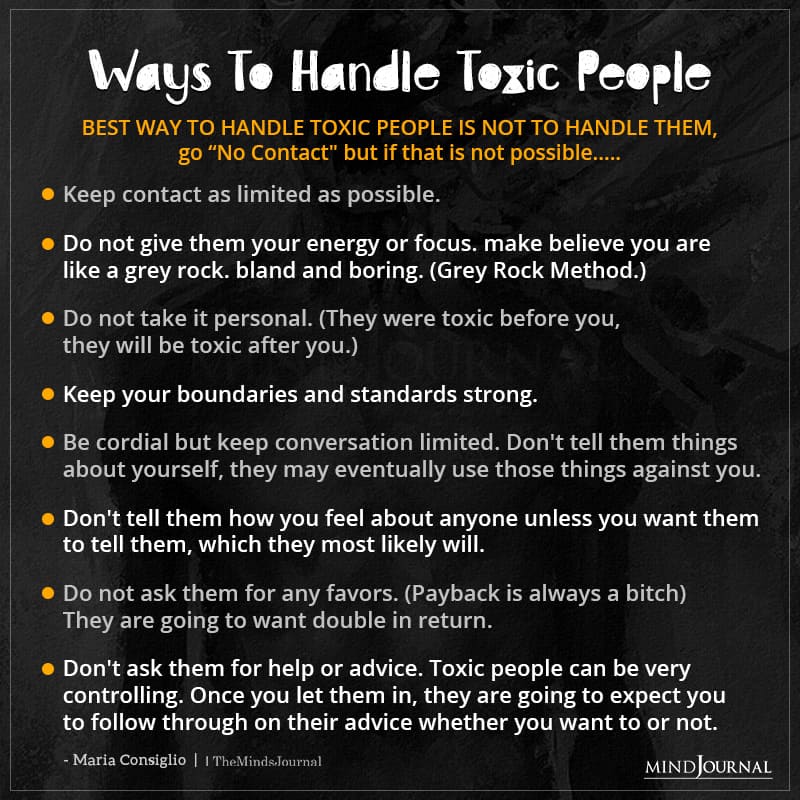
Dealing with difficult people

Placing blame

Consciously or unconsciously, we unfairly blame and label other people as problematic when what is really getting us all worked up are our own insecurities, which trigger unpleasant emotions and challenge us when we are in their presence.

As a result, we then judge these people negatively as difficult, unpleasant, or problematic.

Related: How Emotionally Intelligent People Handle Toxic People: 13 Smart Ways

Challenge yourself to go deeper

We can learn a great deal about ourselves if we make the effort to take a closer, more compassionate look at someone with whom we have interpersonal conflicts. Think of someone with whom you struggle.

This person — no matter how problematic — is highly unlikely to be all bad! Think about and try to identify the uncomfortable feeling or feelings you associate with this person.

Consider the traits you like or admire in this person and the traits you have in common with them. Think about the traits you struggle with. You may find that you share troublesome traits with them.

Compassionate self-reflection

When you begin to examine what the problematic people in your life are mirroring back to you, chances are that you will identify traits you admire in them, traits you share, and even traits you would like to acquire.

The traits you struggle with are traits you mistrust or find undesirable or feel unable to manage. When someone mirrors back a trait with which you struggle or cannot relate, you need to reflect not only on why, but on how you could approach that trait with kindness, and compassion.

Even with the most troublesome people in your life, compassion is the way forward.

Our highest and best selves

Two big reasons why we suffer in life are because we do not accept situations as they are, and we do not accept people as they are.

We need to learn to accept other people as they are. By seeing ourselves as we are and others clearly, we can manage our expectations and conduct our interactions with greater awareness and compassion.

Related: 5 Tips To Manage Stressful People in Your Life

The ripple effect of compassion

In “Have Compassion,” a 2011 post in Psychology Today, blogger Rick Hanson, Ph.D., offers the following observations on the ripple effect of compassion in relationships with others.

He writes: “Those who receive your compassion are more likely to be patient, forgiving, and compassionate with you. Compassion reflects the wisdom that everything is related to everything else, and it naturally draws you into feeling more connected with all things.”

Remember, the world outside of us — including even the most problematic people in it — show us aspects of ourselves. Through our interactions, we learn and grow, and become higher and more authentic versions of ourselves. This, after all, is why we’re here.

Dealing with difficult people

Dealing with difficult people

  • Decide to approach the difficult people in your life in a healthier, compassionate way.
  • Make note of troublesome traits of the problem people in your life, and what insecurities and inadequacies these traits trigger in you.
  • Acknowledge the common positive and negative traits you share, and traits they have that you admire.
  • Accept people as they are.
  • Practice compassion in your dealings and interactions with others, especially those who challenge you.

Related: How To Deal With Mean People The Smart Way

Want to know more about dealing with difficult people? Check this video out below!


Written By Monica Vermani
Originally Appeared On Psychology Today
deal with difficult people

Published On:

Last updated on:

Monica Vermani C. Psych.

Dr. Monica Vermani, C. Psych., is a clinical psychologist specializing in treating trauma, stress, mood, and anxiety disorders, and the founder of Start Living Corporate Wellness. She is also a well-known public speaker, author, corporate wellness expert, and mental health advocate. A regular commentator to online and print media outlets, and TV, radio, and podcasts, including Forbes Magazine, CNN Healthline, Psychology Today, InStyle Magazine, Parade, Martha Stewart, Oprah Daily, and many others, Dr. Vermani’s latest book, A Deeper Wellness, Conquering Stress, Mood, Anxiety, and Traumas, is available worldwide, in print, eBook, and audiobook on Amazon or at www.drmonicavermani.com Think About It!, Dr. Vermani’s recent Ted X UofT talk about dealing with negative thoughts and self-limiting beliefs will be released in the near future.

Disclaimer: The informational content on The Minds Journal have been created and reviewed by qualified mental health professionals. They are intended solely for educational and self-awareness purposes and should not be used as a substitute for professional medical advice, diagnosis, or treatment. If you are experiencing emotional distress or have concerns about your mental health, please seek help from a licensed mental health professional or healthcare provider.

Leave a Comment

Today's Horoscope

Your Daily Horoscope For 18 March 2026: Free Predictions

Daily Horoscope 18 March, 2026: Prediction For Each Zodiac Sign

Start your day with cosmic guidance. Read your daily horoscope for 18 March and uncover your free horoscope today!

Latest Quizzes

Free Vase Personality Test: 3 Options; Choose A Vase

Vase Personality Test: Your First Pick Reveals Your Main Character Trait

Take a moment, look closely, and pick an object that represents you.

Latest Quotes

Apology And Change: Why True Remorse Erases The Past

Apology And Change: Why True Remorse Erases The Past

If you offer a sincere apology and change your behavior, I'll never bring up our past issues again. But without it, you can't ask me to forget—the "past" is just "haven't changed."

Readers Blog

Caption This Image and Selected Wisepicks – 15 March 2026

Caption This Image and Selected Wisepicks – 15 March 2026

Ready to unleash your inner wordsmith? ✨??☺️ Now’s your chance to show off your wit, charm, or sheer genius in just one line! Whether it’s laugh-out-loud funny or surprisingly deep, we want to hear it.Submit your funniest, wittiest, or most thought-provoking caption in the comments. We’ll pick 15+ winners to be featured on our website…

Latest Articles

In life, we will always come across many difficult and problematic people. You might even be working with difficult people in your workspace or dealing with problematic people in your family. So now the question is, how do you deal with difficult people? What are the best ways for dealing with difficult people?

Key Points

  • The problematic people in our lives reflect back to us our insecurities and inadequacies.
  • We can learn a great deal about ourselves if we take a closer, more compassionate look at someone with whom we have interpersonal conflicts.
  • Through our interactions, we can learn and grow, and become higher and more authentic versions of ourselves.

We all have people with whom we struggle, problematic people who seem to drain us of our energies, rub us the wrong way, poke, provoke, frustrate, or trigger us.

What’s really happening when we find ourselves dealing with difficult colleagues and family members, and how we can learn and grow by reflecting on our relationships with the difficult people in our lives?

For the most part, we seek to surround ourselves with people we enjoy and love, people who we have fun with, confide in, and rely on, and for whom we do the same. But most of us do not have complete control over everyone we work with, encounter, or engage with on a regular basis.

We’re also born into families with whom we grow and evolve over time, some in ways find troublesome and with whom we struggle.

At some point in time, we all have family members, friends, colleagues, and strangers who can upset, derail or challenge us, or generate conflict even in the most trivial interaction.

Related: 10 Strategies To Help You Deal With The Difficult People In Your Life

We’re all difficult people

The reality is that to some extent, we’re all likely difficult for someone! The Difficult Person Test — described as one of the most unflattering tests on the internet — rates each test taker’s responses in seven categories, including callousness, aggressiveness, grandiosity, manipulativeness, dominance, risk-taking, and suspicion, and arrives at a final result and score.

While individual results will obviously vary, even people identified as easy to get along with will find that they possess problematic traits and aspects of themselves that identify them as difficult people.

What’s the problem?

In some ways, we may not know ourselves very well or see ourselves as others can. Every person we interact with holds up a mirror for us and allows us to see certain aspects of ourselves.

We see who we are as a son or daughter in front of our parents. We see who we are as a partner in front of our partner, a sibling in front of our sisters and brothers, a student in front of our teachers, a co-worker in front of our colleagues, and a friend in the presence of our friends.

Through our many interactions, everyone reflects back to us who we are. The problematic people in our lives reflect back to us our insecurities and inadequacies.

Dealing with difficult people

Placing blame

Consciously or unconsciously, we unfairly blame and label other people as problematic when what is really getting us all worked up are our own insecurities, which trigger unpleasant emotions and challenge us when we are in their presence.

As a result, we then judge these people negatively as difficult, unpleasant, or problematic.

Related: How Emotionally Intelligent People Handle Toxic People: 13 Smart Ways

Challenge yourself to go deeper

We can learn a great deal about ourselves if we make the effort to take a closer, more compassionate look at someone with whom we have interpersonal conflicts. Think of someone with whom you struggle.

This person — no matter how problematic — is highly unlikely to be all bad! Think about and try to identify the uncomfortable feeling or feelings you associate with this person.

Consider the traits you like or admire in this person and the traits you have in common with them. Think about the traits you struggle with. You may find that you share troublesome traits with them.

Compassionate self-reflection

When you begin to examine what the problematic people in your life are mirroring back to you, chances are that you will identify traits you admire in them, traits you share, and even traits you would like to acquire.

The traits you struggle with are traits you mistrust or find undesirable or feel unable to manage. When someone mirrors back a trait with which you struggle or cannot relate, you need to reflect not only on why, but on how you could approach that trait with kindness, and compassion.

Even with the most troublesome people in your life, compassion is the way forward.

Our highest and best selves

Two big reasons why we suffer in life are because we do not accept situations as they are, and we do not accept people as they are.

We need to learn to accept other people as they are. By seeing ourselves as we are and others clearly, we can manage our expectations and conduct our interactions with greater awareness and compassion.

Related: 5 Tips To Manage Stressful People in Your Life

The ripple effect of compassion

In “Have Compassion,” a 2011 post in Psychology Today, blogger Rick Hanson, Ph.D., offers the following observations on the ripple effect of compassion in relationships with others.

He writes: “Those who receive your compassion are more likely to be patient, forgiving, and compassionate with you. Compassion reflects the wisdom that everything is related to everything else, and it naturally draws you into feeling more connected with all things.”

Remember, the world outside of us — including even the most problematic people in it — show us aspects of ourselves. Through our interactions, we learn and grow, and become higher and more authentic versions of ourselves. This, after all, is why we’re here.

Dealing with difficult people

Dealing with difficult people

  • Decide to approach the difficult people in your life in a healthier, compassionate way.
  • Make note of troublesome traits of the problem people in your life, and what insecurities and inadequacies these traits trigger in you.
  • Acknowledge the common positive and negative traits you share, and traits they have that you admire.
  • Accept people as they are.
  • Practice compassion in your dealings and interactions with others, especially those who challenge you.

Related: How To Deal With Mean People The Smart Way

Want to know more about dealing with difficult people? Check this video out below!


Written By Monica Vermani
Originally Appeared On Psychology Today
deal with difficult people

Published On:

Last updated on:

Monica Vermani C. Psych.

Dr. Monica Vermani, C. Psych., is a clinical psychologist specializing in treating trauma, stress, mood, and anxiety disorders, and the founder of Start Living Corporate Wellness. She is also a well-known public speaker, author, corporate wellness expert, and mental health advocate. A regular commentator to online and print media outlets, and TV, radio, and podcasts, including Forbes Magazine, CNN Healthline, Psychology Today, InStyle Magazine, Parade, Martha Stewart, Oprah Daily, and many others, Dr. Vermani’s latest book, A Deeper Wellness, Conquering Stress, Mood, Anxiety, and Traumas, is available worldwide, in print, eBook, and audiobook on Amazon or at www.drmonicavermani.com Think About It!, Dr. Vermani’s recent Ted X UofT talk about dealing with negative thoughts and self-limiting beliefs will be released in the near future.

Leave a Comment

    Leave a Comment