

What is relationship OCD, and what does it feel like?
It might start with a small doubt, but suddenly you are questioning everything about your relationship. One moment you find yourself fixating on your partner’s flaws, and the next? You’re drowning in guilt, doubt, and “what ifs.”
You tell yourself, “Let me just figure this out, I’ll find clarity.” But you just end up feeling more stuck.
Your mind turns into an interrogation room. And the questions don’t even bring answers. They drain you and your relationship.
Love starts feeling like an impossible problem to solve where your mind would just not let you reach an answer.
So you keep circling around the same thoughts whether that’s “Am I enough?” or “Are they enough?”
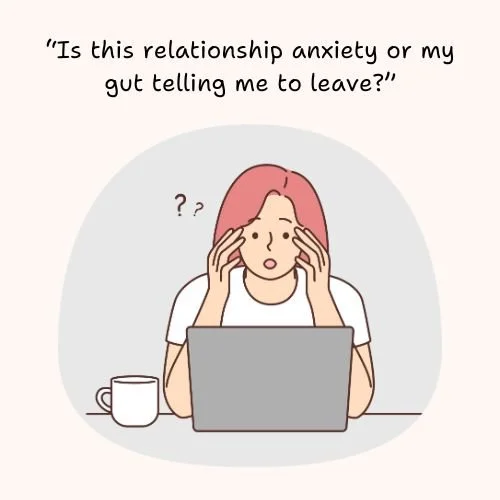
Now, that’s the trap-the more you analyze, the more lost you feel.
10 Signs Your Relationship OCD Stems from Relationship Anxiety and Not Gut Feeling
1. You tend to repetitively measure and question your feelings
According to PsyD Susan Albers, relationship OCD often involves constant questioning and obsessive doubt about the relationship.
This is more likely to prevent one from enjoying the relationship, shifting their focus to the “icks”, the flaws in the relationship or their partner, making it seem like a background.
2. You show love like a performance
The International OCD Foundation (IOCDF) describe relationship OCD as a relationship-centric obsession where individuals become focused on the idea of “rightness” in their relationship, trying to prove the consistency of love or attraction for their partner.
Such mental spirals can lead to obsessive checking for your rightness for each other in the relationship.
3. Your brain picks up on the tiniest signs to think of it as a danger
You start focusing on the tiniest flaws that catch your eye. It could be the way your partner eats, or the slightest drop of emotional intensity, or even how you feel a bit “off” towards them lately.
However, instead of normalizing or tending to ignore these, your brain starts treating them as signs of danger.
Read More Here: Dating Someone With Relationship OCD? 7 Strategies For Supporting Your Loved One
4. You start feeling disconnected from your own self in the relationship
Once relationship OCD sets in, it comes with a lot of guilt and shame and a thousand obsessive check-ins. It becomes difficult to enjoy or experience your own choice of the relationship you made.
The partner you chose, the instincts you followed, the steps you took. This can make you feel more disconnected not just from the relationship but from your very own self.
5. You feel you would be less exhausted or more liberated out of the relationship, even when you’re being treated well by your partner
You tend to experience a phantom sense of relationship at the thought of being single. Even if you’re in a healthy relationship, it can make you feel suffocated and exhausted.
Wanting to be single mainly comes out of this want to escape such tangles of thoughts rather than the relationship itself.
6. You repetitively try to seek reassurances about your relationships almost compulsively
Just like in OCD, your mind tells you not to cross the lines on the floor, or do an action 3 times, in relationship OCD, such compulsions become a test of your relationship.
It can also come in the form of wanting constant reassurances from not just your partner but your friends and family, even when you can realize, it does not seem to help.
Read More Here: Breaking Free Of Obsessive Compulsive Disorder (OCD)
7. You tend to compare your relationship with standards that even you kind of know are unrealistic
Even you know when the standards of relationships can be shown to be unrealistic in novels, movies or simply on social media. Actually, with the rise of numerous couple channels over social media platforms, it has become a massive trend.
Despite all the logic and facts you give yourself, your relationship OCD can turn your thoughts differently and make you compare yours to the curated and showcased ones.
8. Your “what if” questions about your relationship do not align with the relationship anxiety help you’re looking for
You think that answering your “what if” questions about the relationship would provide you with the relationship anxiety help you are looking for.
Instead, these end up doing the opposite.
Because it is like a maze, you open one door, and it takes you to more roundabout ways of getting lost and distanced from your actual relationship experiences.
9. You tend to think that it is not working during the quiet or stable phases of the time period
When there is a lack of emotionally intense or “lack of spark” moments in the relationship, your mind tends to pick up on those energies as if the relationship is not working anymore.
It can sound so convincing that you might find yourself having the urge to break it off.
But it is actually not the case, and it is very human and normal for a relationship to have such moments.
Longer lasting relationships can have numerous of those time periods. This is not a sign that there is something wrong with your relationship.
10. You repetitively keep wondering if you made the wrong choice, which leaves you with guilt and shame:
As you give in to your “what if” questions about whether you made the wrong choice, or if your partner is right for you, or if this is the relationship that you truly wanted.
It can often be followed by periods of intense guilt and shame, making you compensate for it through acts of love that can feel like performance rather than your true natural desire, keeping the loop open.
How To Recover from The Loops of OCD Relationship Anxiety
- Start telling your mind that not feeling the “spark” of being “in love” all the time is often common-it does not mean the relationship is broken, it only makes the involved partners human.
- You can allow those uncertainties and queries to exist; not each of them requires immediate attention.
- Start focusing on the present moments of your relationship with your partner.
- Most importantly, you need to resist the repetitive urge to seek reassurances.
- Once you start focusing on the values shown in the relationship, you’ll start to see how much it can take you away from the loops of OCD Relationship Anxiety.
So, the bottom line is…
Being in a constant phase of mental spiral and doubt cycle due to relationship OCD can be hard. It does not mean something is wrong with you. It can often be traced to patterns of coping mechanisms you developed to protect yourself.
Ultimately, your mind and brain are trying to protect you. However, if you constantly feed answers to their doubts and queries, it is bound to keep you trapped. It is easier said than done, but the most effective way can often be co-existing with their presence and
being honest with your partner.
And then, one day, slowly, you will start to realize how you are coming out of the cycles of your relationship OCD.
Frequently Asked Questions
1. How to Differentiate Between Gut Feeling and Relationship OCD?v
A gut feeling is clearer in itself, rising as a result of present moment actions. These are calmer and have a sort of predictability with them. However, a relationship OCD symptom presents itself suddenly and urgently, in fact, almost chaotically, looking for a certainty that can seem irrational to your own self.
2. Why does Relationship OCD feel so real?
Relationship OCD can feel so real because the thoughts are extremely persistent, and the more frequent they are, the more “real” it seems. This can make anyone dwell more on it, keeping the relationship anxiety spiral ongoing and making it feel truer.


Leave a Comment