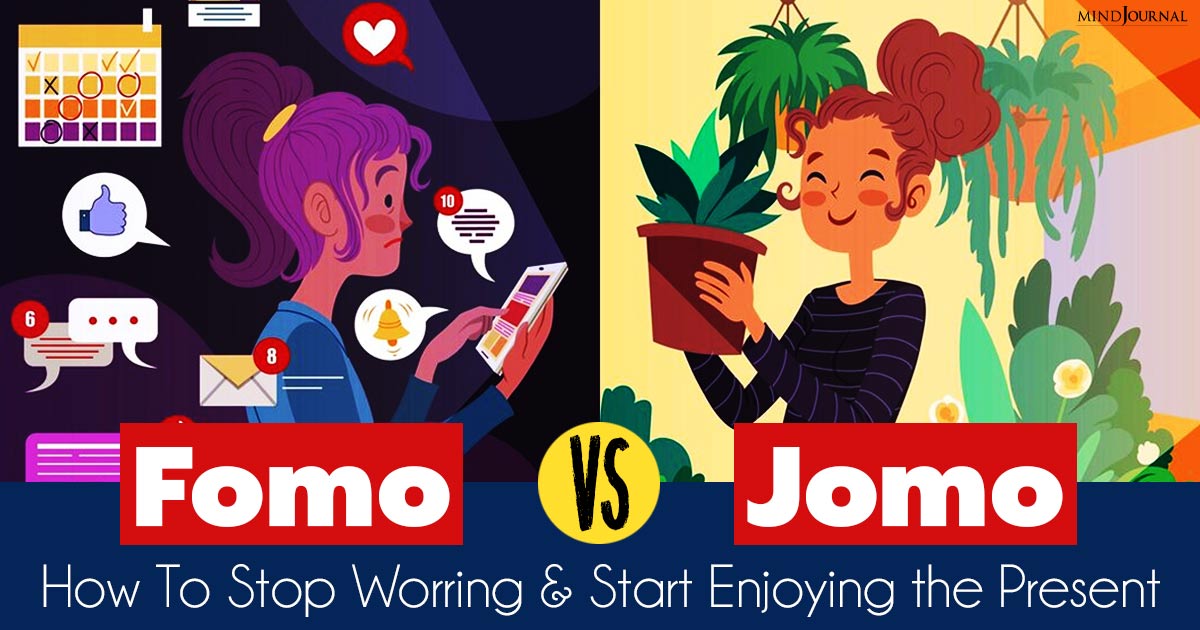
JOMO Vs FOMO: How to Stop Worrying About Missing Out And Start Enjoying the Present

Author : Daisy Simon

JOMO Vs FOMO How to Stop Worrying About Missing Out And Start Enjoying the Present

Are you ready to explore the psychological battle of JOMO VS FOMO? We’ll be diving into the two sides of social connectivity and the importance of solitude.

Ever hopped on your phone and instantly felt envy? You scroll through your social media feeds and see friends having the time of their lives, while you sit at home doing nothing.

It’s what psychologists call FOMO (the Fear of Missing Out), a condition many people are familiar with in our age of smartphones. But could there be a healthier alternative? Say hello to JOMO (the Joy Of Missing Out).

What Is JOMO vs FOMO
jomo vs fomo

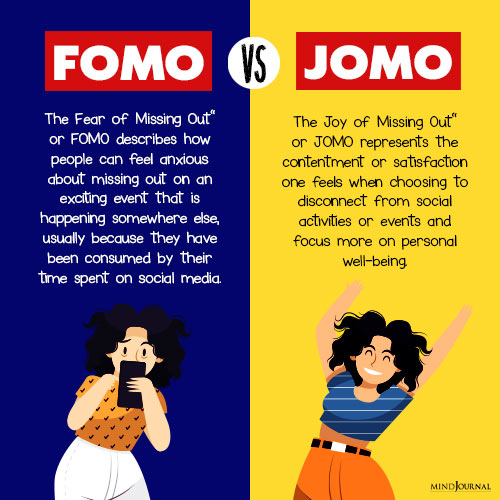
“The Fear of Missing Out” or FOMO is a term that describes how people can feel anxious about missing out on an exciting event that is happening somewhere else, usually because they have been consumed by their time spent on social media.

In this state, the person experiencing FOMO may feel pressured to constantly check their social media feeds or attend events, fearing they’ll miss out on something important or enjoyable.

JOMO, short for “Joy of Missing Out,” represents the contentment or satisfaction one feels when choosing to disconnect from social activities or events and focus more on personal well-being.

Sometimes opting out of certain things can be beneficial for you. It will give you more personal time alone, self-care and relaxation that bring genuine happiness.

Related: 6 Inspiring Lessons From Spiritual Leaders On Mental Health

Benefits and Disadvantages Internal

Disadvantages of FOMO can be:

  1. Anxiety and Stress: Constantly thinking you’re not doing something is a recipe for stress, and social media only makes things worse. If you constantly see your friends posting pictures from their nights out it might make you feel pretty down.
  2. Overcommitment: Trying to save yourself from missing out on something can get really overwhelming really quick. You might feel like you need to say yes to every opportunity you get but if you actually do…you’ll probably end up spreading yourself too thin.
  3. Decision Paralysis: If FOMO gets bad enough, it could start affecting your decision making ability. You might find yourself unable to pick between options for fear that one choice will cause you to miss out on something better.
  4. Reduced Enjoyment: Not being happy in the moment because you’re worried about what else is going on is a huge bummer. Instead of enjoying the present, FOMO victims are always thinking about what they might be missing out on.
  5. Comparison and Envy: When the fear of missing out gets ya, there’s no escape from comparing your life to other people’s lives online. Seeing how much fun everyone else seems to be having can make anyone feel like their own experience aren’t good enough.

Benefits Of JOMO

Opposite from FOMO which leads to stress and anxiety; JOMO offers many health benefits:

  1. Reduced Stress: Disconnecting from social media can help reduce stress and anxiety. JOMO encourages self-care and well-being.
  2. Improved Focus: Without the constant distraction of notifications, your ability to focus on tasks will improve leading to increased productivity.
  3. Enhanced Appreciation: By being present in the moment, you’ll have a deeper appreciation for life’s simple pleasures.
  4. Stronger Relationships: Prioritizing real connections will allow you to create stronger bonds with loved ones which brings more happiness and fulfillment.
  5. Better Overall Well-being: Promoting self-care and self-reflection leads to improved emotional and physical health.

How To Incorporate JOMO – The Joy Of Missing Out

Although embracing JOMO isn’t about isolation but intentional disconnection from social media and endless notifications. Here’s how you can invite the Joy of Missing Out into your life:

1. Turn on Do Not Disturb

Your phone is an endless distraction. Try putting it on Do Not Disturb mode when you need a break from the digital world. Allow yourself to disconnect so you can focus on what’s in front of you.

2. Learn Silence

In a noisy world, silence can be unsettling but it’s necessary for peace. Turn off the TV, put away your gadgets, sit in silence — you’ll be amazed at how rejuvenating it can be.

3. Say No!

You don’t need to say yes to every event or request made for your time. Prioritize your well-being by saying no guilt-free.

4. Build Real Connections

JOMO doesn’t mean cutting ties with everyone around you but rather focusing on meaningful connections that are in person instead of online or through text messages.

How To Overcome FOMO – Fear Of Missing Out

Overcoming FOMO is no easy task but by taking small steps daily, it’s possible:

1. Practice Gratitude: Focus on what you do have rather than what you don’t. It’ll shift your perspective over time.

2. Set Boundaries: Establish specific times to check your phone and stick to them. Setting boundaries with technology helps reduce FOMO.

3. Be Present : Put away distractions and be fully present in the moment. Engage in activities without worrying about what you might be missing elsewhere.

4. Prioritize Your Values: Choose commitments that align with your priorities and values. Don’t feel pressured into saying yes all the time.

In a world that’s constantly buzzing, embracing the joy of missing out (JOMO) can be peaceful and fulfilling. Take time to disconnect, prioritize meaningful connections, and bask in the bliss of small moments.

Related: How Does Social Media Affect Mental Health

After all, now you know the difference between what is JOMO vs FOMO. So, you might find that quiet contentment is the most satisfying feeling in the world!

Share your thoughts below!


jomo vs fomo pin

Published On:

Last updated on:

Daisy Simon

I’m Daisy Simon, member of the Editorial Team at Minds Journal, who loves exploring the cultural zeitgeist through cinema, and pop culture. I hold a degree in Sociology and I write on topics like lifestyle, relationships, feminism, mental health, and how they all connect to the world we live in today. My goal is to spark honest conversations that people can relate to and help us better understand the challenges and ideas shaping our generation.

Disclaimer: The informational content on The Minds Journal have been created and reviewed by qualified mental health professionals. They are intended solely for educational and self-awareness purposes and should not be used as a substitute for professional medical advice, diagnosis, or treatment. If you are experiencing emotional distress or have concerns about your mental health, please seek help from a licensed mental health professional or healthcare provider.

Leave a Comment

Today's Horoscope

Weekly Horoscope 5 April to 11 April 2026

Weekly Horoscope 5 April to 11 April 2026

Something shifts, something becomes clear, and something you ignored refuses to stay hidden. Read more about your zodiac sign and pay attention to what feels different.

Latest Quizzes

Can You Find The Easter Eggs? 10 Hidden Eggs: Look Carefully

No One Can Complete This Easter Egg Hunt Without Missing One—Can You? Take This Quiz Now!

There are 10 hidden eggs in this picture. You have 15 seconds. Can you complete this Easter Egg Hunt without missing one?

Latest Quotes

Real Signs Your Body Is Actually in Good Health: How to Know You’re Truly Well

Real Signs Your Body Is Actually in Good Health: How to Know You’re Truly Well

Real signs your body is healthy don’t always show up on lab reports. From good sleep and clear skin to regular digestion and a stable mood, your body is constantly sending quiet signals of wellness.

Readers Blog

Caption This Image and Selected Wisepicks – 5 April 2026

Caption This Image and Selected Wisepicks – 5 April 2026

Ready to unleash your inner wordsmith? ✨??☺️ Now’s your chance to show off your wit, charm, or sheer genius in just one line! Whether it’s laugh-out-loud funny or surprisingly deep, we want to hear it.Submit your funniest, wittiest, or most thought-provoking caption in the comments. We’ll pick 15+ winners to be featured on our website…

Latest Articles

JOMO Vs FOMO How to Stop Worrying About Missing Out And Start Enjoying the Present

Are you ready to explore the psychological battle of JOMO VS FOMO? We’ll be diving into the two sides of social connectivity and the importance of solitude.

Ever hopped on your phone and instantly felt envy? You scroll through your social media feeds and see friends having the time of their lives, while you sit at home doing nothing.

It’s what psychologists call FOMO (the Fear of Missing Out), a condition many people are familiar with in our age of smartphones. But could there be a healthier alternative? Say hello to JOMO (the Joy Of Missing Out).

What Is JOMO vs FOMO

jomo vs fomo

“The Fear of Missing Out” or FOMO is a term that describes how people can feel anxious about missing out on an exciting event that is happening somewhere else, usually because they have been consumed by their time spent on social media.

In this state, the person experiencing FOMO may feel pressured to constantly check their social media feeds or attend events, fearing they’ll miss out on something important or enjoyable.

JOMO, short for “Joy of Missing Out,” represents the contentment or satisfaction one feels when choosing to disconnect from social activities or events and focus more on personal well-being.

Sometimes opting out of certain things can be beneficial for you. It will give you more personal time alone, self-care and relaxation that bring genuine happiness.

Related: 6 Inspiring Lessons From Spiritual Leaders On Mental Health

Benefits and Disadvantages Internal

Disadvantages of FOMO can be:

  1. Anxiety and Stress: Constantly thinking you’re not doing something is a recipe for stress, and social media only makes things worse. If you constantly see your friends posting pictures from their nights out it might make you feel pretty down.
  2. Overcommitment: Trying to save yourself from missing out on something can get really overwhelming really quick. You might feel like you need to say yes to every opportunity you get but if you actually do…you’ll probably end up spreading yourself too thin.
  3. Decision Paralysis: If FOMO gets bad enough, it could start affecting your decision making ability. You might find yourself unable to pick between options for fear that one choice will cause you to miss out on something better.
  4. Reduced Enjoyment: Not being happy in the moment because you’re worried about what else is going on is a huge bummer. Instead of enjoying the present, FOMO victims are always thinking about what they might be missing out on.
  5. Comparison and Envy: When the fear of missing out gets ya, there’s no escape from comparing your life to other people’s lives online. Seeing how much fun everyone else seems to be having can make anyone feel like their own experience aren’t good enough.

Benefits Of JOMO

Opposite from FOMO which leads to stress and anxiety; JOMO offers many health benefits:

  1. Reduced Stress: Disconnecting from social media can help reduce stress and anxiety. JOMO encourages self-care and well-being.
  2. Improved Focus: Without the constant distraction of notifications, your ability to focus on tasks will improve leading to increased productivity.
  3. Enhanced Appreciation: By being present in the moment, you’ll have a deeper appreciation for life’s simple pleasures.
  4. Stronger Relationships: Prioritizing real connections will allow you to create stronger bonds with loved ones which brings more happiness and fulfillment.
  5. Better Overall Well-being: Promoting self-care and self-reflection leads to improved emotional and physical health.

How To Incorporate JOMO – The Joy Of Missing Out

Although embracing JOMO isn’t about isolation but intentional disconnection from social media and endless notifications. Here’s how you can invite the Joy of Missing Out into your life:

1. Turn on Do Not Disturb

Your phone is an endless distraction. Try putting it on Do Not Disturb mode when you need a break from the digital world. Allow yourself to disconnect so you can focus on what’s in front of you.

2. Learn Silence

In a noisy world, silence can be unsettling but it’s necessary for peace. Turn off the TV, put away your gadgets, sit in silence — you’ll be amazed at how rejuvenating it can be.

3. Say No!

You don’t need to say yes to every event or request made for your time. Prioritize your well-being by saying no guilt-free.

4. Build Real Connections

JOMO doesn’t mean cutting ties with everyone around you but rather focusing on meaningful connections that are in person instead of online or through text messages.

How To Overcome FOMO – Fear Of Missing Out

Overcoming FOMO is no easy task but by taking small steps daily, it’s possible:

1. Practice Gratitude: Focus on what you do have rather than what you don’t. It’ll shift your perspective over time.

2. Set Boundaries: Establish specific times to check your phone and stick to them. Setting boundaries with technology helps reduce FOMO.

3. Be Present : Put away distractions and be fully present in the moment. Engage in activities without worrying about what you might be missing elsewhere.

4. Prioritize Your Values: Choose commitments that align with your priorities and values. Don’t feel pressured into saying yes all the time.

In a world that’s constantly buzzing, embracing the joy of missing out (JOMO) can be peaceful and fulfilling. Take time to disconnect, prioritize meaningful connections, and bask in the bliss of small moments.

Related: How Does Social Media Affect Mental Health

After all, now you know the difference between what is JOMO vs FOMO. So, you might find that quiet contentment is the most satisfying feeling in the world!

Share your thoughts below!


jomo vs fomo pin

Published On:

Last updated on:

Daisy Simon

I’m Daisy Simon, member of the Editorial Team at Minds Journal, who loves exploring the cultural zeitgeist through cinema, and pop culture. I hold a degree in Sociology and I write on topics like lifestyle, relationships, feminism, mental health, and how they all connect to the world we live in today. My goal is to spark honest conversations that people can relate to and help us better understand the challenges and ideas shaping our generation.

Leave a Comment

    Leave a Comment