5 Empowering Techniques for Setting Boundaries in Crucial Areas of Life

Author : Jennifer Guttman Psy.D.

“Setting boundaries is your responsibility. People will continue to do what you allow. You get to decide what is and what isn’t allowed in your life.” – Unknown

Key Points

  • Maintaining boundaries and openly communicating and asserting your values help protect against their being compromised.
  • Committing to mental/emotional health boundaries will decrease your anxiety, depression, and overall sense of being overwhelmed.
  • Define the personal space bubble that feels most comfortable to you, and mindfully explain why you need more breathing room.

Maintaining boundaries is something people struggle with every day. Personal boundaries, or the act of setting boundaries, is a life skill that has been popularized by self-help authors and support groups since the mid-1980s.

The American Psychology Association dictionary defines the term ‘boundary’ as “a psychological demarcation that protects the integrity of an individual or group or that helps the person or group set realistic limits on participation in a relationship or activity.”

Throughout the pandemic, boundary setting became more complicated and challenging for people faced with balancing remote and hybrid models of employment to maintain their work/life equilibrium. However, besides keeping our work/life boundaries, people constantly set boundaries regarding our mental/emotional health, physical space, relationships, and materials.

Sometimes, since we’re unaware, we can set boundaries, but our messaging and preferences may be fluid or inconsistent. This leads to regular boundary violations from those around us. Here are five techniques that, if used correctly, will empower you to set clear boundaries in the five crucial areas I cited.

Related: Setting And Maintaining Boundaries: How To Set Boundaries To Protect Your Mental Health

5 Techniques That Can Help You In Setting Clear Boundaries

1. Mental/Emotional Health.

Setting mental/emotional health boundaries help decrease feelings of anxiety and depression. Holding on to your thoughts, feelings, beliefs, and opinions negates other people’s ability to invalidate or disparage them.

Curate what you choose to listen to, and don’t feel that your emotions must be in sync with everyone else’s. Strong boundaries will enable you to coexist with others while eliminating the need for forced conflict and/or judgment of each other’s state of mind. No one wins. No one loses. This increases self-confidence and self-respect.

Setting boundaries for better emotional and mental health

2. Physical Space.

Define the personal space bubble that feels most comfortable to you. If people come too close to you, move back two or three steps. You can mindfully explain that you require a little more breathing room and that it’s not personal.

Physical touch can feel invasive and uncomfortable. It’s okay to advise people you prefer they don’t touch you and that you hope and trust they can respect your space.

Related: How To Set Clear Boundaries: 5 Steps To Better Emotional Boundaries

3. Work/Life Boundaries.

Set your work life boundaries, and then stick to them. Decide on a daily schedule, when you’ll log on and off your computer, and whether you’ll have work hours on the weekends.

Turn off work notifications on smartphones and laptops when you’re supposed to be ‘out of the office.’ If you’re owed a vacation, don’t forget to take it. If you violate your boundaries, others will too.

4. Relationships.

Setting boundaries in all areas of your relationships is essential. Be clear and transparent regarding your expectations of your partner’s time. For example, how often do you want to have date nights, what activities do you want to share, or how should you spend vacation time? Do you have a strategy for balancing family, intimacy, and solitary time?

If you give unclear messages about your boundaries, your partner is bound to push limits to see what your responses will be. The clearer you are, the less conflict and resentment will result.
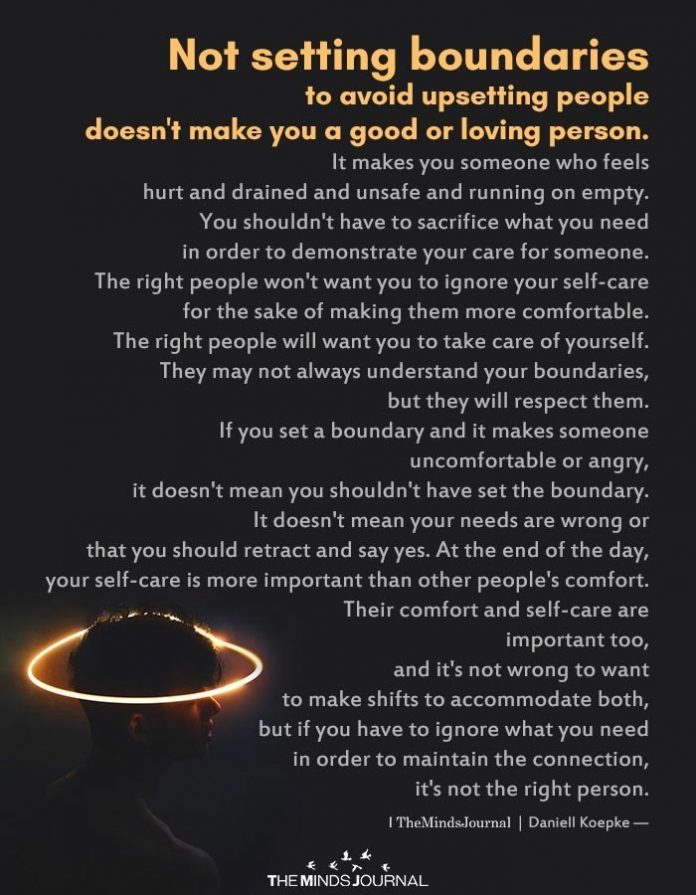
Setting boundaries for a having healthy relationships and a happier you

5. Materials.

Owning property or a specific item does not automatically make it community property. Discuss and define which items are community property and which are not. In addition, set boundaries on items that you’re comfortable being used without permission and which items you’re not.

Be clear about your expectations when you’d like items returned. Avoid sending conflicting messages about your possessions. If your messaging is consistent, people respect your boundaries.

There are many positive aspects to setting more finite boundaries in your life. You will become a stronger person for it, as you experience an improvement in your confidence and self-respect.

Related: How Healthy Boundaries Help Protect Your Personal Space

There will be a concurrent reduction in scenarios where you feel overwhelmed, pressured, depressed, and anxiety-ridden because you have stopped allowing boundary violations. Over time, firm boundaries will assist you on a journey toward a more satisfying life.

Want to know more about how to set work life boundaries? Check this video out below!

The print version of Dr. Jennifer Guttman’s debut as an author, Beyond Happiness, The 6 Secrets Of Lifetime Satisfaction will be published by Post Hill Press on May 30, 2023. Pre-order link http://posthill.to/1637587945. You can also pre-order her book at Barnes & Noble – https://www.barnesandnoble.com/w/beyond-happiness-jennifer-guttman-psyd/1142978001

References:

APA Dictionary of Psychology, 2022, dictionary.apa.org, American Psychological Association
Written By Jennifer Guttman Psy.D.
Originally Appeared On Psychology Today
maintaining boundaries

Published On:

Last updated on:

Jennifer Guttman Psy.D.

Dr. Jennifer Guttman received her doctorate in clinical psychology from Long Island University. She is trained in cognitive behavioral therapy with specializations in trauma treatment and family systems. Over the past five years, Dr. Guttman has launched a motivational brand platform Sustainable Life Satisfaction® with four SLS® YouTube web series. She authored her first book, A Path to Sustainable Life Satisfaction Workbook (Amazon 2017), released the Audible Original, Beyond Happiness, The 6 Secrets of Life Satisfaction (October 2022), and the same title is being published as a hardcover by Post Hill Press (May 30, 2023). Dr. Guttman is a regular contributor to Psychology Today, Thrive Global, and MindBodyGreen, and has written articles for the Washington Post, Newsweek, NBC.com, Marie Claire, Entrepreneur Magazine, Readers Digest, Redbook, Health, and TeenVogue, among others. She has been a guest on several network television programs across the country including, KTLA, ABC News, Channel 20, Springfield, IL, NBC Bloom, and CBS Georgia Channel 13, WMAZ. In addition, she has been featured on dozens of podcasts including Beyond Well, Longevity Live, Unshakeable Self-Confidence, Harvesting Happiness, Resilience Unraveled, and The Hidden Why. Over the past 30 years, she has sustained robust practice with offices in NYC, Connecticut, and virtually as a Cognitive Behavioral Therapist nurturing exciting personal interactions with thousands of clients from diverse walks of life.

Disclaimer: The informational content on The Minds Journal have been created and reviewed by qualified mental health professionals. They are intended solely for educational and self-awareness purposes and should not be used as a substitute for professional medical advice, diagnosis, or treatment. If you are experiencing emotional distress or have concerns about your mental health, please seek help from a licensed mental health professional or healthcare provider.

Leave a Comment

Today's Horoscope

Your Daily Horoscope For 4 April, 2026: Free Predictions

Daily Horoscope 4 April, 2026: Prediction For Each Zodiac Sign

Look at your daily prediction and see what the stars have in store for your love life and your future!

Latest Quizzes

How Many Circles Do You See? A Simple Test of Thinking Style

How Many Circles Do You See? Your Answer Might Reveal Narcissistic Traits! 

Take a closer look at this simple image and discover what your circle count reveals about your thinking style, perception, and attention in this fun and engaging visual test.

Latest Quotes

Real Signs Your Body Is Actually in Good Health: How to Know You’re Truly Well

Real Signs Your Body Is Actually in Good Health: How to Know You’re Truly Well

Real signs your body is healthy don’t always show up on lab reports. From good sleep and clear skin to regular digestion and a stable mood, your body is constantly sending quiet signals of wellness.

Readers Blog

Caption This Image and Selected Wisepicks – 5 April 2026

Caption This Image and Selected Wisepicks – 5 April 2026

Ready to unleash your inner wordsmith? ✨??☺️ Now’s your chance to show off your wit, charm, or sheer genius in just one line! Whether it’s laugh-out-loud funny or surprisingly deep, we want to hear it.Submit your funniest, wittiest, or most thought-provoking caption in the comments. We’ll pick 15+ winners to be featured on our website…

Latest Articles

“Setting boundaries is your responsibility. People will continue to do what you allow. You get to decide what is and what isn’t allowed in your life.” – Unknown

Key Points

  • Maintaining boundaries and openly communicating and asserting your values help protect against their being compromised.
  • Committing to mental/emotional health boundaries will decrease your anxiety, depression, and overall sense of being overwhelmed.
  • Define the personal space bubble that feels most comfortable to you, and mindfully explain why you need more breathing room.

Maintaining boundaries is something people struggle with every day. Personal boundaries, or the act of setting boundaries, is a life skill that has been popularized by self-help authors and support groups since the mid-1980s.

The American Psychology Association dictionary defines the term ‘boundary’ as “a psychological demarcation that protects the integrity of an individual or group or that helps the person or group set realistic limits on participation in a relationship or activity.”

Throughout the pandemic, boundary setting became more complicated and challenging for people faced with balancing remote and hybrid models of employment to maintain their work/life equilibrium. However, besides keeping our work/life boundaries, people constantly set boundaries regarding our mental/emotional health, physical space, relationships, and materials.

Sometimes, since we’re unaware, we can set boundaries, but our messaging and preferences may be fluid or inconsistent. This leads to regular boundary violations from those around us. Here are five techniques that, if used correctly, will empower you to set clear boundaries in the five crucial areas I cited.

Related: Setting And Maintaining Boundaries: How To Set Boundaries To Protect Your Mental Health

5 Techniques That Can Help You In Setting Clear Boundaries

1. Mental/Emotional Health.

Setting mental/emotional health boundaries help decrease feelings of anxiety and depression. Holding on to your thoughts, feelings, beliefs, and opinions negates other people’s ability to invalidate or disparage them.

Curate what you choose to listen to, and don’t feel that your emotions must be in sync with everyone else’s. Strong boundaries will enable you to coexist with others while eliminating the need for forced conflict and/or judgment of each other’s state of mind. No one wins. No one loses. This increases self-confidence and self-respect.

Setting boundaries for better emotional and mental health

2. Physical Space.

Define the personal space bubble that feels most comfortable to you. If people come too close to you, move back two or three steps. You can mindfully explain that you require a little more breathing room and that it’s not personal.

Physical touch can feel invasive and uncomfortable. It’s okay to advise people you prefer they don’t touch you and that you hope and trust they can respect your space.

Related: How To Set Clear Boundaries: 5 Steps To Better Emotional Boundaries

3. Work/Life Boundaries.

Set your work life boundaries, and then stick to them. Decide on a daily schedule, when you’ll log on and off your computer, and whether you’ll have work hours on the weekends.

Turn off work notifications on smartphones and laptops when you’re supposed to be ‘out of the office.’ If you’re owed a vacation, don’t forget to take it. If you violate your boundaries, others will too.

4. Relationships.

Setting boundaries in all areas of your relationships is essential. Be clear and transparent regarding your expectations of your partner’s time. For example, how often do you want to have date nights, what activities do you want to share, or how should you spend vacation time? Do you have a strategy for balancing family, intimacy, and solitary time?

If you give unclear messages about your boundaries, your partner is bound to push limits to see what your responses will be. The clearer you are, the less conflict and resentment will result.

Setting boundaries for a having healthy relationships and a happier you

5. Materials.

Owning property or a specific item does not automatically make it community property. Discuss and define which items are community property and which are not. In addition, set boundaries on items that you’re comfortable being used without permission and which items you’re not.

Be clear about your expectations when you’d like items returned. Avoid sending conflicting messages about your possessions. If your messaging is consistent, people respect your boundaries.

There are many positive aspects to setting more finite boundaries in your life. You will become a stronger person for it, as you experience an improvement in your confidence and self-respect.

Related: How Healthy Boundaries Help Protect Your Personal Space

There will be a concurrent reduction in scenarios where you feel overwhelmed, pressured, depressed, and anxiety-ridden because you have stopped allowing boundary violations. Over time, firm boundaries will assist you on a journey toward a more satisfying life.

Want to know more about how to set work life boundaries? Check this video out below!

The print version of Dr. Jennifer Guttman’s debut as an author, Beyond Happiness, The 6 Secrets Of Lifetime Satisfaction will be published by Post Hill Press on May 30, 2023. Pre-order link http://posthill.to/1637587945. You can also pre-order her book at Barnes & Noble – https://www.barnesandnoble.com/w/beyond-happiness-jennifer-guttman-psyd/1142978001

References:

APA Dictionary of Psychology, 2022, dictionary.apa.org, American Psychological Association
Written By Jennifer Guttman Psy.D.
Originally Appeared On Psychology Today
maintaining boundaries

Published On:

Last updated on:

Jennifer Guttman Psy.D.

Dr. Jennifer Guttman received her doctorate in clinical psychology from Long Island University. She is trained in cognitive behavioral therapy with specializations in trauma treatment and family systems. Over the past five years, Dr. Guttman has launched a motivational brand platform Sustainable Life Satisfaction® with four SLS® YouTube web series. She authored her first book, A Path to Sustainable Life Satisfaction Workbook (Amazon 2017), released the Audible Original, Beyond Happiness, The 6 Secrets of Life Satisfaction (October 2022), and the same title is being published as a hardcover by Post Hill Press (May 30, 2023). Dr. Guttman is a regular contributor to Psychology Today, Thrive Global, and MindBodyGreen, and has written articles for the Washington Post, Newsweek, NBC.com, Marie Claire, Entrepreneur Magazine, Readers Digest, Redbook, Health, and TeenVogue, among others. She has been a guest on several network television programs across the country including, KTLA, ABC News, Channel 20, Springfield, IL, NBC Bloom, and CBS Georgia Channel 13, WMAZ. In addition, she has been featured on dozens of podcasts including Beyond Well, Longevity Live, Unshakeable Self-Confidence, Harvesting Happiness, Resilience Unraveled, and The Hidden Why. Over the past 30 years, she has sustained robust practice with offices in NYC, Connecticut, and virtually as a Cognitive Behavioral Therapist nurturing exciting personal interactions with thousands of clients from diverse walks of life.

Leave a Comment

    Leave a Comment