
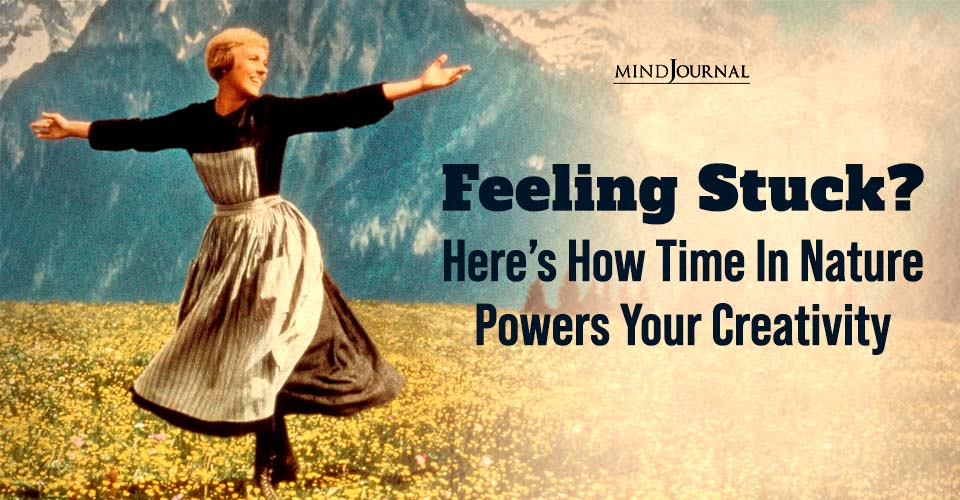
Struggling to spark new ideas or find fresh perspectives? Sometimes, the best solution isn’t staring at your screen or pushing yourself harder, it’s spending time in nature! Learn how it can unlock a flow of creativity you never knew was there!
The natural world can significantly energize your creative impulses.
Key points
- A compelling bank of research points to the value of nature as a creative stimulant.
- Nature offers time and opportunity to regain the creativity we enjoyed as kids.
- Nature has stimulated many creative inventions and innovative concepts.

Ever have “one of those days?” You know, a day when someone cuts you off in traffic, your boss piles several assignments on your desk and says they need to be completed by noon yesterday, your kids are on a “sugar high,” and your favorite sports team just lost a most important game. Yeah, what a bummer!
So, you decide to go outside and take a walk through the neighborhood, a nearby park, or around a local pond. Or, maybe you just sit under a spreading oak tree for some “chill” time. In minutes, you notice a decided loosening of tension and a significant reduction of stress. Your spirits are elevated and you discover new energy. But there’s another advantage to time in nature. It can have a most positive effect on your creative output – particularly if it is incorporated as a regular part of your everyday activities. Let’s take a look.
Read More Here: I’m 78-Years-Old And My Memory Is ‘Razor Sharp’— I Do 5 Things Every Day
What the Research Says
A 2022 study demonstrated that viewing an environment with natural elements stimulates a flexible imagination. The authors noted that nature allows our minds to temporarily detach from daily states, such as moments when we are in a daze or daydreaming, to obtain “flashes of inspiration.” They provided evidence demonstrating that more unique and diverse creative ideas become possible when opinions are flexible, as may occur when we are in natural environments.
Cognitive psychologist Ruth Ann Atchley underscores the value of nature as a wellspring and resource for human creativity when she states, “Nature is a place where our mind can rest, relax, and let down…threat responses. Therefore, we have resources left over — to be creative, to be imaginative, to problem solve — to allow us to…engage in a more productive way.”
In support, my recent article on the six habits of highly creative people underscores the creative significance of time in nature. The piece noted that nature can make us more flexible as thinkers because the outdoors offers numerous creative examples (e.g. intertwining tree roots may result in the revision of an organizational chart, the color of fall leaves may inspire the work of an interior designer), which can influence our creative intentions.
In conducting research for a new book, The Healing Wisdom of the Forest, I came across an extensive meta-analysis done by Yoshifumi Miyazaki and his colleagues at Chiba University in Japan.
They report that even short periods of being in natural spaces results in a variety of health benefits, including lower blood pressure, decreased heart rate, reduced cortisol production, balance of activity in the prefrontal cortex, improved blood glucose levels, higher immune function, and overall physiological relaxation. A related study in Belgium strongly suggests that all are contributing factors in heightened levels of creative expression
What a Naturalist Says
Melanie Tracey is the Communications Manager for the Pennsylvania Game Commission, the state’s wildlife agency. When asked if nature is an essential element of the creative mind, she responded, “Nature is a child’s toolbox, allowing an already very creative mind to flourish and encourage exponential growth.
Adults, on the other hand, have entered the world of logic and [often] lack daily creative thoughts the average child possesses. Using nature as a constructive outlet helps guide adults to take a step back in time and tune into a child-like state of mind; living a more joyful and creative lifestyle.”
I wanted to know how time in nature improves or expands our creativity. Melanie said, “Nature is often viewed as wondrous, some might even say adventurous. When planning your next hike, for example, you can choose the geographic location, the distance in length of the trail you prefer, even the securities you decide to pack for the outing.
However, no amount of planning can prepare you for what you might experience; it is 100% out of your control. Being fully emerged in nature forces a person to be organically curious and thus results in a flood of authentic creativity that you could ever have planned for on a color-coded spreadsheet.”
She also reminded me that, “Humans are notorious for imitating our ecological observations and how we incorporate these elements from nature into our modern-day society without even realizing it. Examples being: animal camouflage to army uniforms, burrs to Velcro, bird aerodynamics to airplanes, woodpeckers to shock absorbers, photosynthesis to solar panels, fireflies to LED lighting, mosquitoes to needles, and beaver fur to wetsuits. These are all prime examples of humans finding creativity within nature.”
In response to a question about the importance of time in nature, she said, “You cannot make creativity, you must take the time to find it! Creativity is not found behind comfortable blue screens where you can hide behind false narratives. It is found under rocks in the dirt and woven through the branches of trees; it’s as genuine as the wildflowers and as strong as the mountain peaks. Why limit yourself to the suppressing restraints of the media, when your creativity feeds off the land?”
Read More Here: How Music Can Energize Your Creativity
When faced with creative challenges, we have a natural outlet that energizes our minds and stimulates our imaginations. We just need to open the door and walk outside.
For deeper insights, grab your copy of The Healing Wisdom of the Forest by Anthony D. Fredericks today.
References
Chin-Wen Yeh, Shih-Han Hung, and Chun-Yen Chang. The influence of natural environments on creativity. Frontiers in Psychiatry. 2022 Jul 27;13:895213. doi: 10.3389/fpsyt.2022.895213.
Atchley, Ruth Ann, Strayer, David L. and Paul Atchley. Creativity in the Wild: Improving Creative Reasoning through Immersion in Natural Settings. PLoS One (December 12, 2012). https://doi.org/10.1371/journal.pone.0051474.
Fredericks, Anthony D. “I’ve studied highly creative people for 40 years: They share these 6 habits.” CNBC – Make It. (October 3, 2024). https://www.cnbc.com/2024/10/03/ive-studied-highly-creative-people-for-40-years-habits-they-share.html
Fredericks, Anthony D. The Healing Wisdom of the Forest: Timeless Lessons of Renewal, Tranquility, and Joy. (Mt. Pleasant, SC: HCI Books, 2025).
Hansen MM, Jones R, Tocchini K. Shinrin-Yoku (Forest Bathing) and Nature Therapy: A State-of-the-Art Review. Int J Environ Res Public Health. 2017 Jul 28;14(8):851. doi: 10.3390/ijerph14080851. PMID: 28788101; PMCID: PMC5580555.
Bijnens, E.M., Derom, C., Thiery, E., Weyers, S., and Nawrot, T.S. Residential green space and child intelligence and behavior across urban, suburban, and rural areas in Belgium: A longitudinal birth cohort study of twins. Markevych, I., ed. PLOS Medicine. 2020;17(8):e1003213. doi:https://doi.org/10.1371/journal.pmed.1003213.
Tracey, Melanie. Personal Interview (September 4, 2025).
Written by: Anthony D. Fredericks Ed.D.
Originally Appeared on Psychology Today


Leave a Comment