Emotional Safety In Relationships: 11 Neuroscience-Backed Tips to Make Someone Feel Safe With You

Author : Tasha Seiter MS, PhD, LMFT

Emotional Safety in Relationships: 11 Science-Backed Ways

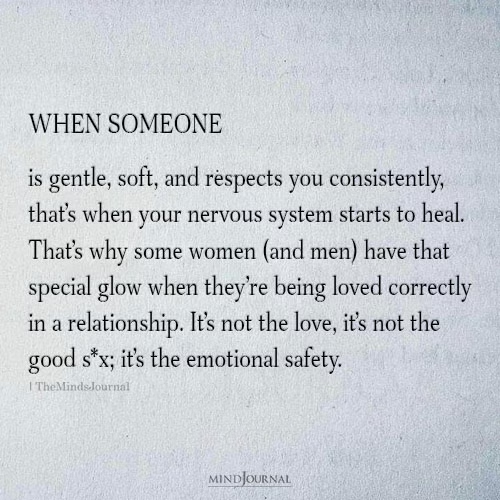
Emotional safety in relationships is built moment by moment – through the way we listen, speak, and show warmth.

If you are trying to learn how to be a safe space for others or how to make someone feel safe, compassionate communication provides clear, neuroscience-backed tools.

These simple habits can turn ordinary conversations into calming, grounding interactions that help others feel truly seen.

KEY POINTS

  • When we speak in warm, soft, slow, and brief ways, we calm our conversation partner’s nervous system.
  • To be a better listener, focus on relaxing, practicing mindfulness, and getting curious.
  • Helping others feel safe in your presence is about speaking and listening from the heart.

We all want to feel safe with others, like we are understood and accepted, and that we belong.

I’d be hard-pressed to find someone who didn’t want others to feel the same way in their presence; most of us want to be there for others in a way that allows them a safe haven and refuge from the stresses of the outside world.

But you might wonder, “How do I become a safe space for others?” Authors Andrew Newburg and Mark Robert Waldman outline these 11 neuroscience-backed ways to help others feel safe in your presence, which comprise the elements of compassionate communication.

Related: Why Emotional Safety Is Necessary For Emotional Connection In Relationships

How to Create Emotional Safety in Relationships: 11 Compassionate Communication Tips

1. Relax

Emotions are contagious. The more relaxed you are, the more this emotion will spread to those around you. Allow your body to be open and easy so that you can fully listen and others feel soothed and comfortable around you on a biological level.

To help yourself relax, try stretching and taking breaths with an extended exhale.

2. Stay present

In today’s world of constant distraction and hustle, knowing that you have someone’s full attention can be wonderfully refreshing. Being heard, seen, and understood is incredibly soothing to the nervous system.

Focus the conversation and your full attention on your partner โ€” be entirely with the person in front of you.

Emotional safety in relationships

3. Cultivate inner silence

As you stay present with your partner, you will notice distractions coming up. You will have other thoughts come into your mind: Things that you have to get done, regrets from the past, or random seemingly unrelated memories or curiosities.

Allow these other thoughts and preoccupations to pass like leaves on a stream in front of you as you focus your attention on the other and the words they are communicating.

4. Increase positivity

When we hear something negative from another person, it not only shifts our mood but can also send the signal that they are too preoccupied to be supportive or fully trusted.

While expressing our negative emotions and not keeping them inside is still important, don’t forget to express the positive ones as well.

Psychologist John Gottman’s research suggests that aiming for a ratio of expressing five positive things for one negative is beneficial for relationships.

5. Reflect on your deepest values

What core values are closest to your heart? Some examples include love, honesty, authenticity, compassion, kindness, integrity, and curiosity.

Take a moment in your communication to become aware of your deepest values and make an effort to embody them in your interactions.

6. Access a pleasant memory

When interacting with someone who exhibits a warm gaze, with softness around the eyes, the brain responds; we feel free from threat and safe in this person’s presence.

One way to convey this kind of warmth is to reflect on a pleasant memory and allow yourself to feel the gratitude and love that this memory evokes in you. You can then bring this warmth to your partner.

Regular meditation practice can be a valuable tool for enhancing your level of gratitude and contentment, and for helping others feel a natural warmth when they are around you.

Related: The Power Of Emotional Security: How Psychological Safety Builds Stronger Family Bonds

7. Observe nonverbal cues

To attune to your partner, take a moment to notice their nonverbal cues: Does their body language appear open and relaxed, or constricted and closed off?

Try to approach your observations with kindness and curiosity, allowing yourself to tune in to your partner’s feelings and needs to feel comfortable.

8. Speak warmly

Speaking in a soft tone with a low, gentle pitch has a physiological relaxation effect on our listeners. Speaking in such a warm way conveys acceptance and comfort, and can calm an adult in the same way a cooing mother soothes her baby.

9. Speak slowly

Research shows that the slower we speak, the more the listener can comprehend, and that slow speech relaxes both the listener’s body and the speaker’s body.

This results in less stress for both partners and greater understanding between them, even with fewer words. To feel understood and to understand someone else, you might try slowing down instead of spinning your wheels.
Emotional safety in relationships

10. Speak briefly

When in the speaker role, try to keep it brief. Neuroscience research suggests that we remember the first 30 seconds of someone speaking the best, and comprehension then drops off.

This makes sense as 30 seconds is the amount of time that information is stored in “working memory.” Be mindful not to overwhelm your listener; keep it concise and clear.

11. Listen deeply

Beyond being fully present with your partner and cultivating your own inner silence, listen deeply to help them feel safe.

Take in their words, feel their emotions alongside them, and allow yourself to experience empathy toward them by validating their feelings.

Helping others feel safe in your presence isnโ€™t about being perfect. Itโ€™s about being connected to the moment as well as speaking and listening from the heart.

By practicing these 11 compassionate communication strategies, you can become a steady and soothing force in your relationships and someone others can truly relax around.

Related: Are You Emotionally Safe In Your Relationship?

When we create emotional safety, we foster more profound connection, trust, and healing for others as well as for ourselves.

In a world that often feels chaotic and overwhelming, becoming a safe haven for someone else is one of the most powerful and meaningful gifts we can offer.

References:

For more about the neuroscience behind these compassionate communication techniques, check out Words Can Change Your Brain by Andrew Newberg and Mark Robert Waldman.

Written by Tasha Seiter MS, PhD, LMFT
Originally Appeared on Psychology Today
how to be a safe space for others

Published On:

Last updated on:

Tasha Seiter MS, PhD, LMFT

Tasha Seiter provides online life and relationship coaching to anyone hoping to improve their life or relationships across the world. She also owns an online therapy practice offering individual, couples, and family therapy throughout the state of Colorado. Her mission in life is to help alleviate suffering and disconnection as well as create more safety, joy, and love in this world as a therapist and coach for couples, individuals, and families. With advanced training in the most evidence-based methods, including Emotionally Focused Couples Therapy (EFT) and Gottman Method Couples Therapy, Seiter uses the most effective methods in her practice to move couples toward secure, joyful relationships. As a scientist-practitioner, Seiter is on the cutting edge of the science of love, relationships, mental health, and personal growth. Her research investigates topics related to couple relationships, the benefits of mindfulness, and stress physiology. She is often featured in the media, offering her expertise regarding relationships and mindfulness, and has recently been seen in Forbes, Healthline, Bustle, Popsugar, MindBodyGreen, Mic, and Best Life Online. She brings an enthusiastic, positive energy to her writing, speaking, and therapeutic roles, along with kindness, acceptance, warmth, and genuineness. Please see her website for more information about her and her services.

Disclaimer: The informational content on The Minds Journal have been created and reviewed by qualified mental health professionals. They are intended solely for educational and self-awareness purposes and should not be used as a substitute for professional medical advice, diagnosis, or treatment. If you are experiencing emotional distress or have concerns about your mental health, please seek help from a licensed mental health professional or healthcare provider.

Leave a Comment

Today's Horoscope

Weekly Horoscope PART one

Weekly Horoscope 15 March to 21 March 2026

Read your zodiac signโ€™s prediction to understand the energy surrounding you and how to make the most of the days ahead!

Latest Quizzes

Interesting Finger Personality Test: 4 Finger Lines

Finger Personality Test: Join Your Fingers And Reveal A Hidden Personality Secret!

Look closely at your finger lines. Which pattern do you see? This personality test might surprise you!

Latest Quotes

How Men Show Love Through Actions (Male Psychology in Relationships)

How Men Show Love Through Actions (Male Psychology in Relationships)

Male psychology in relationships shows that men express love through presence, protection, and peace more than poetry. Decode his actions so you can see how deeply he actually cares.

Readers Blog

Caption This Image and Selected Wisepicks โ€“ 15 March 2026

Caption This Image and Selected Wisepicks โ€“ 15 March 2026

Ready to unleash your inner wordsmith? โœจ??โ˜บ๏ธ Nowโ€™s your chance to show off your wit, charm, or sheer genius in just one line! Whether itโ€™s laugh-out-loud funny or surprisingly deep, we want to hear it.Submit your funniest, wittiest, or most thought-provoking caption in the comments. Weโ€™ll pick 15+ winners to be featured on our website…

Latest Articles

Emotional Safety in Relationships: 11 Science-Backed Ways

Emotional safety in relationships is built moment by moment – through the way we listen, speak, and show warmth.

If you are trying to learn how to be a safe space for others or how to make someone feel safe, compassionate communication provides clear, neuroscience-backed tools.

These simple habits can turn ordinary conversations into calming, grounding interactions that help others feel truly seen.

KEY POINTS

  • When we speak in warm, soft, slow, and brief ways, we calm our conversation partner’s nervous system.
  • To be a better listener, focus on relaxing, practicing mindfulness, and getting curious.
  • Helping others feel safe in your presence is about speaking and listening from the heart.

We all want to feel safe with others, like we are understood and accepted, and that we belong.

I’d be hard-pressed to find someone who didn’t want others to feel the same way in their presence; most of us want to be there for others in a way that allows them a safe haven and refuge from the stresses of the outside world.

But you might wonder, “How do I become a safe space for others?” Authors Andrew Newburg and Mark Robert Waldman outline these 11 neuroscience-backed ways to help others feel safe in your presence, which comprise the elements of compassionate communication.

Related: Why Emotional Safety Is Necessary For Emotional Connection In Relationships

How to Create Emotional Safety in Relationships: 11 Compassionate Communication Tips

1. Relax

Emotions are contagious. The more relaxed you are, the more this emotion will spread to those around you. Allow your body to be open and easy so that you can fully listen and others feel soothed and comfortable around you on a biological level.

To help yourself relax, try stretching and taking breaths with an extended exhale.

2. Stay present

In today’s world of constant distraction and hustle, knowing that you have someone’s full attention can be wonderfully refreshing. Being heard, seen, and understood is incredibly soothing to the nervous system.

Focus the conversation and your full attention on your partner โ€” be entirely with the person in front of you.

Emotional safety in relationships

3. Cultivate inner silence

As you stay present with your partner, you will notice distractions coming up. You will have other thoughts come into your mind: Things that you have to get done, regrets from the past, or random seemingly unrelated memories or curiosities.

Allow these other thoughts and preoccupations to pass like leaves on a stream in front of you as you focus your attention on the other and the words they are communicating.

4. Increase positivity

When we hear something negative from another person, it not only shifts our mood but can also send the signal that they are too preoccupied to be supportive or fully trusted.

While expressing our negative emotions and not keeping them inside is still important, don’t forget to express the positive ones as well.

Psychologist John Gottman’s research suggests that aiming for a ratio of expressing five positive things for one negative is beneficial for relationships.

5. Reflect on your deepest values

What core values are closest to your heart? Some examples include love, honesty, authenticity, compassion, kindness, integrity, and curiosity.

Take a moment in your communication to become aware of your deepest values and make an effort to embody them in your interactions.

6. Access a pleasant memory

When interacting with someone who exhibits a warm gaze, with softness around the eyes, the brain responds; we feel free from threat and safe in this person’s presence.

One way to convey this kind of warmth is to reflect on a pleasant memory and allow yourself to feel the gratitude and love that this memory evokes in you. You can then bring this warmth to your partner.

Regular meditation practice can be a valuable tool for enhancing your level of gratitude and contentment, and for helping others feel a natural warmth when they are around you.

Related: The Power Of Emotional Security: How Psychological Safety Builds Stronger Family Bonds

7. Observe nonverbal cues

To attune to your partner, take a moment to notice their nonverbal cues: Does their body language appear open and relaxed, or constricted and closed off?

Try to approach your observations with kindness and curiosity, allowing yourself to tune in to your partner’s feelings and needs to feel comfortable.

8. Speak warmly

Speaking in a soft tone with a low, gentle pitch has a physiological relaxation effect on our listeners. Speaking in such a warm way conveys acceptance and comfort, and can calm an adult in the same way a cooing mother soothes her baby.

9. Speak slowly

Research shows that the slower we speak, the more the listener can comprehend, and that slow speech relaxes both the listener’s body and the speaker’s body.

This results in less stress for both partners and greater understanding between them, even with fewer words. To feel understood and to understand someone else, you might try slowing down instead of spinning your wheels.

Emotional safety in relationships

10. Speak briefly

When in the speaker role, try to keep it brief. Neuroscience research suggests that we remember the first 30 seconds of someone speaking the best, and comprehension then drops off.

This makes sense as 30 seconds is the amount of time that information is stored in “working memory.” Be mindful not to overwhelm your listener; keep it concise and clear.

11. Listen deeply

Beyond being fully present with your partner and cultivating your own inner silence, listen deeply to help them feel safe.

Take in their words, feel their emotions alongside them, and allow yourself to experience empathy toward them by validating their feelings.

Helping others feel safe in your presence isnโ€™t about being perfect. Itโ€™s about being connected to the moment as well as speaking and listening from the heart.

By practicing these 11 compassionate communication strategies, you can become a steady and soothing force in your relationships and someone others can truly relax around.

Related: Are You Emotionally Safe In Your Relationship?

When we create emotional safety, we foster more profound connection, trust, and healing for others as well as for ourselves.

In a world that often feels chaotic and overwhelming, becoming a safe haven for someone else is one of the most powerful and meaningful gifts we can offer.

References:

For more about the neuroscience behind these compassionate communication techniques, check out Words Can Change Your Brain by Andrew Newberg and Mark Robert Waldman.

Written by Tasha Seiter MS, PhD, LMFT
Originally Appeared on Psychology Today
how to be a safe space for others

Published On:

Last updated on:

Tasha Seiter MS, PhD, LMFT

Tasha Seiter provides online life and relationship coaching to anyone hoping to improve their life or relationships across the world. She also owns an online therapy practice offering individual, couples, and family therapy throughout the state of Colorado. Her mission in life is to help alleviate suffering and disconnection as well as create more safety, joy, and love in this world as a therapist and coach for couples, individuals, and families. With advanced training in the most evidence-based methods, including Emotionally Focused Couples Therapy (EFT) and Gottman Method Couples Therapy, Seiter uses the most effective methods in her practice to move couples toward secure, joyful relationships. As a scientist-practitioner, Seiter is on the cutting edge of the science of love, relationships, mental health, and personal growth. Her research investigates topics related to couple relationships, the benefits of mindfulness, and stress physiology. She is often featured in the media, offering her expertise regarding relationships and mindfulness, and has recently been seen in Forbes, Healthline, Bustle, Popsugar, MindBodyGreen, Mic, and Best Life Online. She brings an enthusiastic, positive energy to her writing, speaking, and therapeutic roles, along with kindness, acceptance, warmth, and genuineness. Please see her website for more information about her and her services.

Leave a Comment

    Leave a Comment