

Emotional Burnout symptoms don’t happen overnight. You keep pushing yourself throughout the day despite feeling exhausted. You are attending meetings, taking calls, meeting deadlines, showing up for everyone and you tell yourself you will rest later.
You may have stopped noticing how blossoming flowers made you excited or how you used to hum songs randomly. You start feeling oddly distanced from yourself and the world. Now, this does not sound like normal day stress, does it?
As per the American Psychological Association (APA), women tend to report a higher average level of stress than men. A 2023 report shows the scale being 5.3 versus 4.8. It has been on the rise now more than ever.
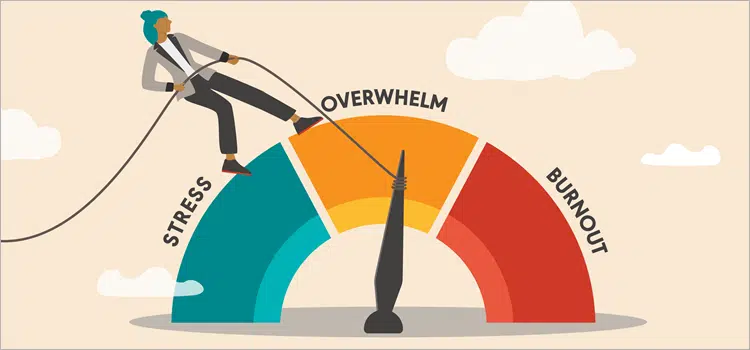
So, if your stress is causing you emotional burnout symptoms and not just overwhelm, you need to watch out for these 9 signs. Then, you can figure out how to recover from emotional burnout.
9 Emotional Burnout Symptoms: Signs of Emotional Burnout To Look Out For
1. You are feeling hopeless and stuck in most situations, you keep feeling like you don’t have a way out
If you start feeling trapped and start experiencing hopelessness more frequently, you might be feeling emotionally burnout.
Symptoms of anxiety often accompany.
So, the increased heart palpitations and sleep impairment that you’re feeling might actually be crucial emotional burnout symptoms.
Continuously feeling this way, making you seem like you do not have a way out, worsens it further.
Read More Here: Life With Anxiety: The World of “What Ifs”
2. You have been feeling a constant sense of lack of satisfaction and productivity
Burnout can make you feel useless and powerless. You may feel you’re running on autopilot mode. This increases further when your expectations and pressures become higher and unclear.
It often gives rise to decreased satisfaction with the things around you and even yourself.
Constantly being tied up in such feelings makes you question your productivity. These are quite common signs of emotional burnout.
Workplace stressors can often leave you with the inability to disconnect. When you exhibit type A personality behavior, you are already ambitious, motivated, and highly competitive. It increases the chances of being unable to disconnect, decreasing your time to recharge.
Read More Here: Your Burnout Isn’t A Badge Of Honor—It’s A Boundary Cry
3. You are feeling isolated and disassociated from what used to give you pleasure
When you are severely emotionally burnout, it can result in feeling isolated and detached or disassociated from even those activities that earlier could make you feel joy or give you pleasure. This is called anhedonia.
When you’re going through phases of intense emotional and mental exhaustion, your brain might make you detached to preserve itself.
You might tend to feel meaningless in making new hobbies or even socializing with your closest friends. Running on autopilot also tends to make your brain feel foggy.
4. It is not mere tiredness anymore; you feel a sense of chronic physical, emotional, and mental exhaustion that you cannot really explain
The tiredness from stress remains limited to overwhelm when a period of rest can take you back to your earlier self. But when you keep feeling highly fatigued and exhausted even after that, it might be time for you to check out the emotional burnout symptoms.
Chronic and unmanaged stress leads to you feeling emotionally burnout, and hence, its recovery can take months.
It is not just that workplace stressors become its sole reason. Due to being involved in dynamics where you have been playing the role of the caregiver for a long time, you would be more prone to experience caregiver burnout.
Conventionally, women experience greater levels of caregiver burnout, with caregiving responsibilities affecting their work life more.
5. You feel distanced from your earlier self, have cynical thoughts and an overall sense of increased negativity
If your brain is bringing you thoughts that suddenly seem cynical and negative, it’s not shocking. You might be experiencing this as one of the symptoms of emotional burnout.
During phases of continuous exhaustion, it becomes harder to be active about solving your problems. A pessimistic attitude is likely to develop earlier, as it is like the brain’s coping mechanism to deal with situations where it feels totally powerless.
6. You get irritated too soon and find yourself more agitated than before
Often overlooked, a sudden rise in irritability and mood swings is quite a common emotional burnout symptom.
It generally occurs due to nervous system dysregulation resulting from chronic stress. It often leads to the development of impairment in emotional regulation.
This can reduce your cognitive function. Cognitive function is central to how your memory and reasoning work. It also includes how you think and interact with the world.
7. You are feeling demotivated and keep doubting yourself
Feelings of decreased satisfaction, detachment, inadequacy, and cynical thoughts are the absolute combination that can lower your self-worth.
And, a low sense of self-worth is going to demotivate you really soon.
A feeling of failure results from the internalization of decreased productivity. Basically, feeling emotionally burnout messes with your brain’s reward system, making you harder on your already exhausted self.
8. You are feeling drained, numb and empty
With detachment and isolation comes the feelings of emotional numbness and emptiness. The mind tends to shut itself down when it gets too much to handle.
It can happen when too many demands are being asked of you, or too many emotions have to be processed by you.
9. You seem to be stuck in a loop of procrastination and guilt
When you are feeling emotionally burnout, your mental and emotional energy is being used up more than the average. This tends to make even the basic tasks seem like a lot.
Such exhaustion may lead you to avoidance that can end up causing you guilt. This guilt makes you more anxious, bringing in increased emotional burnout. And guess what? It makes you procrastinate more.
This is a self-exhausting loop that is very crucial to break to recover. It is necessary that you take appropriate help, as otherwise, this ongoing loop is going to harm you more.
How To Recover From Emotional Burnout?
- Setting boundaries by saying no to extra demands being asked of you that hamper your health
- Practicing self-compassion where you need to be gentler and kinder to yourself
- Taking out time for yourself in calm headspaces that let you quieten your mind
- Being engaged in your hobbies, it is an important way of self-expression
- Allowing yourself to take help and support from others
So, the bottom line is…
Chronic periods of stress can cause both overwhelm and feelings of being emotionally burnout. But, the latter is the intense stage occurring due to that chronic stress being unmanaged. It becomes difficult to break the burnout circles, and it is important to pay attention.
It is a time-consuming process, but without recovery, emotional burnout can have long-term effects on your mental, behavioral and even physical health.
Frequently Asked Questions
What are the dangers of emotional burnout?
If untreated, emotional burnout can lead to the development of serious health issues and complications. It can even result in deterioration of cardiovascular health and depression. Weakened immunity, too, might occur, which can increase the chances of infection.
How can I cure emotional burnout?
The best option to cure emotional burnout is to seek professional help. Besides, practising self-care, being compassionate to yourself, meditation, and journaling can also help with navigating the symptoms of emotional burnout.


Leave a Comment