How the Sandwich Technique Can Transform Your Relationships

Author : Dr. Judith Orloff

“The Sandwich Technique” is a mindful, sensitive communication strategy which everyone (including sensitive people) can use to transform the relationships with their partner, friends, family, and co-workers. 

This technique is not intended to be fake or simply to placate others. Being brutally direct can backfire and make people feel defensive and unable to hear your comments (no matter how useful they are). 

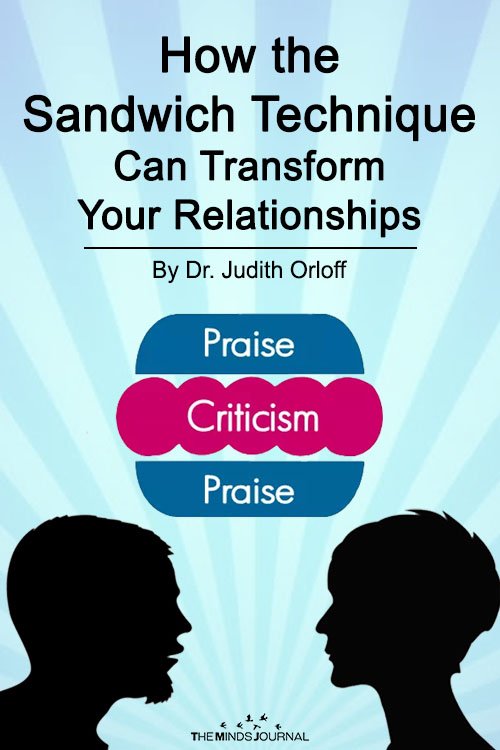
When you use The Sandwich Technique, make requests not demands. Then, when you are communicating about a difficult issue, you sandwich the request between two positive statements. It’s a creative way of presenting challenging topics so that others can hear you. Let’s say you need more alone time. First you could say, “I appreciate all your support and I need your help with this.” Then place your request: “It would be great I can take more alone time to decompress. This will help me be even more present with you later.”

You empower your relationships by expressing your needs. Also, relationships thrive on both people feeling accepted. One patient told me, “My husband accepts me as I am. Through his acceptance I have learned to be true to myself.” 

We all have issues to resolve in relationships no matter how good the match. To do this, we need to have loving, creative conversations. 

4 Tips to Apply “The Sandwich Technique” (From “The Empath’s Survival Guide.”

  1. Focus on a single emotional issue and don’t repeat yourself. We can have many emotional issues going on simultaneously which can be overwhelming for us and others. The best way to communicate is by sharing one issue at a time without repeating it, unless being asked for clarification. My partner says he feels like his brain is being squeezed if I raise too many problems at once, or if I keep repeating myself to make a point. Men, especially, tend to be task oriented, and they like to be helpful. Multiple requests for change make it all seem impossible. 
  1. Don’t take things personally, even when they are personal. This is an important but demanding principle of the spiritual path yet it’s basic to good communication and relationship harmony. Try to be less reactive to comments and more centered so you aren’t triggered as often or as intensely.
  1. Observe the “No Yelling Rule.” Many of us, especially sensitive people, become overwhelmed around yelling and loud voices. Our partners need to understand how unproductive and hurtful this can be. For the sake of self-preservation, I’m strict about this rule in my house. 
  1. Don’t be a people pleaser or try to fix your partner. We become tired when we try to fix others’ problems or keep trying to please them at the expense of our own needs. So, practice loving detachment and set boundaries. For instance, my partner dislikes getting instructions on self-improvement. When he’s going through a hard time, he has trained me to say, “I have faith that you can handle it,” rather than offering suggestions he didn’t ask for. It’s a gift to let others be themselves and face their own difficulties.

         _____

Good relationships are possible for everyone, including sensitive people. They can enhance your sense of security, love, and grounding. Marriage or any kind of sacred union needs to be a competition of generosity. Each person is in service to the other, aiming to deepen their devotion, kindness, passion, and love every day. In relationships, you can learn from each other. Consideration and tolerance is essential. 

(Adapted from The Empath’s Survival Guide by Judith Orloff, MD.)
 

How the Sandwich Technique Can Transform Your Relationships2

Published On:

Last updated on:

Dr. Judith Orloff

Judith Orloff, MD is the New York Times best-selling author of The Empath’s Survival Guide: Life Strategies for Sensitive People. Her new book Thriving as an Empath offers daily self-care tools for sensitive people along with its companion The Empath’s Empowerment Journal. Dr. Orloff is a psychiatrist, an empath, and is on the UCLA Psychiatric Clinical Faculty. She synthesizes the pearls of traditional medicine with cutting edge knowledge of intuition, energy, and spirituality. Dr. Orloff also specializes in treating highly sensitive, empathic people in her private practice. Dr. Orloff’s work has been featured on The Today Show, CNN, Oprah Magazine, the New York Times. Dr. Orloff has spoken at Google-LA and has a popular TEDX talk. Her other books are Thriving as an Empath: 365 Days of Self-Care for Sensitive People, The Empowered Empath’s Journal, Emotional Freedom and Guide to Intuitive Healing. Explore more information about her Empath Support Online course and speaking schedule on www.drjudithorloff.com.

Disclaimer: The informational content on The Minds Journal have been created and reviewed by qualified mental health professionals. They are intended solely for educational and self-awareness purposes and should not be used as a substitute for professional medical advice, diagnosis, or treatment. If you are experiencing emotional distress or have concerns about your mental health, please seek help from a licensed mental health professional or healthcare provider.

Leave a Comment

Today's Horoscope

Your Daily Horoscope For 4 April, 2026: Free Predictions

Daily Horoscope 4 April, 2026: Prediction For Each Zodiac Sign

Look at your daily prediction and see what the stars have in store for your love life and your future!

Latest Quizzes

How Many Circles Do You See? A Simple Test of Thinking Style

How Many Circles Do You See? Your Answer Might Reveal Narcissistic Traits! 

Take a closer look at this simple image and discover what your circle count reveals about your thinking style, perception, and attention in this fun and engaging visual test.

Latest Quotes

Real Signs Your Body Is Actually in Good Health: How to Know You’re Truly Well

Real Signs Your Body Is Actually in Good Health: How to Know You’re Truly Well

Real signs your body is healthy don’t always show up on lab reports. From good sleep and clear skin to regular digestion and a stable mood, your body is constantly sending quiet signals of wellness.

Readers Blog

Caption This Image and Selected Wisepicks – 5 April 2026

Caption This Image and Selected Wisepicks – 5 April 2026

Ready to unleash your inner wordsmith? ✨??☺️ Now’s your chance to show off your wit, charm, or sheer genius in just one line! Whether it’s laugh-out-loud funny or surprisingly deep, we want to hear it.Submit your funniest, wittiest, or most thought-provoking caption in the comments. We’ll pick 15+ winners to be featured on our website…

Latest Articles

“The Sandwich Technique” is a mindful, sensitive communication strategy which everyone (including sensitive people) can use to transform the relationships with their partner, friends, family, and co-workers. 

This technique is not intended to be fake or simply to placate others. Being brutally direct can backfire and make people feel defensive and unable to hear your comments (no matter how useful they are). 

When you use The Sandwich Technique, make requests not demands. Then, when you are communicating about a difficult issue, you sandwich the request between two positive statements. It’s a creative way of presenting challenging topics so that others can hear you. Let’s say you need more alone time. First you could say, “I appreciate all your support and I need your help with this.” Then place your request: “It would be great I can take more alone time to decompress. This will help me be even more present with you later.”

You empower your relationships by expressing your needs. Also, relationships thrive on both people feeling accepted. One patient told me, “My husband accepts me as I am. Through his acceptance I have learned to be true to myself.” 

We all have issues to resolve in relationships no matter how good the match. To do this, we need to have loving, creative conversations. 

4 Tips to Apply “The Sandwich Technique” (From “The Empath’s Survival Guide.”

  1. Focus on a single emotional issue and don’t repeat yourself. We can have many emotional issues going on simultaneously which can be overwhelming for us and others. The best way to communicate is by sharing one issue at a time without repeating it, unless being asked for clarification. My partner says he feels like his brain is being squeezed if I raise too many problems at once, or if I keep repeating myself to make a point. Men, especially, tend to be task oriented, and they like to be helpful. Multiple requests for change make it all seem impossible. 
  1. Don’t take things personally, even when they are personal. This is an important but demanding principle of the spiritual path yet it’s basic to good communication and relationship harmony. Try to be less reactive to comments and more centered so you aren’t triggered as often or as intensely.
  1. Observe the “No Yelling Rule.” Many of us, especially sensitive people, become overwhelmed around yelling and loud voices. Our partners need to understand how unproductive and hurtful this can be. For the sake of self-preservation, I’m strict about this rule in my house. 
  1. Don’t be a people pleaser or try to fix your partner. We become tired when we try to fix others’ problems or keep trying to please them at the expense of our own needs. So, practice loving detachment and set boundaries. For instance, my partner dislikes getting instructions on self-improvement. When he’s going through a hard time, he has trained me to say, “I have faith that you can handle it,” rather than offering suggestions he didn’t ask for. It’s a gift to let others be themselves and face their own difficulties.

         _____

Good relationships are possible for everyone, including sensitive people. They can enhance your sense of security, love, and grounding. Marriage or any kind of sacred union needs to be a competition of generosity. Each person is in service to the other, aiming to deepen their devotion, kindness, passion, and love every day. In relationships, you can learn from each other. Consideration and tolerance is essential. 

(Adapted from The Empath’s Survival Guide by Judith Orloff, MD.)


How the Sandwich Technique Can Transform Your Relationships2

Published On:

Last updated on:

Dr. Judith Orloff

Judith Orloff, MD is the New York Times best-selling author of The Empath’s Survival Guide: Life Strategies for Sensitive People. Her new book Thriving as an Empath offers daily self-care tools for sensitive people along with its companion The Empath’s Empowerment Journal. Dr. Orloff is a psychiatrist, an empath, and is on the UCLA Psychiatric Clinical Faculty. She synthesizes the pearls of traditional medicine with cutting edge knowledge of intuition, energy, and spirituality. Dr. Orloff also specializes in treating highly sensitive, empathic people in her private practice. Dr. Orloff’s work has been featured on The Today Show, CNN, Oprah Magazine, the New York Times. Dr. Orloff has spoken at Google-LA and has a popular TEDX talk. Her other books are Thriving as an Empath: 365 Days of Self-Care for Sensitive People, The Empowered Empath’s Journal, Emotional Freedom and Guide to Intuitive Healing. Explore more information about her Empath Support Online course and speaking schedule on www.drjudithorloff.com.

Leave a Comment

    Leave a Comment